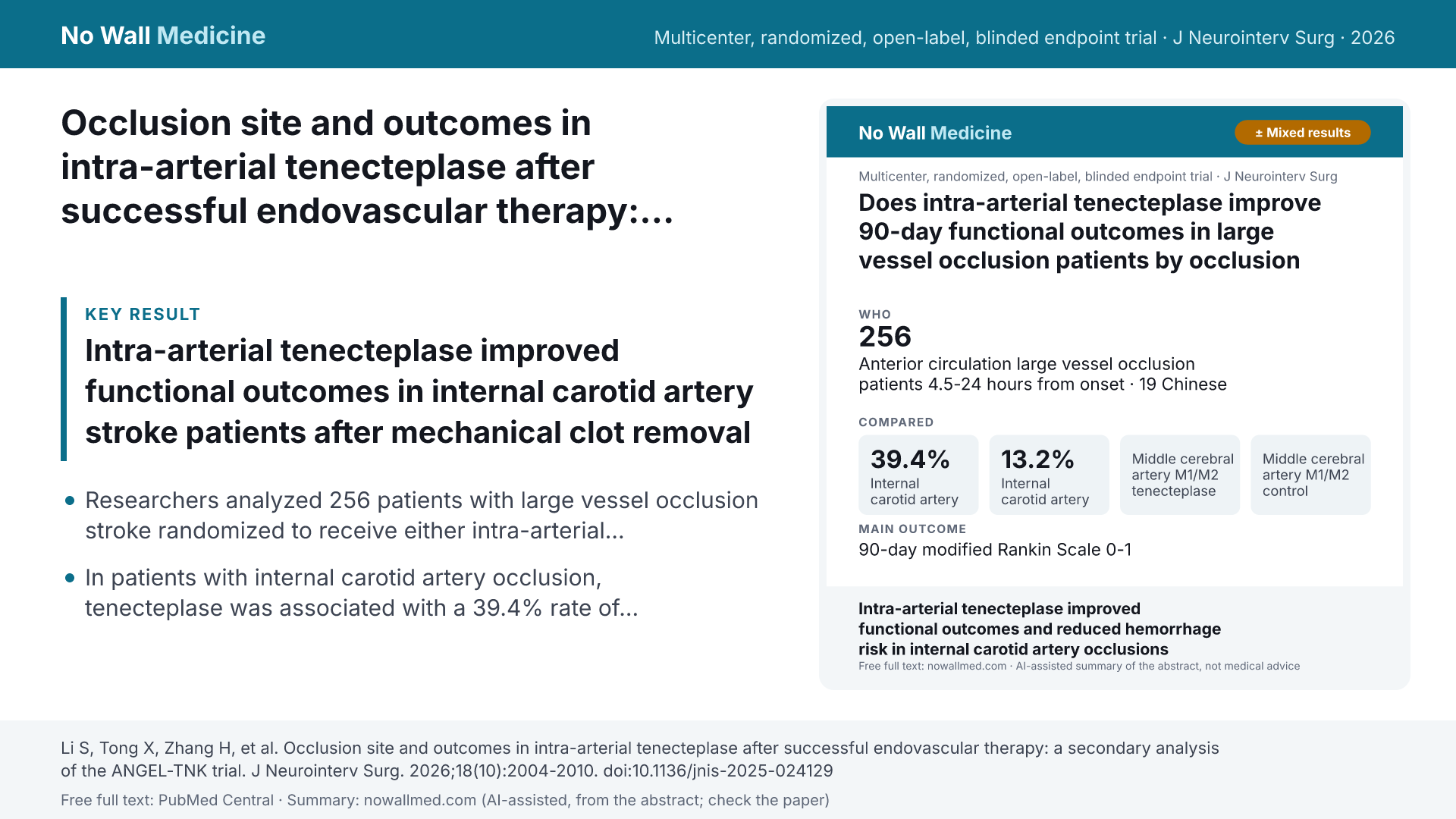
Intra-arterial tenecteplase improved functional outcomes in internal carotid artery stroke patients after mechanical clot removal
Occlusion site and outcomes in intra-arterial tenecteplase after successful endovascular therapy: a secondary analysis of the ANGEL-TNK trial
Multicenter, randomized, open-label, blinded endpoint trialMixed results
Does intra-arterial tenecteplase improve 90-day functional outcomes in large vessel occlusion patients by occlusion site?
Who
256
Anterior circulation large vessel occlusion patients 4.5-24 hours from onset · 19 Chinese stroke centers
Compared
39.4%Internal carotid artery tenecteplase
13.2%Internal carotid artery control
Middle cerebral artery M1/M2 tenecteplase
Middle cerebral artery M1/M2 control
Main outcome
90-day modified Rankin Scale 0-1
Result: relative risk 2.99 (95% CI 1.51 to 5.96)
Bottom line: Intra-arterial tenecteplase improved functional outcomes and reduced hemorrhage risk in internal carotid artery occlusions but not middle cerebral artery occlusions.
J Neurointerv Surg · 2026-09-14Download image
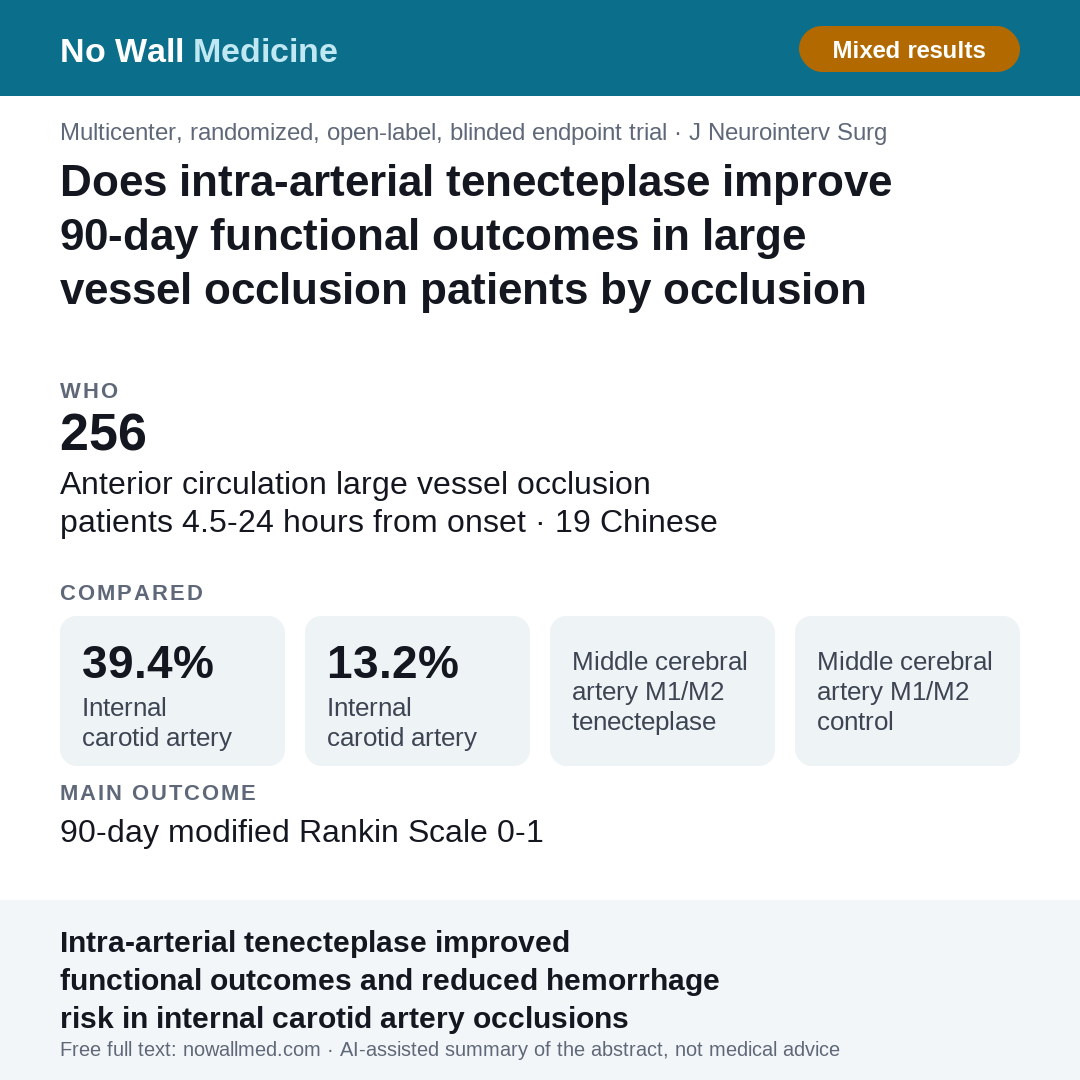
Clinical question: Does intra-arterial tenecteplase improve 90-day functional outcomes in large vessel occlusion patients by occlusion site?
Why it matters: It is unclear if adding intra-arterial tenecteplase to mechanical clot removal is effective for different types of large vessel occlusion sites.
Key points
- Researchers analyzed 256 patients with large vessel occlusion stroke randomized to receive either intra-arterial tenecteplase or standard medical management after successful mechanical clot removal.
- In patients with internal carotid artery occlusion, tenecteplase was associated with a 39.4% rate of excellent functional outcome at 90 days compared to 13.2% for controls.
- Tenecteplase was associated with a lower rate of any intracranial hemorrhage within 48 hours in internal carotid artery patients at 15.2% versus 39.5%.
Headline and key points written with AI from the paper’s abstract, with every number checked against it. Read the paper before relying on them.
Was this summary helpful?
Abstract
Background
Endovascular thrombectomy achieves macroreperfusion in large vessel occlusion (LVO) stroke, but only one-quarter of patients had excellent functional outcome. Adjunct intra-arterial (IA) tenecteplase could further improve the treatment effect, yet its efficacy across internal carotid artery (ICA) versus middle cerebral artery (MCA) M1/M2 occlusion remains unclear. Objective
To evaluate whether IA tenecteplase improves 90-day functional outcomes in LVO patients stratified by occlusion site (ICA, MCA M1, MCA M2). Methods
Prespecified secondary analysis of the ANGEL-TNK trial (multicenter, randomized, open-label, blinded endpoint) in 19 Chinese stroke centers. Participants were enrolled who had anterior circulation LVO, 4.5-24 hours from symptom onset, and CT angiography (CTA)/magnetic resonance angiography (MRA)-proven ICA, M1, or M2 occlusion. Intervention
Randomization (1:1) to IA tenecteplase (0.125 mg/kg) or standard medical management after expanded Thrombolysis in Cerebral Infarction (eTICI) 2b50-3 reperfusion. Main outcome measure
The primary outcome was the rate of 90-day modified Rankin Scale (mRS) 0-1. Results
There were 256 patients in the trial, including 71 (27.7%) ICA, 122 (47.6%) MCA M1, and 62 (24.2%) MCA M2. ICA occlusion patients treated with IA tenecteplase had higher rates of 90-day mRS 0-1 (39.4% vs 13.2%; relative risk (RR) 2.99; 95% CI 1.51 to 5.96; p=0.002) and mRS 0-3 (54.5% vs 42.1%; RR 1.30; p=0.048) versus controls, with a significant shift toward better mRS scores (median 3 (IQR 1-4) vs 4 (2-6); odds ratio (OR) 2.26; p<0.001). Post hoc analysis showed higher eTICI progression in ICA patients (51.5%) versus MCA M1 (37.9%) and M2 (25.7%). IA tenecteplase had a lower any intracranial hemorrhage within 48 hours in ICA patients (15.2% vs 39.5%; RR 0.38; p<0.001) compared with standard medical management. No significant benefits were observed in the MCA M1/M2 subgroups, and interaction effects were significant between ICA and MCA segments for functional outcomes and safety. Conclusions and relevance
IA tenecteplase had a better functional outcome and lower hemorrhage risk in ICA occlusion compared with standard medical management but not in MCA M1/M2. Occlusion site is a critical determinant of response to IA tenecteplase. A pooled analysis of IA tenecteplase stratified by occlusion site strata is warranted.
Abstract reproduced under the article’s CC BY NC licence.
Subject terms
Cite this article
Li S, Tong X, Zhang H, et al. Occlusion site and outcomes in intra-arterial tenecteplase after successful endovascular therapy: a secondary analysis of the ANGEL-TNK trial. J Neurointerv Surg. 2026. doi:10.1136/jnis-2025-024129
Spotted a mistake? Suggest a correction