Asymptomatic SARS-CoV-2 infections are less infectious than symptomatic ones according to meta-analysis
Occurrence and transmission potential of asymptomatic and presymptomatic SARS-CoV-2 infections: Update of a living systematic review and meta-analysis
Living systematic review and meta-analysisHarm found
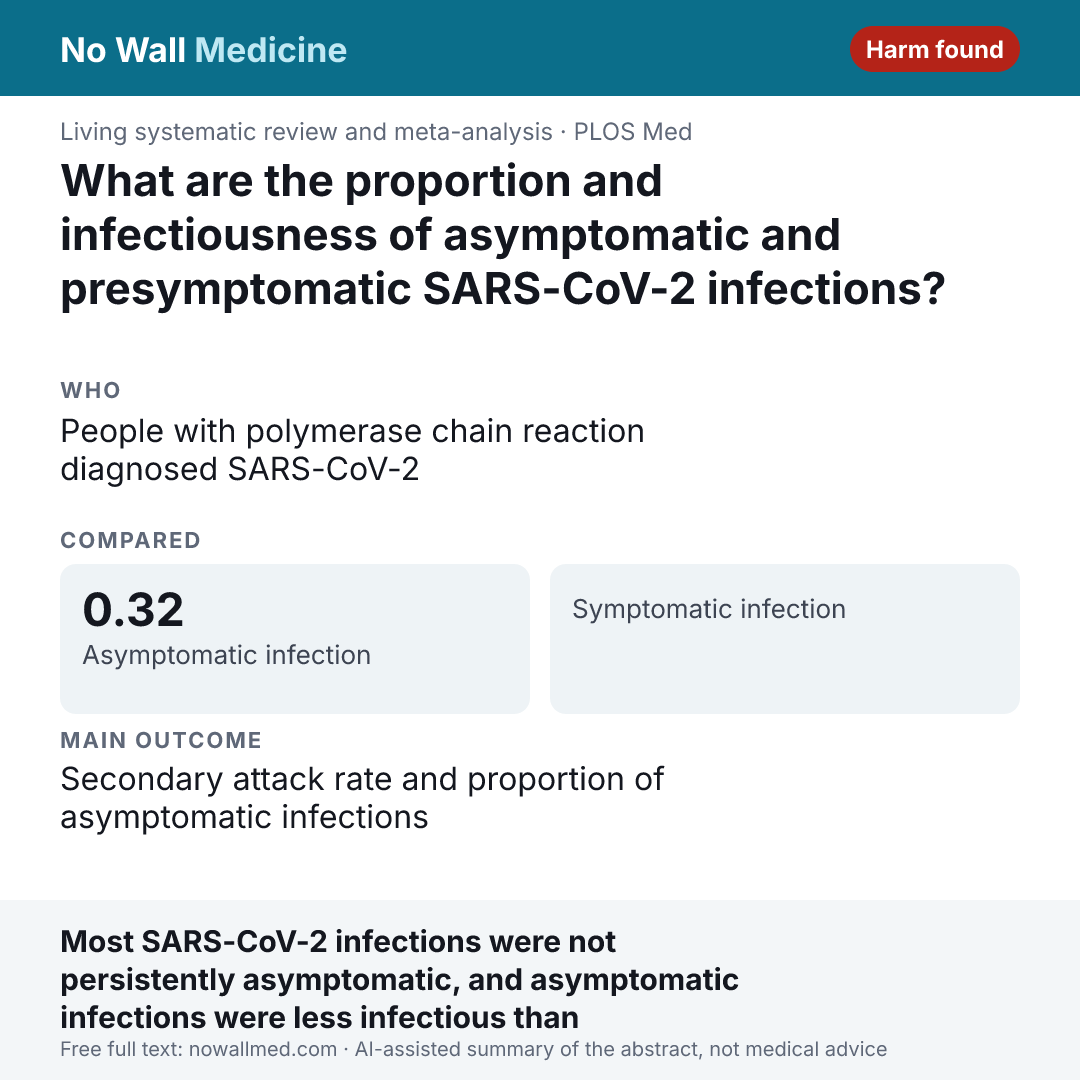
What are the proportion and infectiousness of asymptomatic and presymptomatic SARS-CoV-2 infections?
Who
People with polymerase chain reaction diagnosed SARS-CoV-2
Compared
0.32Asymptomatic infection (95% CI 0.16 to 0.64)
Symptomatic infection
Main outcome
Secondary attack rate and proportion of asymptomatic infections
Result: secondary attack rate 0.32 (95% CI 0.16 to 0.64)
Bottom line: Most SARS-CoV-2 infections were not persistently asymptomatic, and asymptomatic infections were less infectious than symptomatic infections.
Limitation: High heterogeneity and high risks of selection and information bias in certain studies.
PLOS Med · 2022-05-26 · Save PNG
Clinical question: What are the proportion and infectiousness of asymptomatic and presymptomatic SARS-CoV-2 infections?
Why it matters: The proportion of people who do not experience symptoms and their role in spreading SARS-CoV-2 remained a subject of debate.
Key points
- Researchers updated a systematic review of 130 studies to measure the proportion of people without symptoms and their ability to spread the virus.
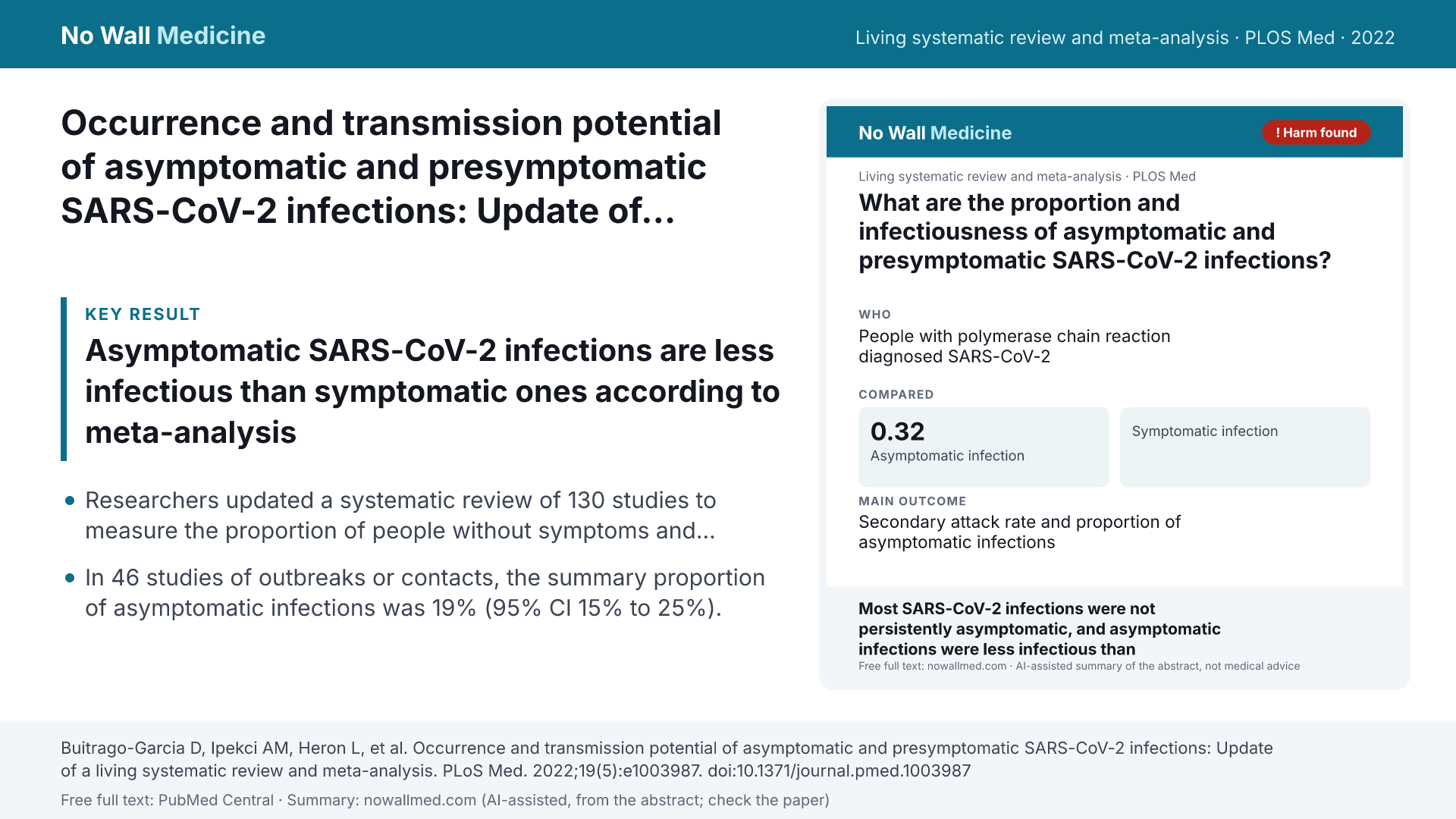
- In 46 studies of outbreaks or contacts, the summary proportion of asymptomatic infections was 19% (95% CI 15% to 25%).
- The secondary attack rate, or the risk of spreading the virus to contacts, was 0.32 (95% CI 0.16 to 0.64) for asymptomatic infections compared to symptomatic ones.
Limitation the authors note: The authors noted high heterogeneity, high risks of selection and information bias, and limited information regarding variants of concern or vaccinated individuals.
Headline and key points written with AI from the paper’s abstract, with every number checked against it. Read the paper before relying on them.
Was this summary helpful?
Subject terms
Headline, design, result, key points, caveat and citation as plain text.
Cite this article
Buitrago-Garcia D, Ipekci AM, Heron L, et al. Occurrence and transmission potential of asymptomatic and presymptomatic SARS-CoV-2 infections: Update of a living systematic review and meta-analysis. PLoS Med. 2022;19(5):e1003987. doi:10.1371/journal.pmed.1003987
Spotted a mistake? Suggest a correction