Once-monthly subcutaneous octreotide depot showed superior biochemical control compared to placebo in acromegaly patients
Octreotide Subcutaneous Depot for Acromegaly: A Randomized, Double-blind, Placebo-controlled Phase 3 Trial, ACROINNOVA 1
Randomized, double-blind trialBenefit found
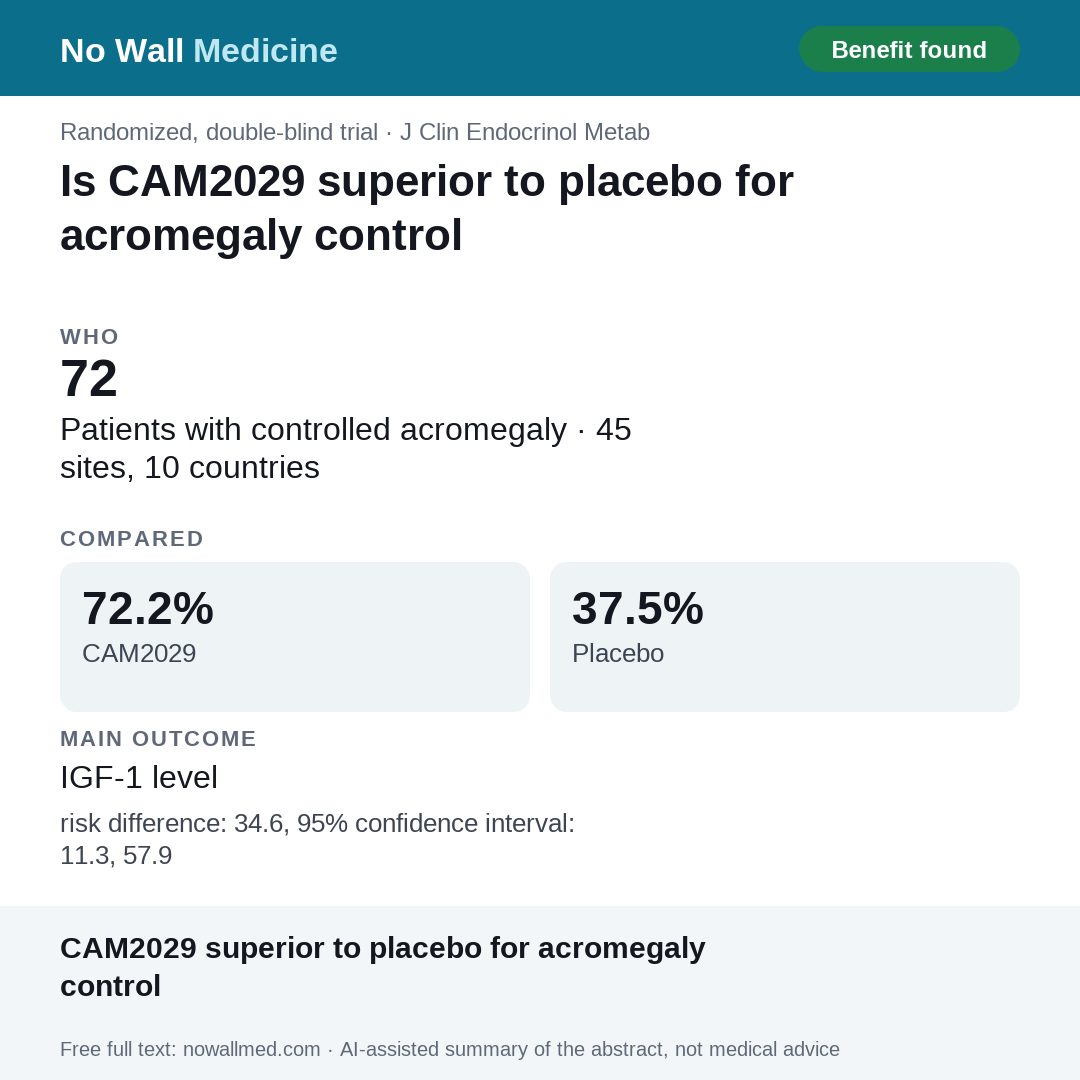
Is CAM2029 superior to placebo for acromegaly control
Who
72
Patients with controlled acromegaly · 45 sites, 10 countries
Compared
72.2%CAM2029
37.5%Placebo
Main outcome
IGF-1 level
Result: risk difference: 34.6, 95% confidence interval: 11.3, 57.9
Bottom line: CAM2029 superior to placebo for acromegaly control
J Clin Endocrinol Metab · 2024-10-08Download image
Why it matters: Standard treatments for acromegaly typically require administration by a healthcare provider rather than allowing for self-administration.
Key points
- The study involved 72 patients with controlled acromegaly who were randomized to receive either once-monthly CAM2029 or a placebo.
- At week 22/24, 72.2% of patients treated with CAM2029 achieved IGF-1 levels within the normal range compared to 37.5% for placebo.
- CAM2029 treated patients also showed a 70.0% response rate for combined IGF-1 and growth hormone levels compared to 37.5% for placebo.
Headline and key points written with AI from the paper’s abstract, with every number checked against it. Read the paper before relying on them.
Was this summary helpful?
Subject terms
Cite this article
Ferone D, Freda P, Katznelson L, Gatto F, Kadioğlu P, Maffei P. Octreotide Subcutaneous Depot for Acromegaly: A Randomized, Double-blind, Placebo-controlled Phase 3 Trial, ACROINNOVA 1. J Clin Endocrinol Metab. 2024. doi:10.1210/clinem/dgae707
Spotted a mistake? Suggest a correction
Top studies every Monday
The week’s key trials and guidelines in your specialties, plus any topics you follow. By email, free.
Get the weekly digest