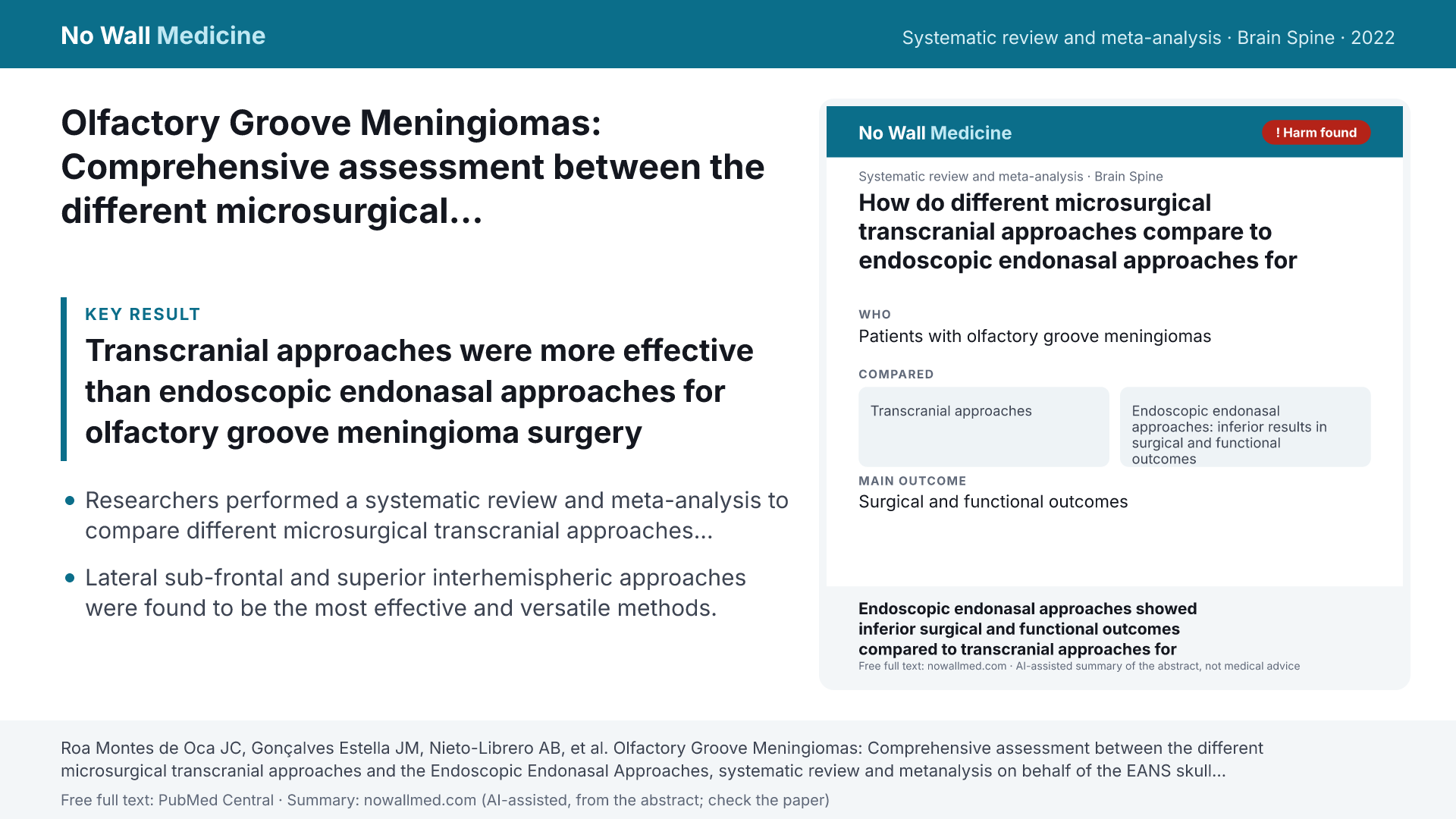
Transcranial approaches were more effective than endoscopic endonasal approaches for olfactory groove meningioma surgery
Olfactory Groove Meningiomas: Comprehensive assessment between the different microsurgical transcranial approaches and the Endoscopic Endonasal Approaches, systematic review and metanalysis on behalf of the EANS skull base section
Systematic review and meta-analysisHarm found
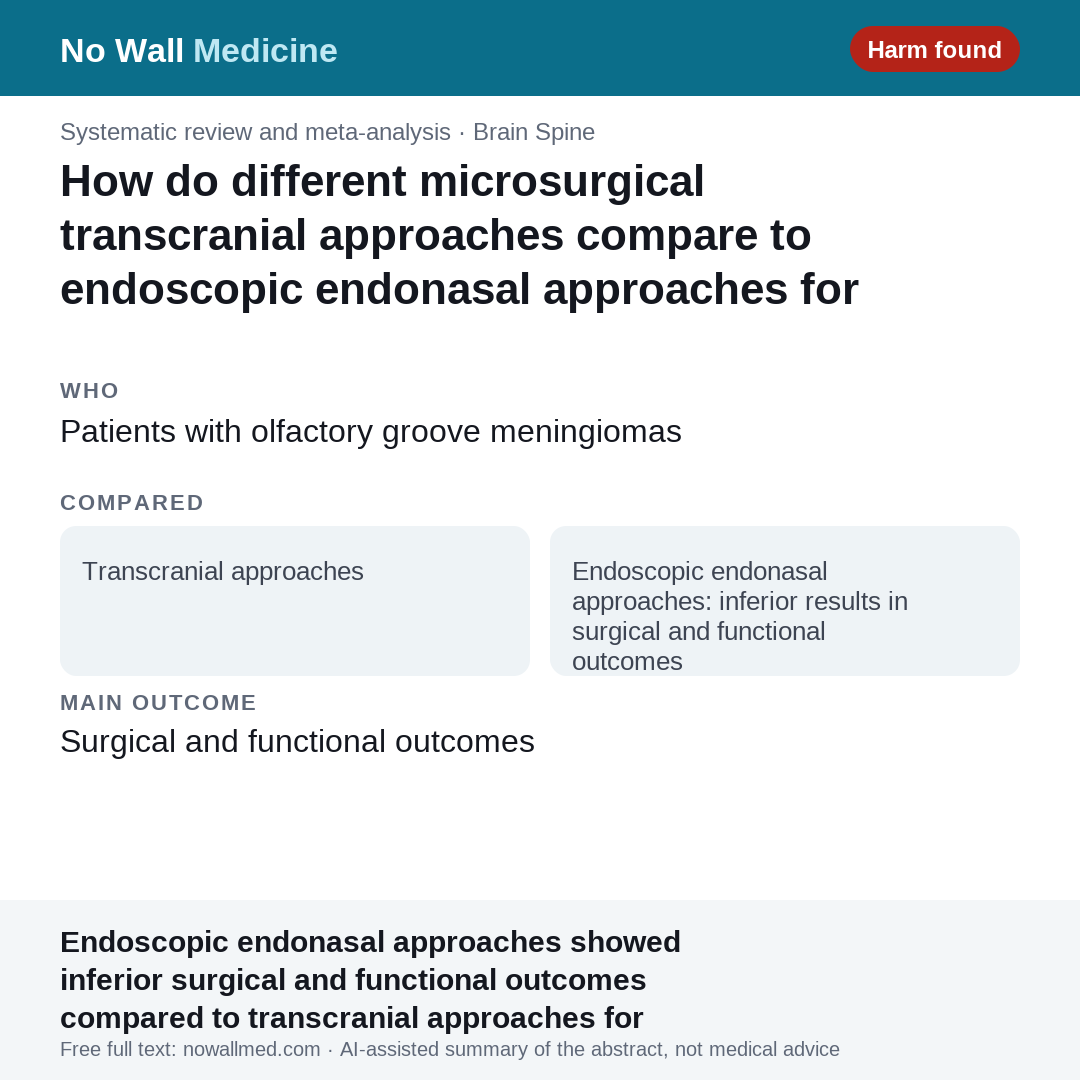
How do different microsurgical transcranial approaches compare to endoscopic endonasal approaches for olfactory groove meningiomas?
Who
Patients with olfactory groove meningiomas
Compared
Transcranial approaches
Endoscopic endonasal approaches: inferior results in surgical and functional outcomes
Main outcome
Surgical and functional outcomes
Bottom line: Endoscopic endonasal approaches showed inferior surgical and functional outcomes compared to transcranial approaches for olfactory groove meningiomas.
Brain Spine · 2022-11-01Download image
Clinical question: How do different microsurgical transcranial approaches compare to endoscopic endonasal approaches for olfactory groove meningiomas?
Why it matters: It is unclear which surgical approach is most effective for treating olfactory groove meningiomas, specifically regarding the debate between transcranial and endoscopic endonasal methods.
Key points
- Researchers performed a systematic review and meta-analysis to compare different microsurgical transcranial approaches with endoscopic endonasal approaches for olfactory groove meningioma surgery.
- Lateral sub-frontal and superior interhemispheric approaches were found to be the most effective and versatile methods.
- Endoscopic endonasal approaches were associated with inferior surgical and functional outcomes compared to transcranial methods.
Headline and key points written with AI from the paper’s abstract, with every number checked against it. Read the paper before relying on them.
Was this summary helpful?
Cite this article
Roa Montes de Oca JC, Gonçalves Estella JM, Nieto-Librero AB, Galindo-Villardón P, Roa Ramírez CJ, Gonçalves Sánchez J. Olfactory Groove Meningiomas: Comprehensive assessment between the different microsurgical transcranial approaches and the Endoscopic Endonasal Approaches, systematic review and metanalysis on behalf of the EANS skull base section. Brain Spine. 2022. doi:10.1016/j.bas.2022.101661
Spotted a mistake? Suggest a correction