Impaired sense of smell was associated with a higher risk of cognitive decline
Olfactory Impairment and Incident Cognitive Decline: A Systematic Review and Meta-Analysis
Systematic review and meta-analysisBenefit found
Is olfactory impairment associated with incident cognitive decline?
Who
37,783
Adults with self-reported or objectively measured olfactory impairment
Compared
Olfactory impairment: 2.06-fold greater risk
Normal olfaction
Main outcome
Incident cognitive decline
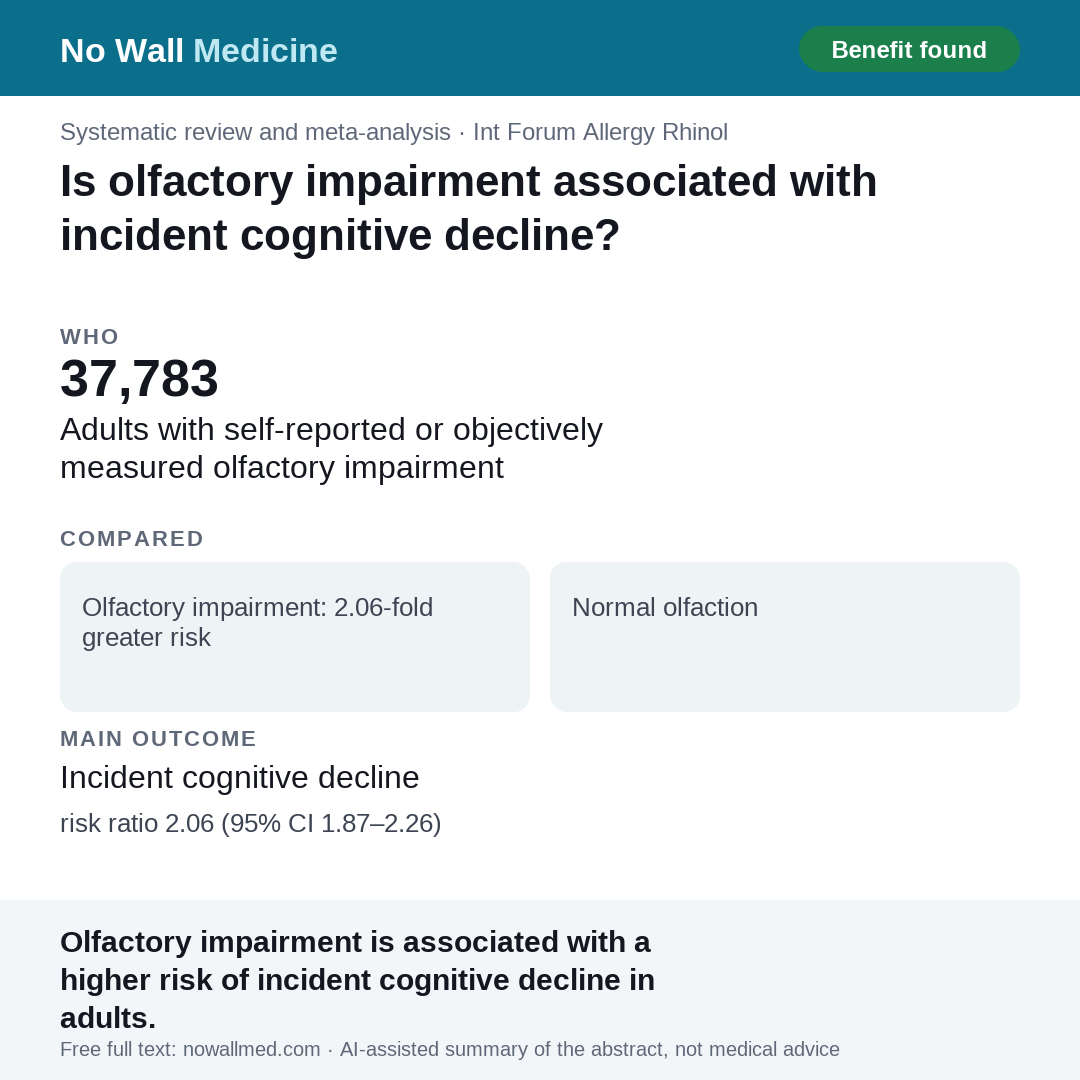
Result: risk ratio 2.06 (95% CI 1.87‒2.26)
Bottom line: Olfactory impairment is associated with a higher risk of incident cognitive decline in adults.
Int Forum Allergy Rhinol · 2025-07-10Download image
Clinical question: Is olfactory impairment associated with incident cognitive decline?
Why it matters: The temporal relationship between a reduced sense of smell and the development of cognitive decline remains unclear.
Key points
- Researchers analyzed 48 studies involving 37,783 participants to examine the link between olfactory impairment, or loss of smell, and cognitive decline.
- Individuals with olfactory impairment had a 2.06-fold greater risk of cognitive decline compared to those with a normal sense of smell.
- The risk of cognitive decline increased by 18% for every 10% decrease in olfactory score and by 15% per point loss on the Sniffin' Sticks Odor Identification Test.
Headline and key points written with AI from the paper’s abstract, with every number checked against it. Read the paper before relying on them.
Topics
Cite this article
Yeo BSY, Song HJJMD, Tan BKJ, Suresh A, Ho OTW, Chan JH. Olfactory Impairment and Incident Cognitive Decline: A Systematic Review and Meta-Analysis. Int Forum Allergy Rhinol. 2025. doi:10.1002/alr.23635
Spotted a mistake? Suggest a correction