Targeted axillary dissection may replace lymph node dissection for patients with ultrasound-detectable breast cancer metastases
Omission of axillary lymph node dissection in ultrasound-detectable axillary metastases in primary breast cancer treated by upfront surgery: prospective randomized SENOMAC-ULTRA non-inferiority trial
Prospective, international, multicentre, randomized non-inferiority trialUnclear result
Can targeted axillary dissection safely replace axillary lymph node dissection in clinically node-positive breast cancer?
Who
Adults with stage II-III invasive breast cancer and ultrasound-detectable axillary metastases · International, multicentre
Compared
Targeted axillary dissection
Standard axillary lymph node dissection
Main outcome
recurrence-free survival
Bottom line: The trial is ongoing to evaluate if targeted axillary dissection is non-inferior to standard dissection.
BJS Open · 2026-08-06Download image
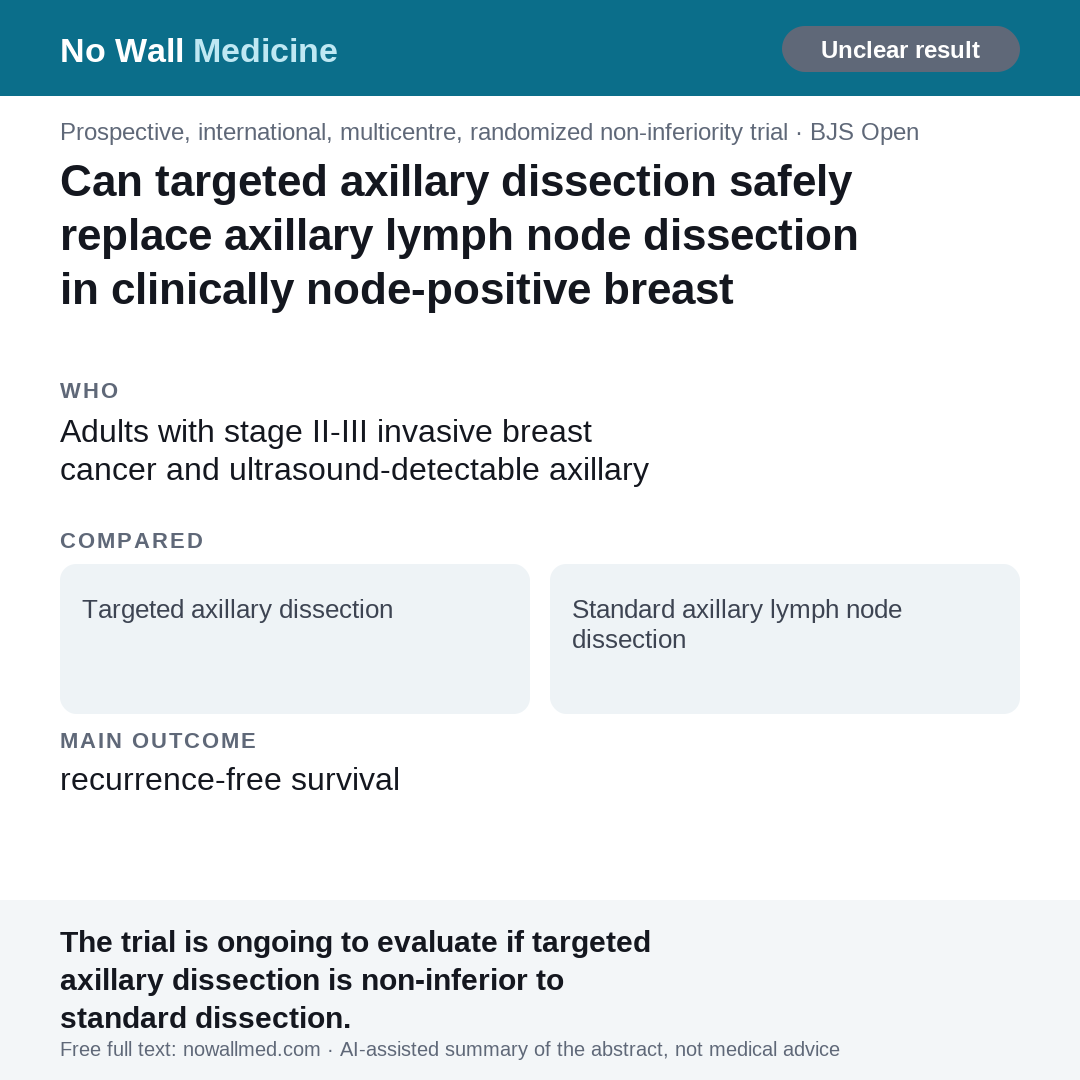
Clinical question: Can targeted axillary dissection safely replace axillary lymph node dissection in clinically node-positive breast cancer?
Why it matters: Standard axillary lymph node dissection causes significant arm morbidity and long-term functional impairment in patients with clinically node-positive disease.
Key points
- The SENOMAC-ULTRA trial is a prospective, international, multicentre, randomized study comparing targeted axillary dissection to standard axillary lymph node dissection.
- Researchers are studying adults with stage II-III invasive breast cancer and axillary metastases that were detected by ultrasound and confirmed by biopsy.
- The primary goal is to determine if targeted axillary dissection is non-inferior regarding recurrence-free survival over a planned 10-year follow-up period.
Headline and key points written with AI from the paper’s abstract, with every number checked against it. Read the paper before relying on them.
Topics
Spotted a mistake? Suggest a correction