Rapid sodium correction in patients with low blood sodium is associated with lower mortality
On the optimal sodium correction rate in hyponatraemia and clinical outcome: a meta-analysis
Meta-analysis of 11 retrospective studiesMixed results
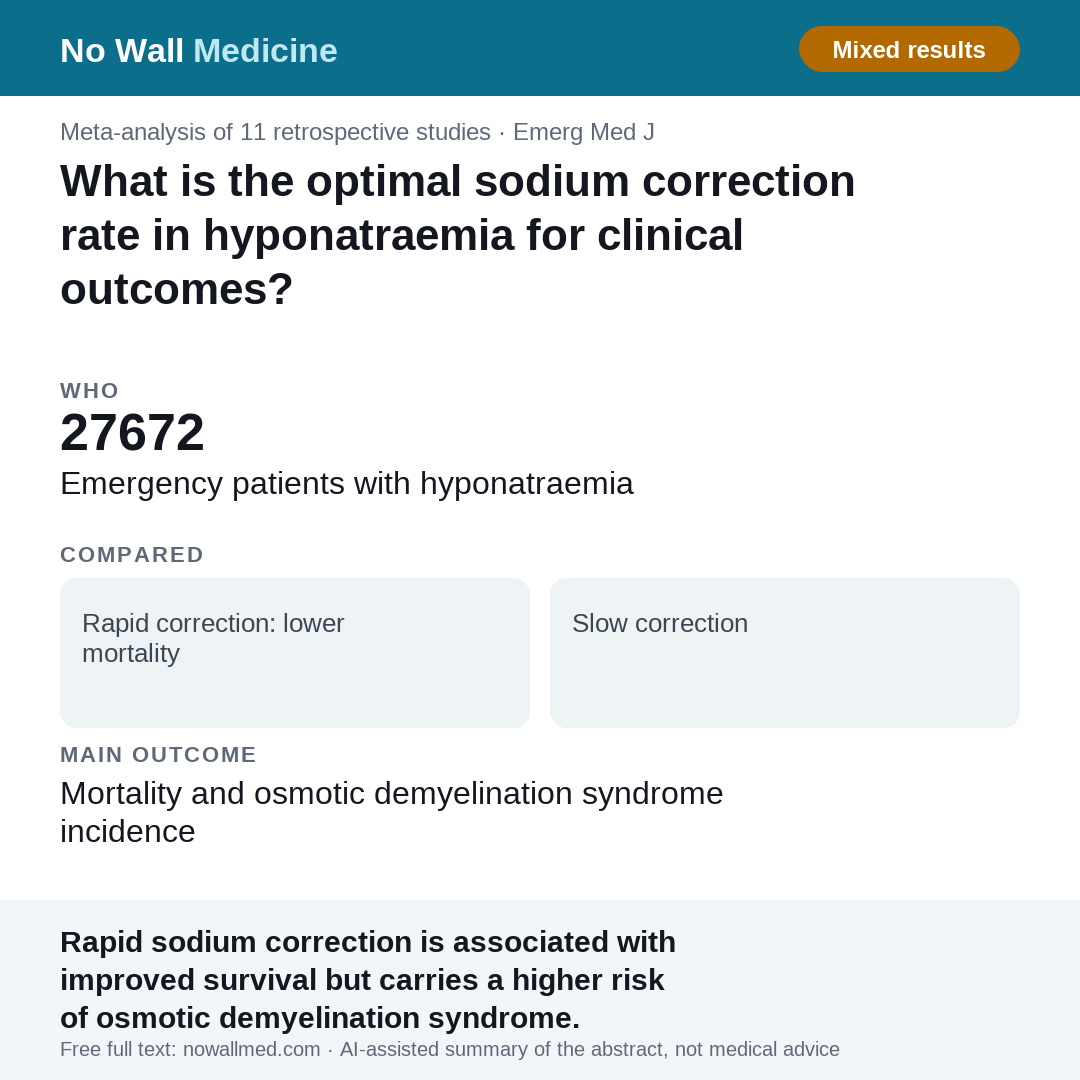
What is the optimal sodium correction rate in hyponatraemia for clinical outcomes?
Who
27672
Emergency patients with hyponatraemia
Compared
Rapid correction: lower mortality
Slow correction
Main outcome
Mortality and osmotic demyelination syndrome incidence
Result: OR: 0.398, p<0.001; OR: 0.489, p<0.001; OR: 0.57, p<0.001
Bottom line: Rapid sodium correction is associated with improved survival but carries a higher risk of osmotic demyelination syndrome.
Limitation: No causal relation can be concluded
Emerg Med J · 2026-09-18Download image
Clinical question: What is the optimal sodium correction rate in hyponatraemia for clinical outcomes?
Why it matters: Low serum sodium levels are associated with higher mortality in emergency patients, making the optimal rate of correction an important clinical question.
Key points
- Researchers analyzed 11 retrospective studies involving 27,672 cases to compare mortality rates between slow and rapid sodium correction.
- Rapid correction was associated with lower mortality at thresholds of 8 mmol/L/day (OR: 0.398, p<0.001), 10 mmol/L/day (OR: 0.489, p<0.001), and 12 mmol/L/day (OR: 0.57, p<0.001).
- The incidence of osmotic demyelination syndrome, a serious neurological condition, was 0.085% overall but higher in the rapid correction group (OR: 3.959, p=0.002).
Limitation the authors note: The study was a meta-analysis of retrospective studies, so no causal relation can be concluded.
Headline and key points written with AI from the paper’s abstract, with every number checked against it. Read the paper before relying on them.
Abstract
Background
Hyponatraemia is associated with greater mortality in emergency patients. Therefore, the correction of low serum sodium levels remains an important field in clinical practice. Methods
Eligible studies were searched through a literature query in PubMed and Web of Science in August 2024. Sodium correction rates and mortality data were extracted. The articles were grouped based on the threshold used to distinguish between slow and rapid correction. For each group, a random effects model was used for meta-analysis. The sodium correction rate thresholds were 8, 10 and 12 mmol/L/24 hours. Additionally, a random effects model was used to estimate the difference in osmotic demyelination syndrome (ODS) incidence. Results
11 retrospective studies with a total of 27 672 cases were included in the meta-analysis, each scoring at least 8* on the Newcastle-Ottawa quality assessment score. Mortality was significantly lower in the rapid correction group compared with the slow correction group for the 8 mmol/L/day threshold (OR: 0.398, p<0.001), for 10 mmol/L/day (OR: 0.489, p<0.001) and for 12 mmol/L/day (OR: 0.57, p<0.001). Overall incidence of ODS was low (0.085%), but it was higher in the rapid correction group (OR: 3.959, p=0.002). Conclusion
Within all three thresholds of sodium correction, rapid correction was associated with improved survival. Although no causal relation can be concluded, a more liberal approach to sodium correction rate in hyponatraemia may be beneficial. However, osmotic demyelination remains a serious, although very rare, issue.
Abstract reproduced under the article’s CC BY NC licence.
Topics
Cite this article
Matrisch L, Rau Y, Graßhoff L, Nitschke M. On the optimal sodium correction rate in hyponatraemia and clinical outcome: a meta-analysis. Emerg Med J. 2026. doi:10.1136/emermed-2025-215189
Spotted a mistake? Suggest a correction