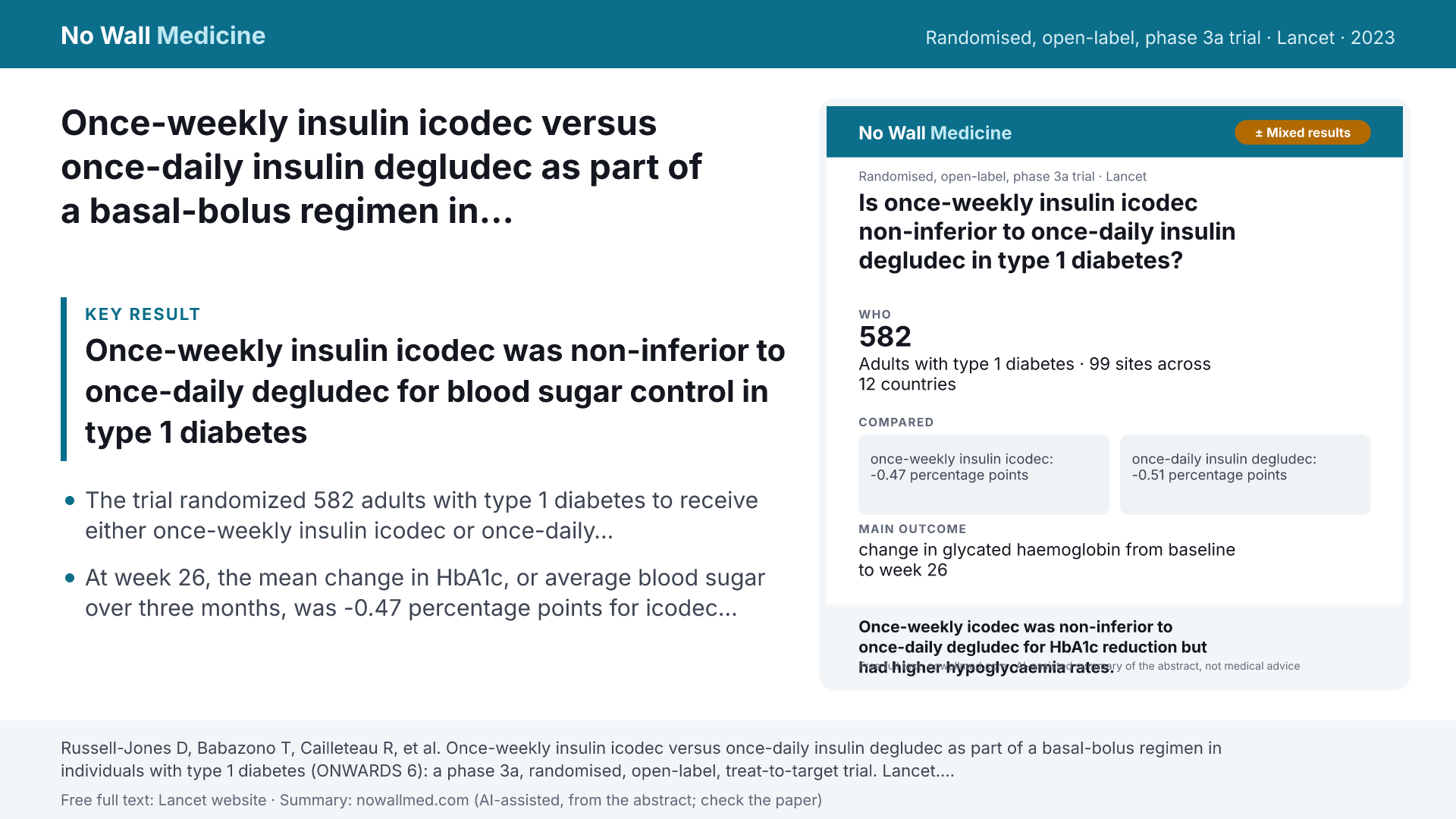
Once-weekly insulin icodec was non-inferior to once-daily degludec for blood sugar control in type 1 diabetes
Once-weekly insulin icodec versus once-daily insulin degludec as part of a basal-bolus regimen in individuals with type 1 diabetes (ONWARDS 6): a phase 3a, randomised, open-label, treat-to-target trial
Randomised, open-label, phase 3a trialMixed results
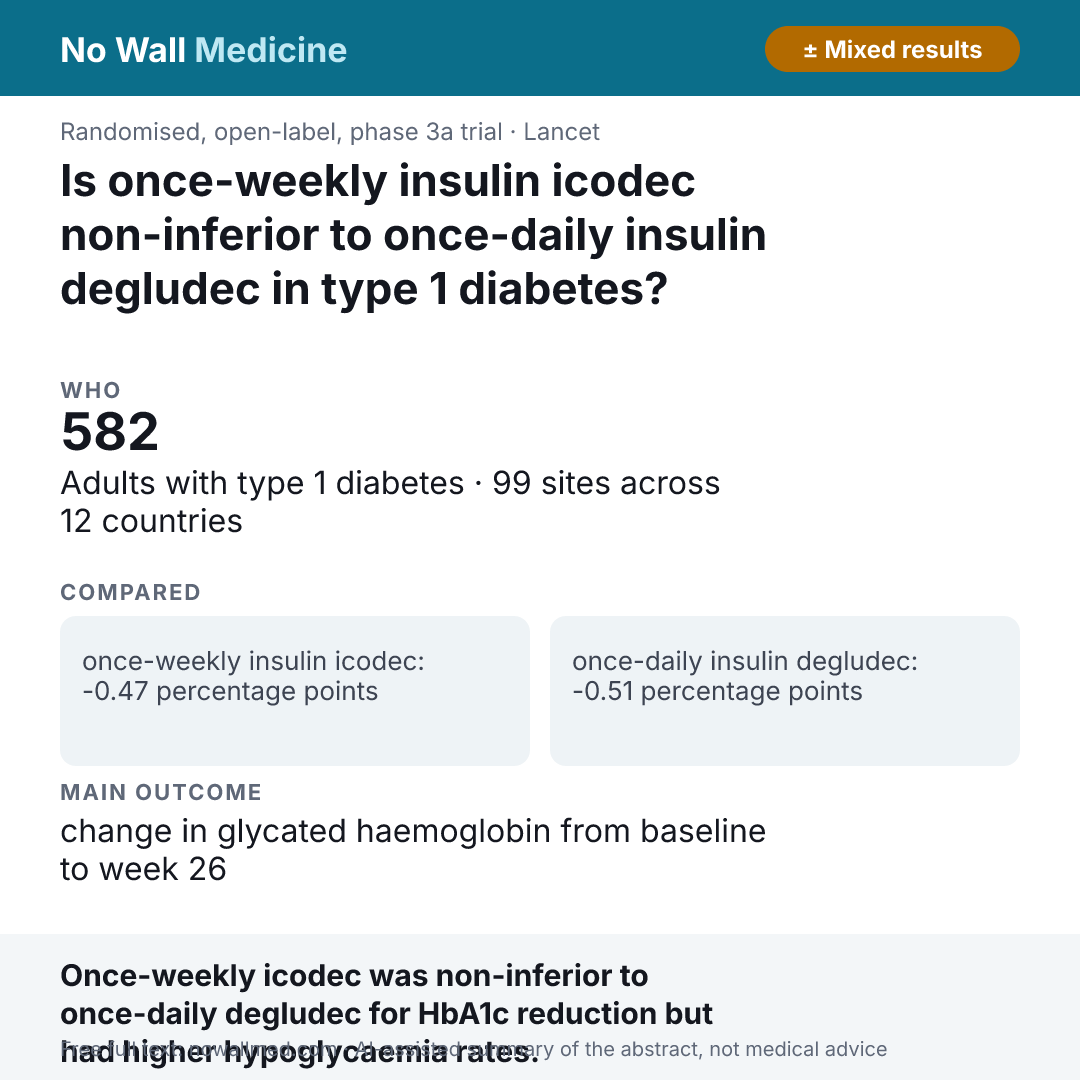
Is once-weekly insulin icodec non-inferior to once-daily insulin degludec in type 1 diabetes?
Who
582
Adults with type 1 diabetes · 99 sites across 12 countries
Compared
once-weekly insulin icodec: -0.47 percentage points
once-daily insulin degludec: -0.51 percentage points
Main outcome
change in glycated haemoglobin from baseline to week 26
Result: estimated treatment difference 0.05 percentage points (95% CI -0.13 to 0.23)
Bottom line: Once-weekly icodec was non-inferior to once-daily degludec for HbA1c reduction but had higher hypoglycaemia rates.
Funded by: Novo Nordisk
Lancet · 2023-10-17 · Save PNG
Clinical question: Is once-weekly insulin icodec non-inferior to once-daily insulin degludec in type 1 diabetes?
Key points
- The trial randomized 582 adults with type 1 diabetes to receive either once-weekly insulin icodec or once-daily insulin degludec alongside daily insulin aspart injections.
- At week 26, the mean change in HbA1c, or average blood sugar over three months, was -0.47 percentage points for icodec and -0.51 percentage points for degludec.
- The rate of combined clinically significant or severe hypoglycemia, or low blood sugar, was higher with icodec at 19.9 events per patient-year compared to 10.4 for degludec.
Headline and key points written with AI from the paper’s abstract, with every number checked against it. Read the paper before relying on them.
Was this summary helpful?
Abstract
Background
ONWARDS 6 compared the efficacy and safety of once-weekly subcutaneous insulin icodec (icodec) and once-daily insulin degludec (degludec) in adults with type 1 diabetes. Methods
This 52-week (26-week main phase plus a 26-week safety extension), randomised, open-label, treat-to-target, phase 3a trial was done at 99 sites across 12 countries. Adults with type 1 diabetes (glycated haemoglobin [HbA1c] <10·0% [86 mmol/mol]) were randomly assigned (1:1) to once-weekly icodec or once-daily degludec, both in combination with insulin aspart (two or more daily injections). The primary endpoint was change in HbA1c from baseline to week 26, tested for non-inferiority (0·3 percentage point margin) in all randomly assigned participants. This trial is registered with ClinicalTrials.gov, NCT04848480, and is now complete. Findings
Between April 30 and Oct 15, 2021, of 655 participants screened, 582 participants were randomly assigned to icodec (n=290) or degludec (n=292). At week 26, from baseline values of 7·59% (icodec) and 7·63% (degludec), estimated mean changes in HbA1c were -0·47 percentage points and -0·51 percentage points, respectively (estimated treatment difference 0·05 percentage points [95% CI -0·13 to 0·23]), confirming non-inferiority of icodec to degludec (p=0·0065). Overall rate of combined clinically significant or severe hypoglycaemia (baseline to week 26) was statistically significantly higher with icodec than degludec (19·9 vs 10·4 events per patient-year of exposure; estimated rate ratio 1·9 [95% CI 1·5 to 2·3]; p<0·0001). The rate was also statistically significantly higher with icodec than degludec when evaluated over 57 weeks (52 weeks plus a 5-week follow-up period). 39 serious adverse events were reported in 24 (8%) participants receiving icodec, and 25 serious adverse events were reported in 20 (7%) participants receiving degludec. One participant in the icodec group died; this was judged unlikely to be due to the trial product. Interpretation
In adults with type 1 diabetes, once-weekly icodec showed non-inferiority to once-daily degludec in HbA1c reduction at week 26, with statistically significantly higher rates of combined clinically significant or severe hypoglycaemia. For icodec, time below 3·0 mmol/L (<54 mg/dL) was at the threshold of the internationally recommended target (<1%) during weeks 22-26 and below target during weeks 48-52. Funding
Novo Nordisk.
Abstract reproduced under the article’s CC BY licence.
Subject terms
Headline, design, result, key points, caveat and citation as plain text.
Cite this article
Russell-Jones D, Babazono T, Cailleteau R, et al. Once-weekly insulin icodec versus once-daily insulin degludec as part of a basal-bolus regimen in individuals with type 1 diabetes (ONWARDS 6): a phase 3a, randomised, open-label, treat-to-target trial. Lancet. 2023;402(10413):1636-1647. doi:10.1016/S0140-6736(23)02179-7
Spotted a mistake? Suggest a correction