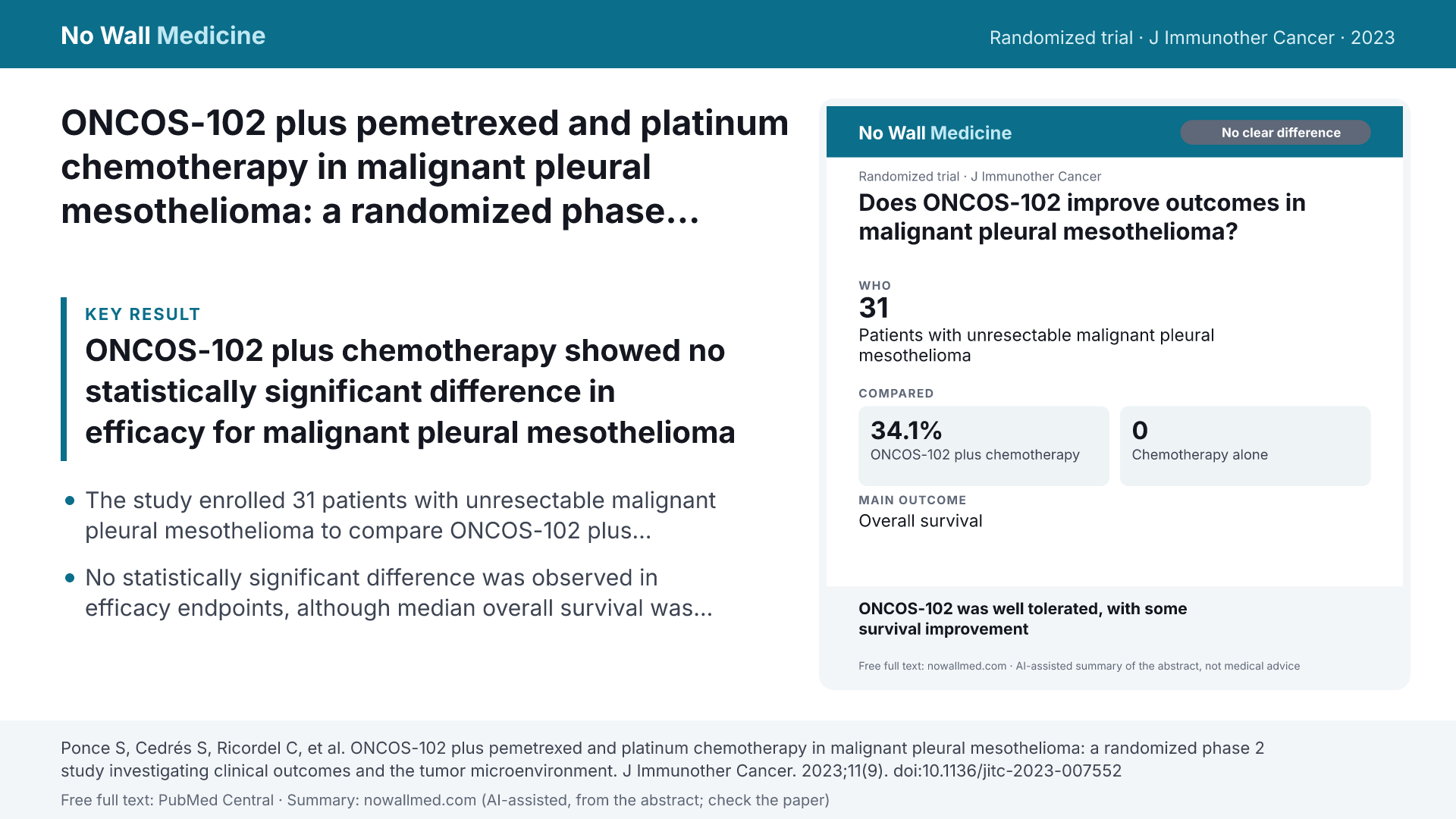
ONCOS-102 plus chemotherapy showed no statistically significant difference in efficacy for malignant pleural mesothelioma
ONCOS-102 plus pemetrexed and platinum chemotherapy in malignant pleural mesothelioma: a randomized phase 2 study investigating clinical outcomes and the tumor microenvironment
Randomized trialNo clear difference
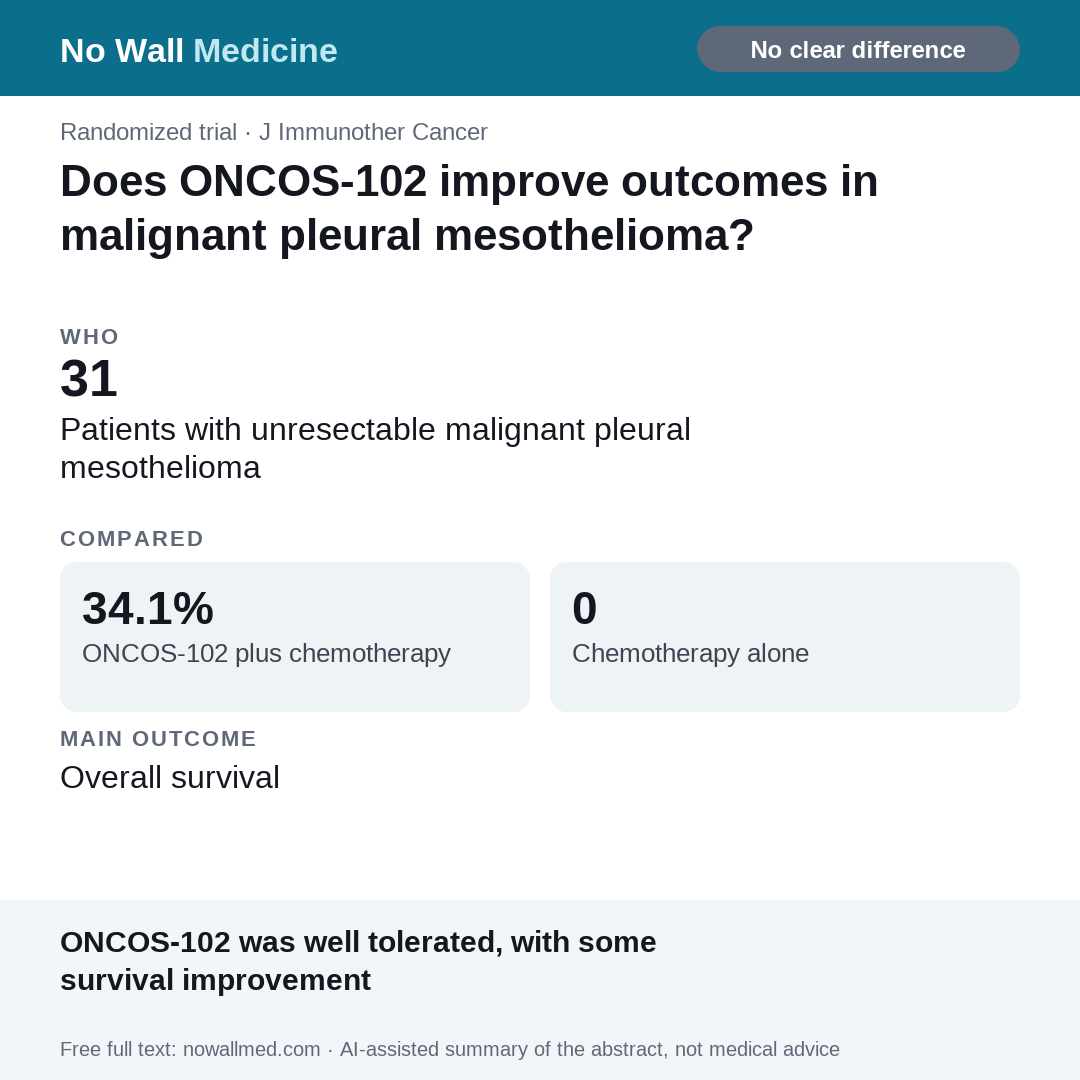
Does ONCOS-102 improve outcomes in malignant pleural mesothelioma?
Who
31
Patients with unresectable malignant pleural mesothelioma
Compared
34.1%ONCOS-102 plus chemotherapy (30-month OS rate)
0Chemotherapy alone (30-month OS rate)
Main outcome
Overall survival
Bottom line: ONCOS-102 was well tolerated, with some survival improvement
J Immunother Cancer · 2023-09-04Download image
Clinical question: Does ONCOS-102 improve outcomes in malignant pleural mesothelioma?
Why it matters: It was unknown if adding the oncolytic adenovirus ONCOS-102 to standard chemotherapy could improve outcomes or change the tumor microenvironment in malignant pleural mesothelioma.
Key points
- The study enrolled 31 patients with unresectable malignant pleural mesothelioma to compare ONCOS-102 plus chemotherapy against chemotherapy alone.
- No statistically significant difference was observed in efficacy endpoints, although median overall survival was 20.3 months versus 13.5 months in chemotherapy-naïve patients.
- Grade 3 or higher adverse events included anemia and neutropenia, occurring in 15.0% and 40.0% of the ONCOS-102 group and 27.3% and 45.5% of the chemotherapy-alone group.
Headline and key points written with AI from the paper’s abstract, with every number checked against it. Read the paper before relying on them.
Was this summary helpful?
Abstract
Background
ONCOS-102, an oncolytic adenovirus expressing granulocyte-macrophage colony-stimulating factor, can alter the tumor microenvironment to an immunostimulatory state. Combining ONCOS-102 with standard-of-care chemotherapy for malignant pleural mesothelioma (MPM) may improve treatment outcomes. Methods
In this open-label, randomized study, patients with unresectable MPM received intratumoral ONCOS-102 (3×10¹¹ virus particles on days 1, 4, 8, 36, 78, and 120) and pemetrexed plus cisplatin/carboplatin (from day 22), or pemetrexed plus cisplatin/carboplatin alone. The primary endpoint was safety. Overall survival (OS), progression-free survival, objective response rate, and tumor immunologic activation (baseline and day 36 biopsies) were also assessed. Results
In total, 31 patients (safety lead-in: n=6, randomized: n=25) were enrolled. Anemia (15.0% and 27.3%) and neutropenia (40.0% and 45.5%) were the most frequent grade ≥3 adverse events (AEs) in the ONCOS-102 (n=20) and chemotherapy-alone (n=11) cohorts. No patients discontinued ONCOS-102 due to AEs. No statistically significant difference in efficacy endpoints was observed. There was a numerical improvement in OS (30-month OS rate 34.1% vs 0; median OS 20.3 vs 13.5 months) with ONCOS-102 versus chemotherapy alone in chemotherapy-naïve patients (n=17). By day 36, ONCOS-102 was associated with increased T-cell infiltration and immune-related gene expression that was not observed in the control cohort. Substantial immune activation in the tumor microenvironment was associated with survival at month 18 in the ONCOS-102 cohort. Conclusions
ONCOS-102 plus pemetrexed and cisplatin/carboplatin was well tolerated by patients with MPM. In injected tumors, ONCOS-102 promoted a proinflammatory environment, including T-cell infiltration, which showed association with survival at month 18.
Abstract reproduced under the article’s CC BY NC licence.
Subject terms
Cite this article
Ponce S, Cedrés S, Ricordel C, et al. ONCOS-102 plus pemetrexed and platinum chemotherapy in malignant pleural mesothelioma: a randomized phase 2 study investigating clinical outcomes and the tumor microenvironment. J Immunother Cancer. 2023. doi:10.1136/jitc-2023-007552
Spotted a mistake? Suggest a correction