App-based treatment for urinary incontinence showed similar effectiveness to standard care after 12 months
One year effectiveness of an app-based treatment for urinary incontinence in comparison to care as usual in Dutch general practice: A pragmatic randomised controlled trial over 12 months
Pragmatic, randomised controlled, superiority trialNo clear difference
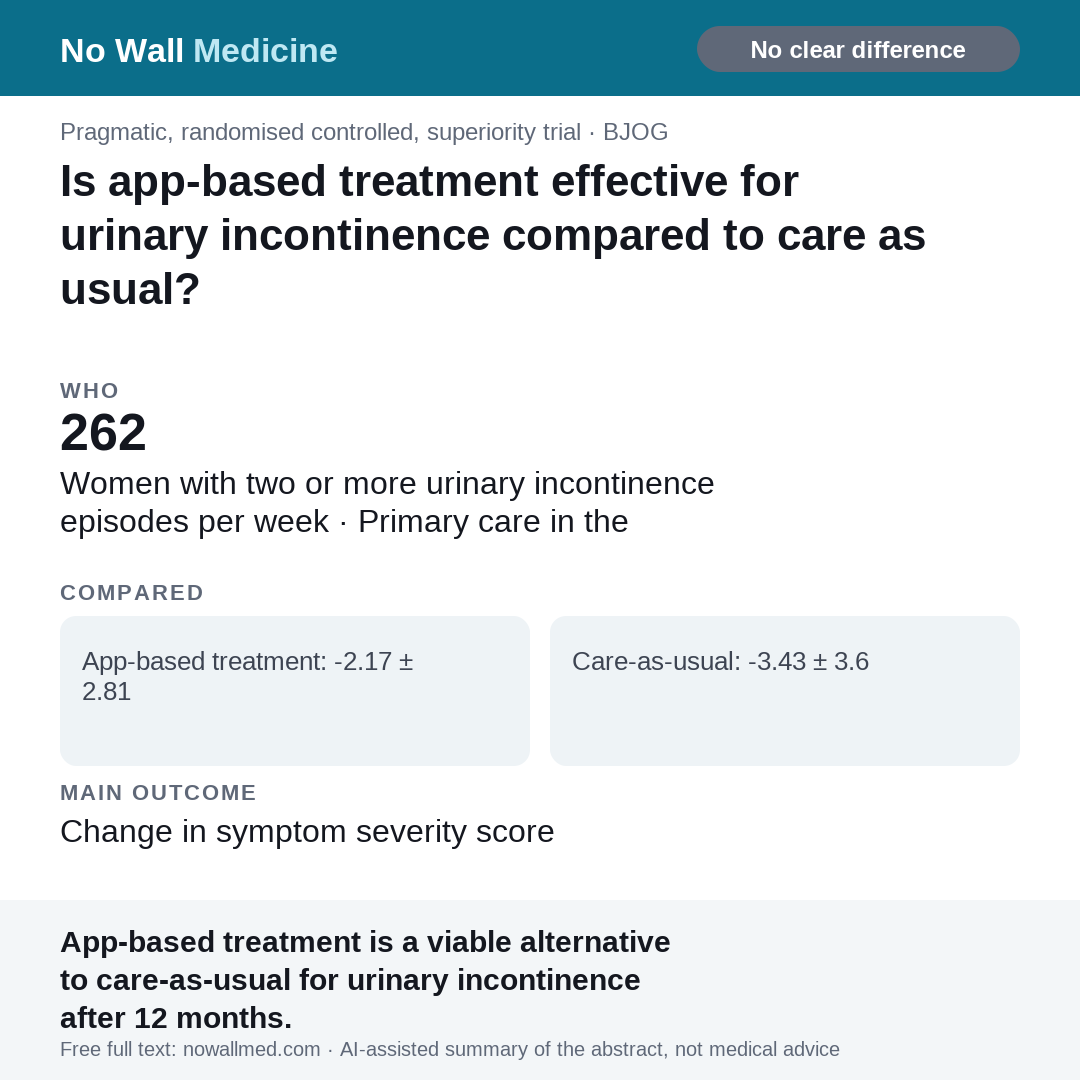
Is app-based treatment effective for urinary incontinence compared to care as usual?
Who
262
Women with two or more urinary incontinence episodes per week · Primary care in the Netherlands
Compared
App-based treatment: -2.17 ± 2.81
Care-as-usual: -3.43 ± 3.6
Main outcome
Change in symptom severity score
Result: mean difference of 0.903 (-0.66 to 1.871)
Bottom line: App-based treatment is a viable alternative to care-as-usual for urinary incontinence after 12 months.
BJOG · 2022-05-31Download image
Clinical question: Is app-based treatment effective for urinary incontinence compared to care as usual?
Why it matters: It was unknown if an app-based treatment for stress, urgency, or mixed urinary incontinence is as effective as standard primary care over one year.
Key points
- Researchers studied 262 women with urinary incontinence in Dutch primary care, comparing an app-based treatment to standard care as usual.
- Both groups showed clinically relevant improvements in symptom severity, with the app group at -2.17 ± 2.81 and the care-as-usual group at -3.43 ± 3.6.
- The difference in symptom severity between the two groups was not statistically significant, with a mean difference of 0.903 (-0.66 to 1.871).
Headline and key points written with AI from the paper’s abstract, with every number checked against it. Read the paper before relying on them.
Was this summary helpful?
Subject terms
Cite this article
Loohuis AM, Van Der Worp H, Wessels NJ, Dekker JH, Slieker-Ten Hove MC, Berger MY. One year effectiveness of an app-based treatment for urinary incontinence in comparison to care as usual in Dutch general practice: A pragmatic randomised controlled trial over 12 months. BJOG. 2022. doi:10.1111/1471-0528.16875
Spotted a mistake? Suggest a correction
Top studies every Monday
The week’s key trials and guidelines in your specialties, plus any topics you follow. By email, free.
Get the weekly digest