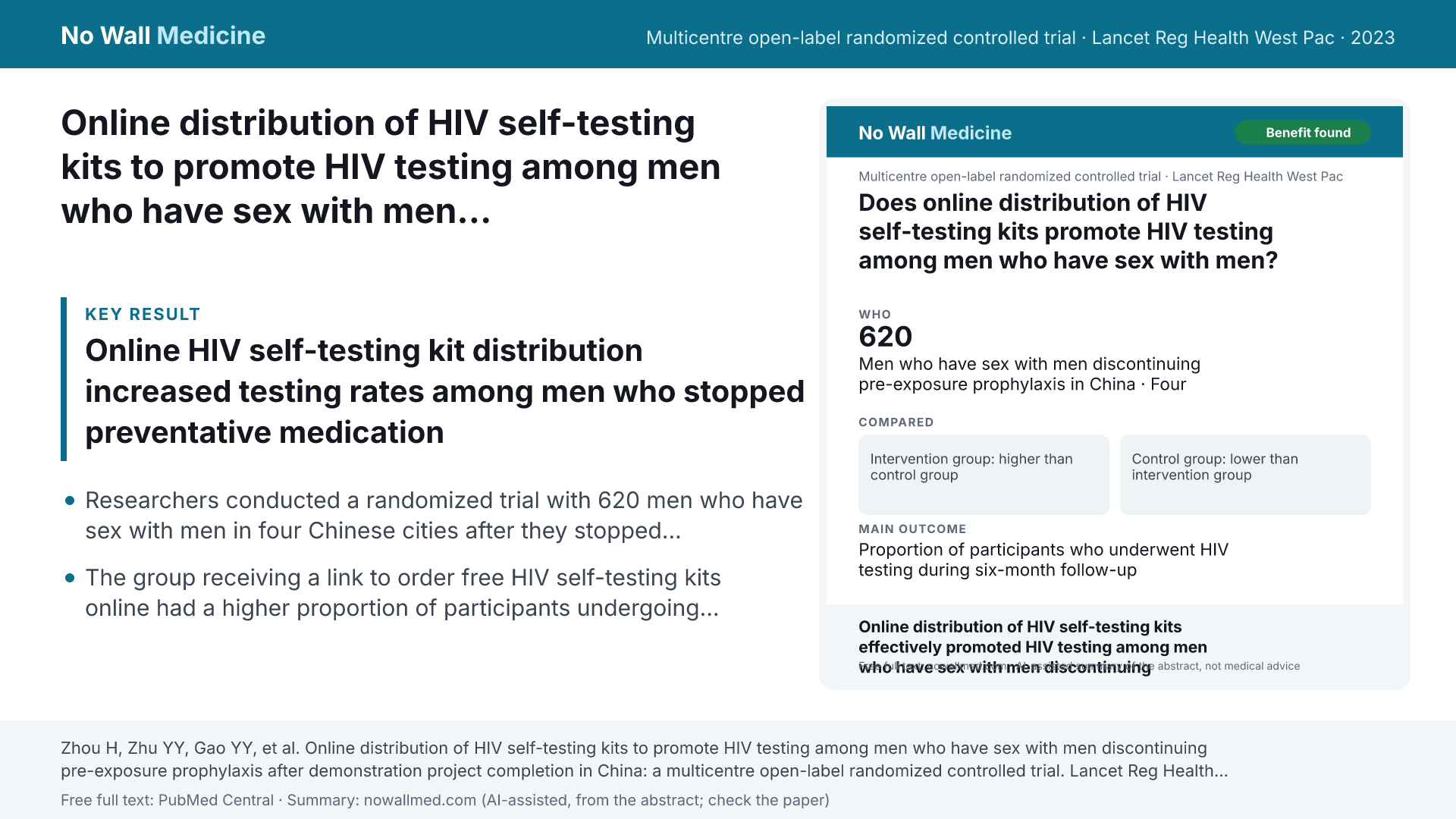
Online HIV self-testing kit distribution increased testing rates among men who stopped preventative medication
Online distribution of HIV self-testing kits to promote HIV testing among men who have sex with men discontinuing pre-exposure prophylaxis after demonstration project completion in China: a multicentre open-label randomized controlled trial
Multicentre open-label randomized controlled trialBenefit found
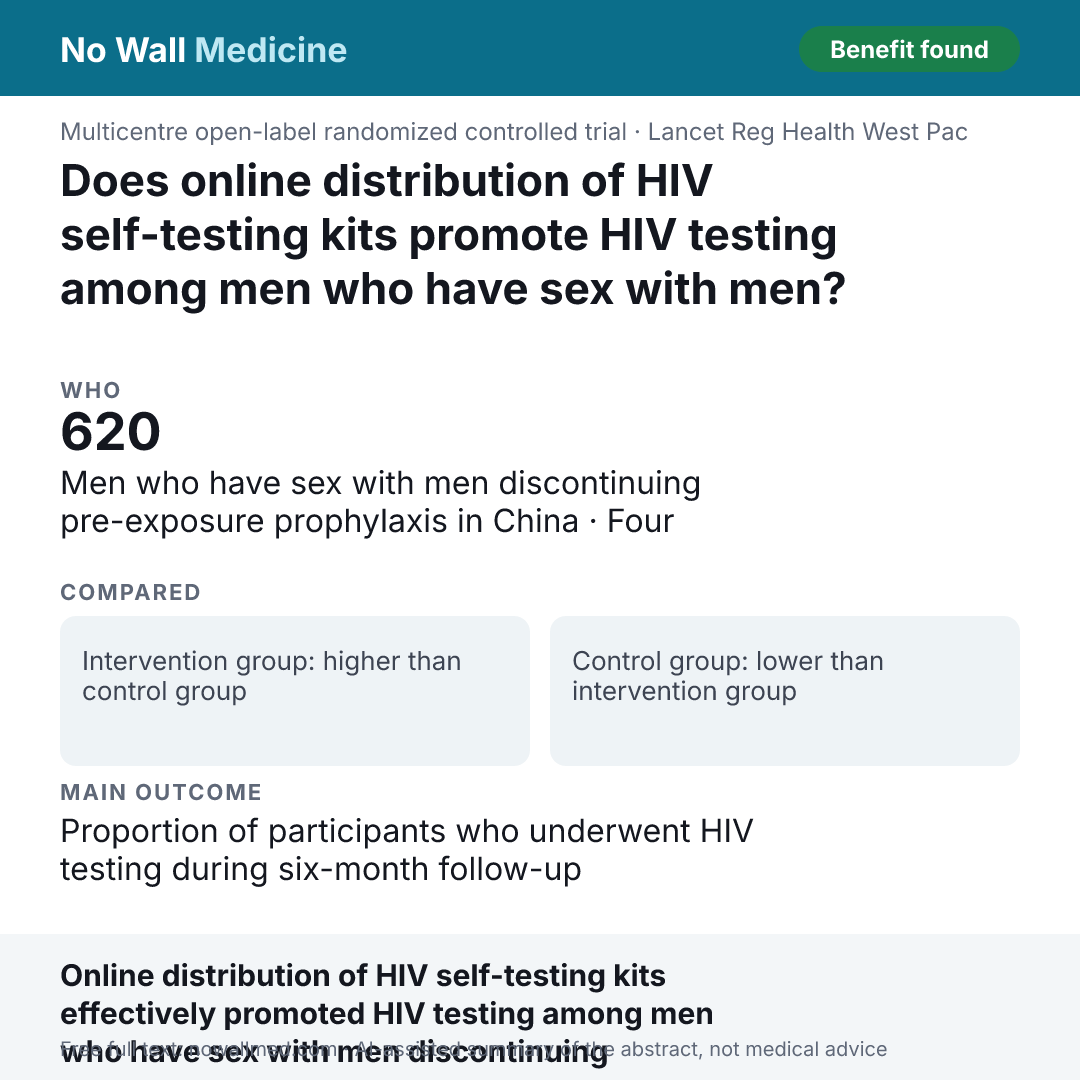
Does online distribution of HIV self-testing kits promote HIV testing among men who have sex with men?
Who
620
Men who have sex with men discontinuing pre-exposure prophylaxis in China · Four cities in China
Compared
Intervention group: higher than control group
Control group: lower than intervention group
Main outcome
Proportion of participants who underwent HIV testing during six-month follow-up
Result: adjusted risk difference 26.7 (95% CI 24.6 to 28.7)
Bottom line: Online distribution of HIV self-testing kits effectively promoted HIV testing among men who have sex with men discontinuing pre-exposure prophylaxis.
Funded by: National Natural Science Foundation of China and others
Lancet Reg Health West Pac · 2023-10-14 · Save PNG
Clinical question: Does online distribution of HIV self-testing kits promote HIV testing among men who have sex with men?
Key points
- Researchers conducted a randomized trial with 620 men who have sex with men in four Chinese cities after they stopped taking pre-exposure prophylaxis.
- The group receiving a link to order free HIV self-testing kits online had a higher proportion of participants undergoing HIV testing at three months (adjusted risk difference: 36.7) and six months (adjusted risk difference: 26.7).
- Follow-up completion rates were 99.0% in the intervention group and 95.0% in the control group.
Headline and key points written with AI from the paper’s abstract, with every number checked against it. Read the paper before relying on them.
Was this summary helpful?
Abstract
Background
HIV self-testing (HIVST) offers potential solutions to challenges associated with site-based HIV testing (SBHT). However, the effectiveness of HIVST as an HIV prevention strategy for men who have sex with men (MSM) discontinuing pre-exposure prophylaxis (PrEP) after the completion of PrEP demonstration project has rarely been assessed. Methods
The China Real-world Study of Oral PrEP (CROPrEP) project was conducted in four cities in China. Participants were directed to community resources to continue their PrEP medication after the discontinuation of project-provided PrEP at the last CROPrEP visit. We conducted a multicentre open-label randomized controlled trial among MSM who had discontinued PrEP induced by the completion of CROPrEP. Eligible participants were randomly assigned to either the intervention group or the control group (1:1). Participants received regular health education and behavioural interventions throughout the trial. The intervention group was given a link to order free HIVST kits online, while the control group received information about free SBHT. Both groups completed internet-based follow-up surveys at three and six months. The primary outcome was the proportion of participants who underwent HIV testing during the six-month follow-up period. This trial was registered at chictr.org.cn (ChiCTR2000038416). Findings
Between November 2020 and January 2021, we recruited a total of 620 participants (300 in the intervention group and 320 in the control group). The follow-up completion rates were 99·0% and 95·0% in the intervention and control groups, respectively. At baseline, the median age of participants was 32 (interquartile range: 26-37), and 77·7% underwent HIV testing in the past three months. The proportion of participants who underwent HIV testing in the past three months was higher in the intervention group than in the control group at both the three-month (adjusted risk difference [RD]: 36·7, 95% confidence interval [CI]: 35·1-38·5, p < 0·001) and six-month (RD: 26·7, 95% CI: 24·6-28·7 p < 0·001) follow-up periods. Interpretation
Our study suggests that providing online distribution of HIVST kits for MSM with PrEP discontinuation induced by completion of the PrEP project effectively promoted HIV testing. This digital approach improves access to HIV testing for MSM and can be applicable to other settings where MSM turn to online public health services. Funding
The study was funded by the Fund of National Natural Science Foundation of China; the Mega-Projects of National Science Research for the 13th Five-Year Plan; and the Liaoning Revitalization Talents Program, China.
Abstract reproduced under the article’s CC BY-NC-ND licence.
Headline, design, result, key points, caveat and citation as plain text.
Cite this article
Zhou H, Zhu YY, Gao YY, et al. Online distribution of HIV self-testing kits to promote HIV testing among men who have sex with men discontinuing pre-exposure prophylaxis after demonstration project completion in China: a multicentre open-label randomized controlled trial. Lancet Reg Health West Pac. 2023;41:100922. doi:10.1016/j.lanwpc.2023.100922
Spotted a mistake? Suggest a correction