Online perceived control intervention and voice education showed similar results for muscle tension dysphonia
Online Intervention for Muscle Tension Dysphonia: A Pilot Randomized Clinical Trial
Pilot randomized clinical trialNo clear difference
Is a perceived control intervention effective for muscle tension dysphonia compared to voice education?
Who
50
Adults with muscle tension dysphonia · Academic otolaryngology clinics
Compared
-2.44perceived control intervention (95% CI, -4.25 to -0.63)
-2.94voice education program (95% CI, -4.12 to -1.76)
Main outcome
Voice-related impairment measured by Voice Handicap Index-10
Bottom line: Both perceived control intervention and voice education programs appear promising for further development in treating muscle tension dysphonia.
JAMA Otolaryngol · 2025-02-27Download image
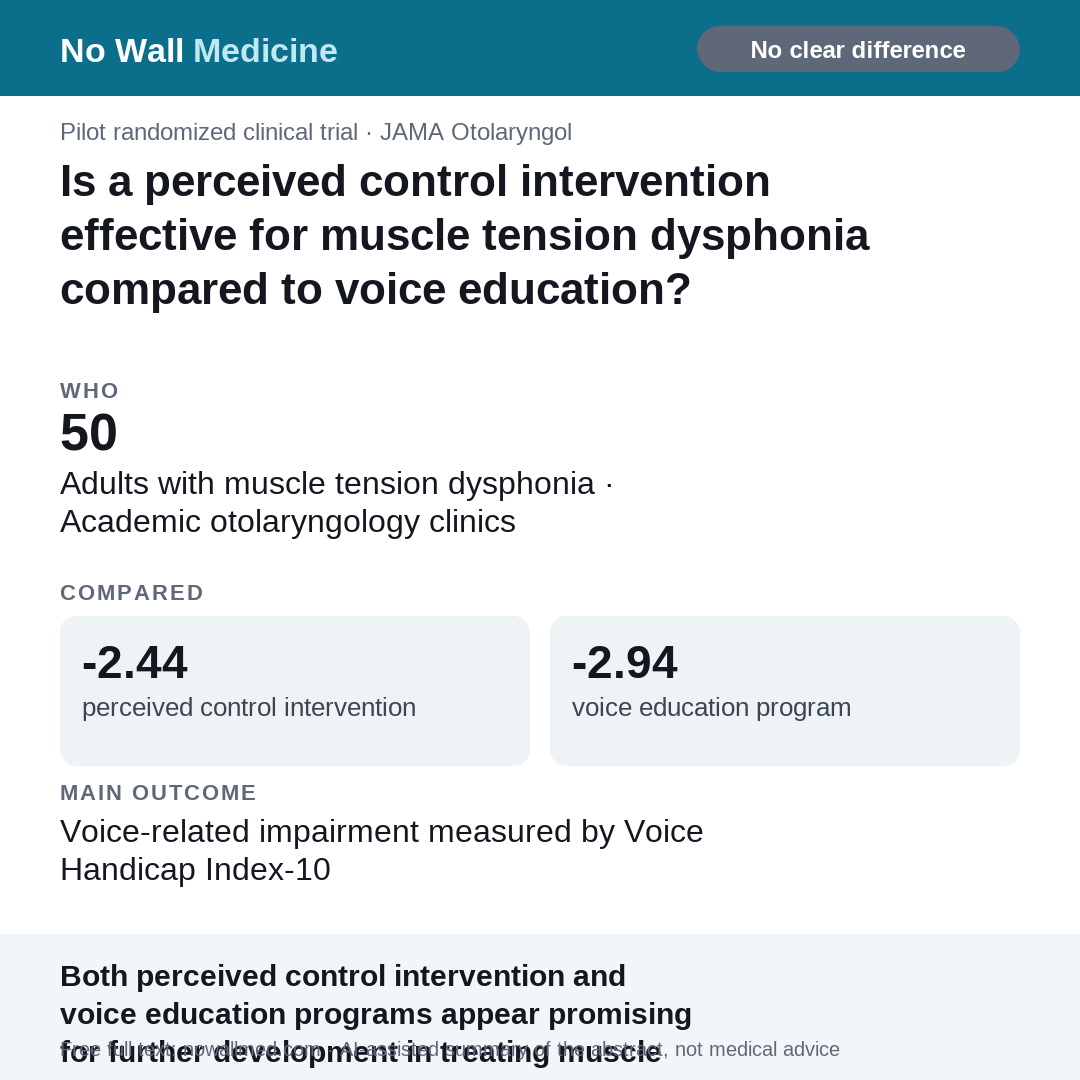
Clinical question: Is a perceived control intervention effective for muscle tension dysphonia compared to voice education?
Why it matters: It is unknown if targeting psychological factors through a perceived control intervention can be a helpful addition to clinical voice care for muscle tension dysphonia.
Key points
- The pilot randomized clinical trial studied 50 adults with muscle tension dysphonia, comparing a perceived control intervention to a voice education program.
- Changes in voice-related impairment were similar between the perceived control group (-2.44; 95% CI, -4.25 to -0.63) and the education group (-2.94; 95% CI, -4.12 to -1.76).
- Both programs were feasible and acceptable, with 80% of the 50 participants completing the study.
Headline and key points written with AI from the paper’s abstract, with every number checked against it. Read the paper before relying on them.
Cite this article
Nguyen-Feng VN, Frazier PA, Liu Y, Feddema E, Wils B, Nikcevich E. Online Intervention for Muscle Tension Dysphonia: A Pilot Randomized Clinical Trial. JAMA Otolaryngol. 2025. doi:10.1001/jamaoto.2024.5255
Spotted a mistake? Suggest a correction
Top studies every Monday
The week’s key trials and guidelines in your specialties, by email. Free.
Get the weekly digest