Onward Virus Transmission after Measles Secondary Vaccination Failure
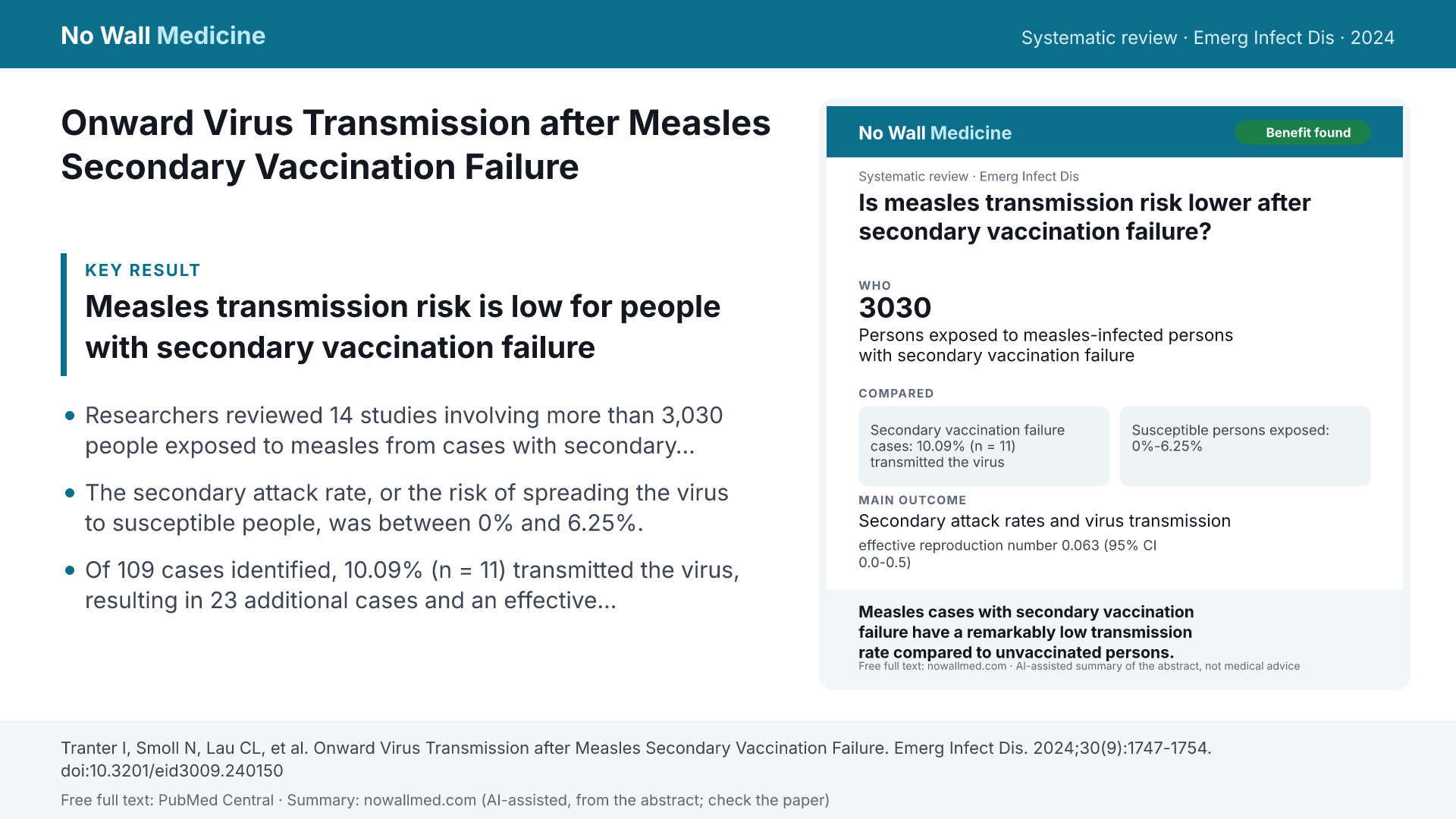
Key result: Measles transmission risk is low for people with secondary vaccination failure
Systematic reviewBenefit found
Is measles transmission risk lower after secondary vaccination failure?
Who
3030
Persons exposed to measles-infected persons with secondary vaccination failure
Compared
Secondary vaccination failure cases: 10.09% (n = 11) transmitted the virus
Susceptible persons exposed: 0%-6.25%
Main outcome
Secondary attack rates and virus transmission
Result: effective reproduction number 0.063 (95% CI 0.0-0.5)
Bottom line: Measles cases with secondary vaccination failure have a remarkably low transmission rate compared to unvaccinated persons.
Emerg Infect Dis · 2024-08-23
Key points
- Researchers reviewed 14 studies involving more than 3,030 people exposed to measles from cases with secondary vaccination failure, which is when a vaccine fails to provide long-term immunity.
- The secondary attack rate, or the risk of spreading the virus to susceptible people, was between 0% and 6.25%.
- Of 109 cases identified, 10.09% (n = 11) transmitted the virus, resulting in 23 additional cases and an effective reproduction number of 0.063 (95% CI 0.0-0.5).
Discussion prompts
- Would these patients look like yours? Who was left out?
- Is the main outcome one that matters to patients?
- Is the difference large enough to change what you do?
Cite: Tranter I, Smoll N, Lau CL, et al. Onward Virus Transmission after Measles Secondary Vaccination Failure. Emerg Infect Dis. 2024;30(9):1747-1754. doi:10.3201/eid3009.240150
Free full text: PubMed Central · Summary and visual abstract: nowallmed.com/a/onward-virus-transmission-after-measles-secondary-vaccination-ugkz4p/ (AI-assisted from the abstract; check the paper before relying on it).