Opioid receptor agonists were associated with increased circulating tumor cell formation in bladder cancer
μ-opioid receptor agonist facilitates circulating tumor cell formation in bladder cancer via the MOR/AKT/Slug pathway: a comprehensive study including randomized controlled trial
Preclinical models and clinical trialHarm found
Do mu-opioid receptor agonists affect circulating tumor cell formation in bladder cancer?
Who
Mouse models and clinical bladder cancer patients
Compared
mu-opioid receptor agonist treatment: significant increase in the number of mesenchymal and/or epithelial circulating tumor cells
control
Main outcome
number of circulating tumor cells
Bottom line: Mu-opioid receptor agonists promote bladder cancer metastasis by facilitating circulating tumor cell formation via the MOR/PI3K/AKT/Slug pathway.
Cancer Commun · 2023-02-05Download image
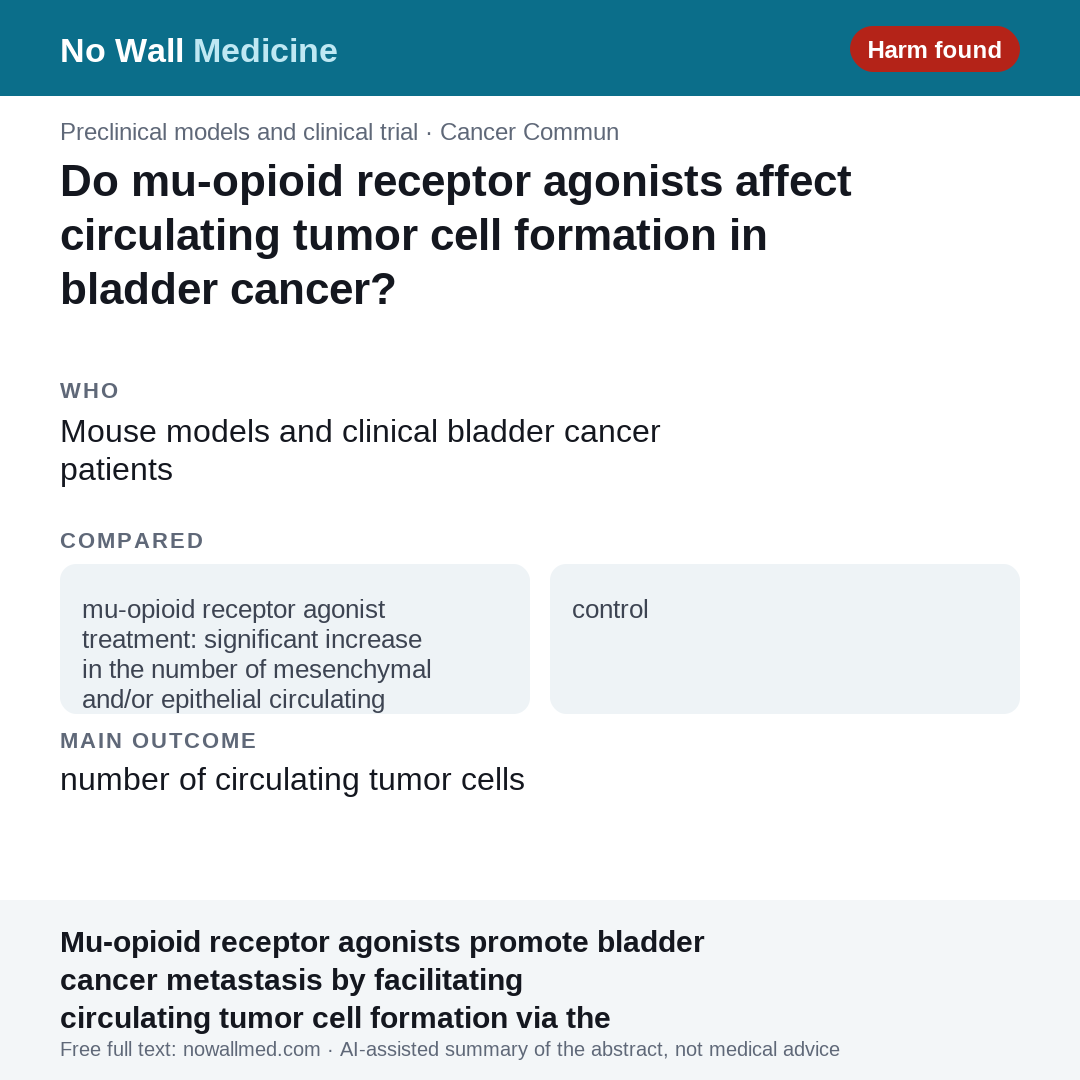
Clinical question: Do mu-opioid receptor agonists affect circulating tumor cell formation in bladder cancer?
Why it matters: It is unknown whether μ-opioid receptor agonists affect the progression and metastasis of bladder cancer.
Key points
- Researchers studied mouse models and clinical bladder cancer patients to see if μ-opioid receptor agonists affect tumor progression.
- Treatment with these drugs was associated with an increase in the number of mesenchymal and/or epithelial circulating tumor cells.
- The process was linked to the activation of the MOR/PI3K/AKT/Slug signaling pathway and the epithelial-mesenchymal transition, where cancer cells change properties to move.
Headline and key points written with AI from the paper’s abstract, with every number checked against it. Read the paper before relying on them.
Was this summary helpful?
Subject terms
Cite this article
Wang X, Zhang S, Jin D, Luo J, Shi Y, Zhang Y. μ-opioid receptor agonist facilitates circulating tumor cell formation in bladder cancer via the MOR/AKT/Slug pathway: a comprehensive study including randomized controlled trial. Cancer Commun. 2023. doi:10.1002/cac2.12408
Spotted a mistake? Suggest a correction
Top studies every Monday
The week’s key trials and guidelines in your specialties, plus any topics you follow. By email, free.
Get the weekly digest