Adding antiplatelet therapy to anticoagulants showed no net clinical benefit for stroke patients
Optimal Antithrombotics for Ischemic Stroke and Concurrent Atrial Fibrillation and Atherosclerosis: A Randomized Clinical Trial
Multicenter, open-label randomized clinical trialNo clear difference
Does adding an antiplatelet agent to anticoagulant therapy improve net clinical benefit?
Who
316
Patients with ischemic stroke or transient ischemic attack, nonvalvular atrial fibrillation, and atherosclerotic cardiovascular disease · 41 sites across Japan
Compared
17.8%Combination therapy
19.6%Monotherapy
Main outcome
Composite of ischemic cardiovascular events and major bleeding within 2 years
Result: hazard ratio 0.91 (95% CI 0.53-1.55)
Bottom line: Adding an antiplatelet agent to anticoagulant therapy provided no net clinical benefit and increased bleeding risk.
JAMA Neurol · 2025-10-06Download image
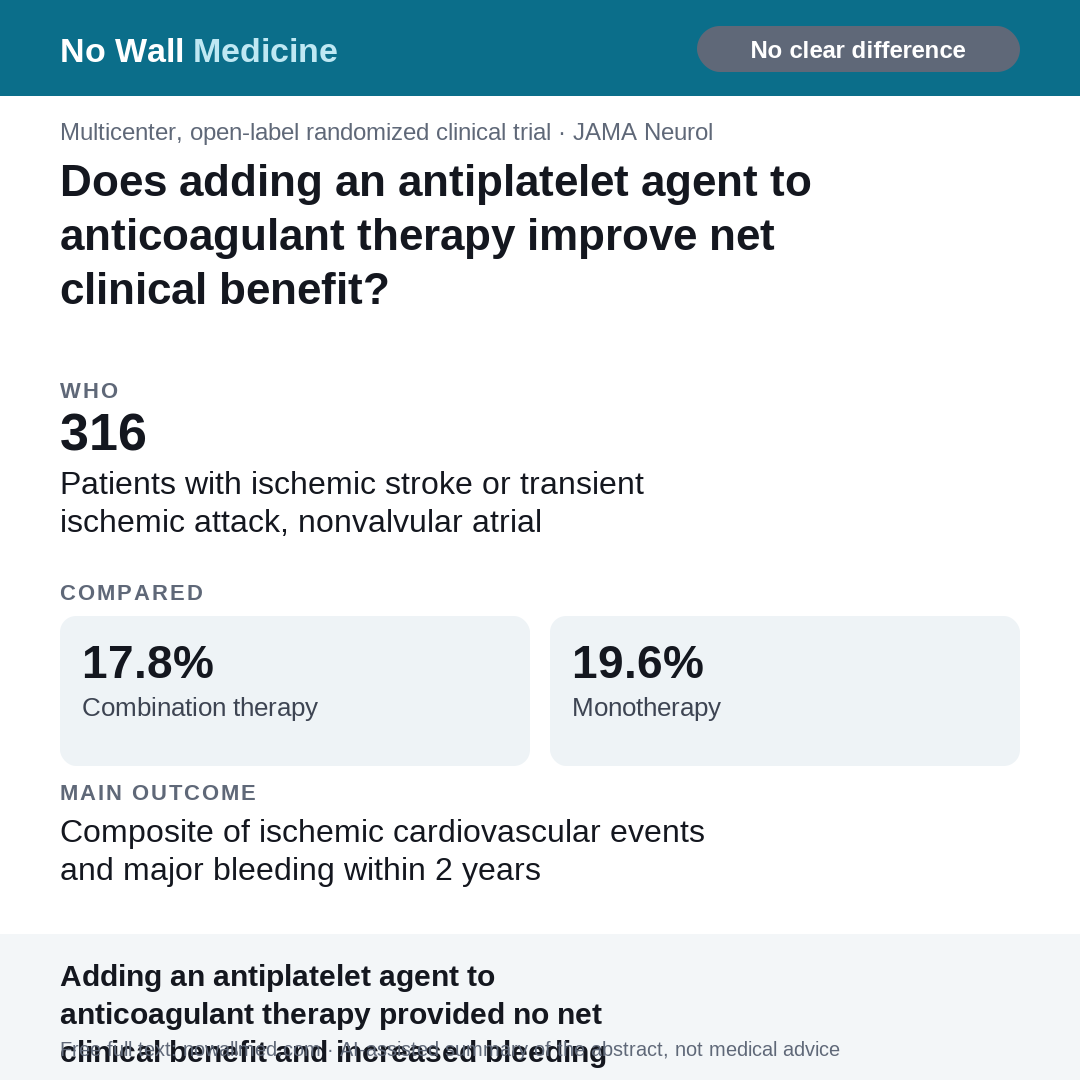
Clinical question: Does adding an antiplatelet agent to anticoagulant therapy improve net clinical benefit?
Why it matters: The optimal antithrombotic strategy is uncertain for patients with ischemic stroke or transient ischemic attack who also have nonvalvular atrial fibrillation and atherosclerotic cardiovascular disease.
Key points
- The study randomized 316 patients with ischemic stroke or transient ischemic attack, nonvalvular atrial fibrillation, and atherosclerotic cardiovascular disease to receive either combination or monotherapy.
- The primary composite outcome of ischemic cardiovascular events and major bleeding occurred in 17.8% of the combination group and 19.6% of the monotherapy group.
- Major and clinically relevant nonmajor bleeding occurred in 19.5% of patients receiving combination therapy compared to 8.6% in the monotherapy group.
Headline and key points written with AI from the paper’s abstract, with every number checked against it. Read the paper before relying on them.
Topics
Cite this article
Okazaki S, Tanaka K, Yazawa Y, Doijiri R, Koga M, Ihara M. Optimal Antithrombotics for Ischemic Stroke and Concurrent Atrial Fibrillation and Atherosclerosis: A Randomized Clinical Trial. JAMA Neurol. 2025. doi:10.1001/jamaneurol.2025.3662
Spotted a mistake? Suggest a correction