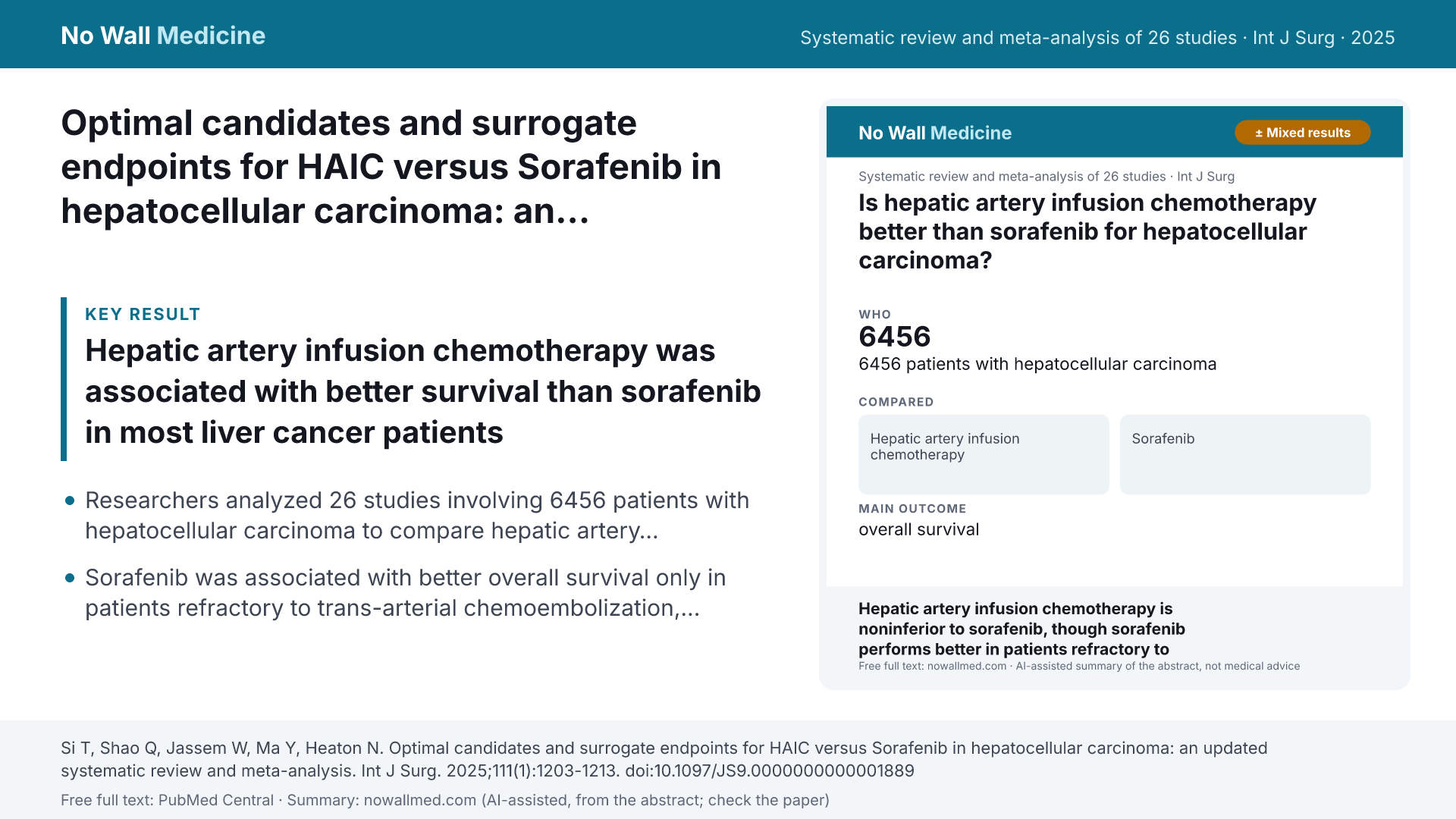
Optimal candidates and surrogate endpoints for HAIC versus Sorafenib in hepatocellular carcinoma: an updated systematic review and meta-analysis
Key result: Hepatic artery infusion chemotherapy was associated with better survival than sorafenib in most liver cancer patients
Key points
- Researchers analyzed 26 studies involving 6456 patients with hepatocellular carcinoma to compare hepatic artery infusion chemotherapy and sorafenib.
- Sorafenib was associated with better overall survival only in patients refractory to trans-arterial chemoembolization, while hepatic artery infusion chemotherapy outperformed sorafenib in other subgroups.
- One-year overall survival and one-year progression-free survival were strongly correlated with long-term overall survival.
Why it matters: The inclusion of hepatic artery infusion chemotherapy in clinical guidelines is limited due to a lack of evidence-based support regarding optimal patient populations and surrogate endpoints.
Discussion prompts
- Would these patients look like yours? Who was left out?
- Is the main outcome one that matters to patients?
- Is the difference large enough to change what you do?
Cite: Si T, Shao Q, Jassem W, Ma Y, Heaton N. Optimal candidates and surrogate endpoints for HAIC versus Sorafenib in hepatocellular carcinoma: an updated systematic review and meta-analysis. Int J Surg. 2025;111(1):1203-1213. doi:10.1097/JS9.0000000000001889
Free full text: PubMed Central · Summary and visual abstract: nowallmed.com/a/optimal-candidates-and-surrogate-endpoints-for-haic-versus-sorafenib-kqwqze/ (AI-assisted from the abstract; check the paper before relying on it).