Fifteen percent and five percent dextrose concentrations reduced pain in tendinopathy compared to saline
Optimal Dextrose Concentration for Prolotherapy in Tendinopathy: A Systematic Review and Network Meta-Analysis of Randomized Controlled Trials
Network meta-analysis of randomized controlled trialsMixed results
What dextrose concentration is most effective for reducing pain in tendinopathy?
Who
490
Patients with tendinopathy
Compared
15% dextrose: MD=-4.66 (95% CI, -5.36 to -3.96)
5% dextrose: MD=-3.55 (95% CI, -4.24 to -2.86)
20% dextrose: MD=0.26 (95% CI, -0.22 to 0.74)
10.7% dextrose-morrhuate: MD=-0.30 (95% CI, -1.23 to 0.63)
Main outcome
0-10 pain scores at 6-12 weeks
Bottom line: Five and fifteen percent dextrose reduced pain, but evidence is limited and based on a single trial.
Limitation: Evidence is limited, certainty is low to very low, and results may reflect differences in tendon site or schedule.
Arch Phys Med Rehabil · 2026-10-09Download image
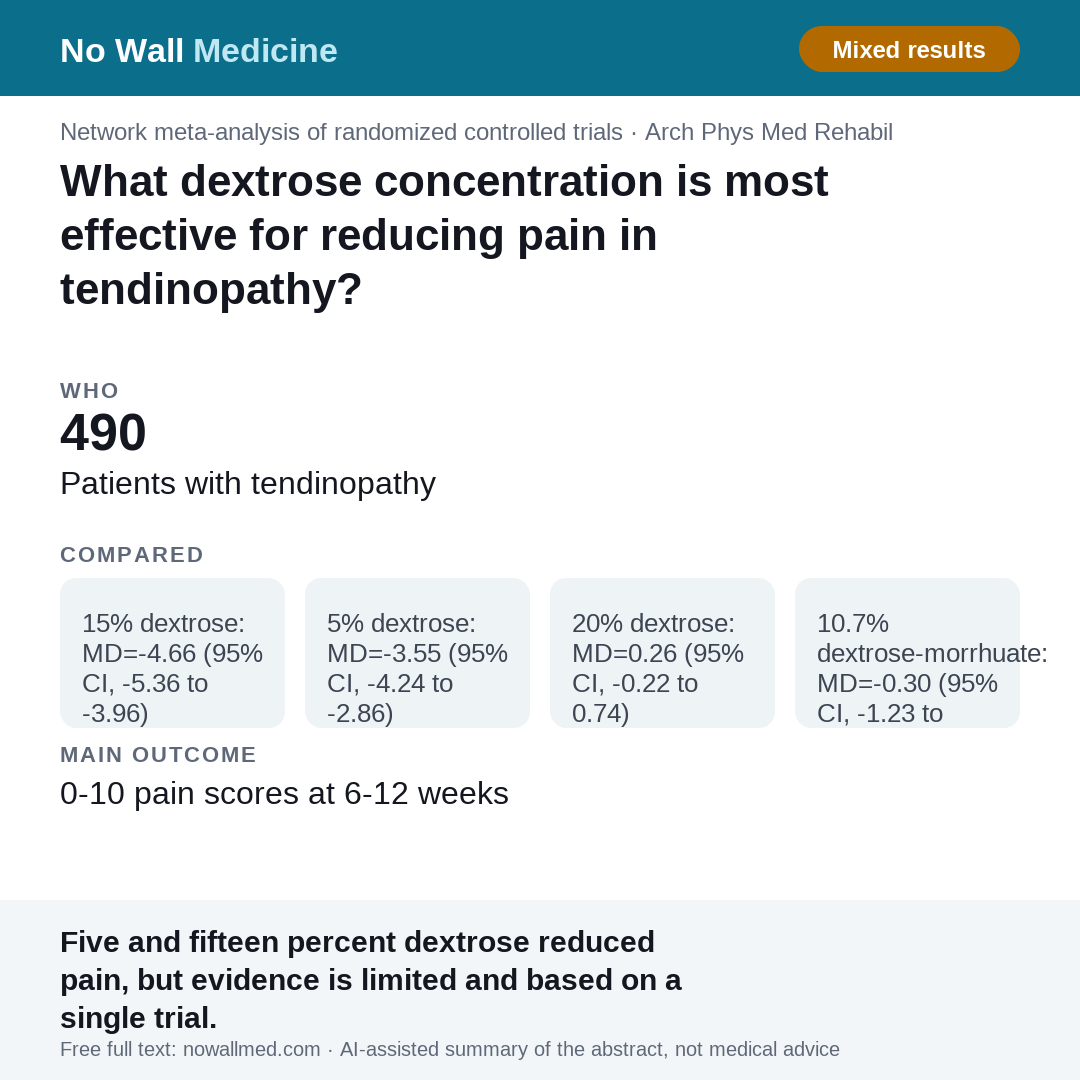
Clinical question: What dextrose concentration is most effective for reducing pain in tendinopathy?
Why it matters: It is currently unclear which concentration of dextrose is most effective for treating pain in patients with tendinopathy.
Key points
- Researchers analyzed nine randomized controlled trials involving 490 participants to compare different dextrose concentrations for treating tendon pain.
- Compared to saline, 15% dextrose reduced pain by 4.66 points and 5% dextrose reduced pain by 3.55 points.
- In a single trial, 15% dextrose reduced pain by 1.11 points more than 5% dextrose.
Limitation the authors note: The certainty of the evidence was rated as low to very low, and the apparent advantage of certain concentrations was based on a single trial.
Headline and key points written with AI from the paper’s abstract, with every number checked against it. Read the paper before relying on them.
Spotted a mistake? Suggest a correction