Combined training and high-intensity interval training reduced blood pressure most effectively in adults
Optimal Exercise Modalities and Dosages for Blood Pressure Reduction in Adults With Prehypertension and Established Hypertension: A Network Meta-Analysis and Dose-Response Relationship Study
Network meta-analysis and dose-response studyBenefit found
What are the optimal exercise modalities and doses for blood pressure reduction?
Who
105
Adults with prehypertension and established hypertension
Compared
Combined training: systolic BP -12.05 mm Hg, diastolic BP -6.20 mm Hg
High-intensity interval training: systolic BP -10.97 mm Hg, diastolic BP -6.42 mm Hg
Main outcome
systolic and diastolic blood pressure
Bottom line: Combined training and high-intensity interval training provide the most significant blood pressure reductions.
J Am Heart Assoc · 2026-05-14Download image
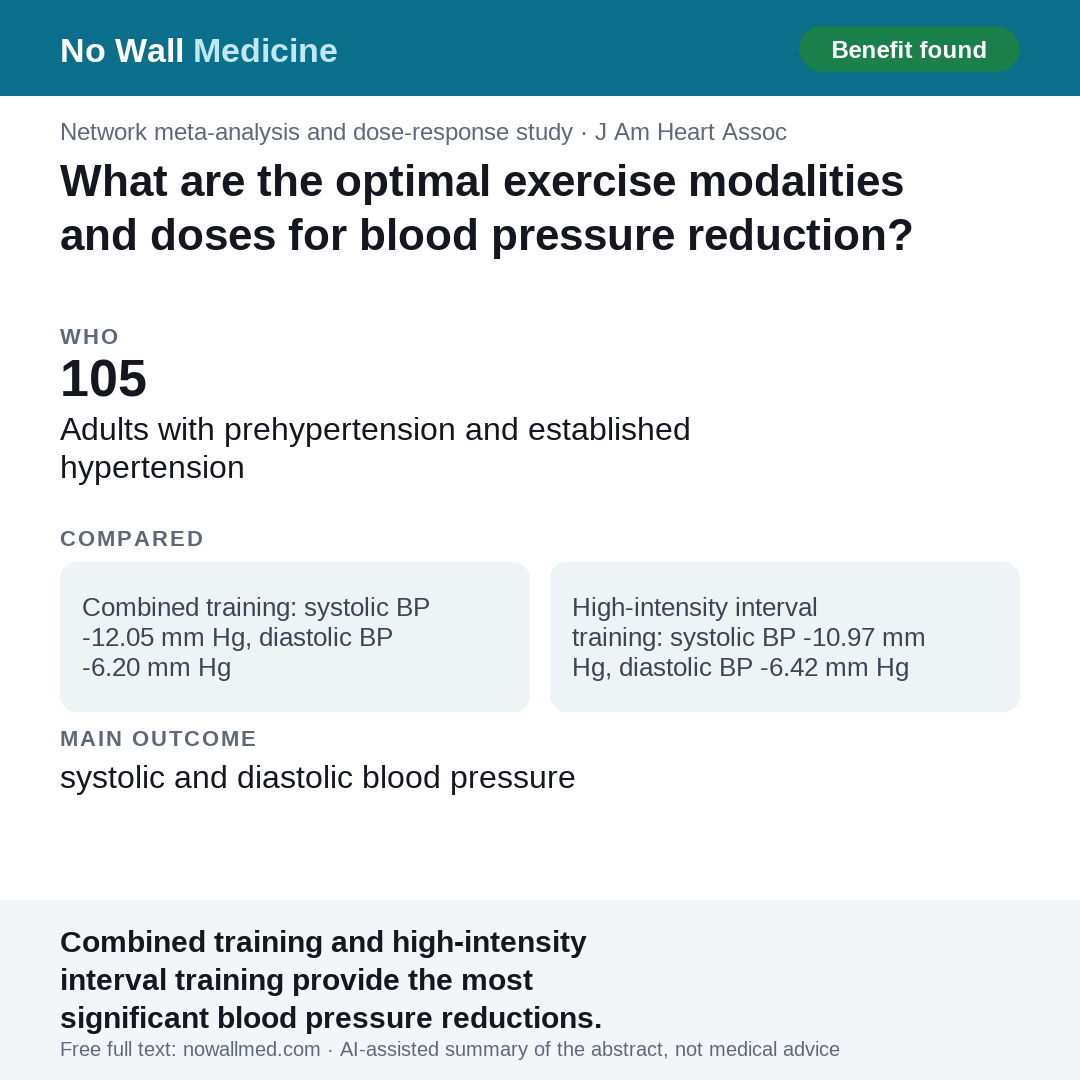
Clinical question: What are the optimal exercise modalities and doses for blood pressure reduction?
Why it matters: The optimal type and amount of exercise for reducing blood pressure in adults with prehypertension and hypertension remain unclear.
Key points
- Researchers analyzed 105 randomized controlled trials to compare how different types and amounts of exercise affect systolic and diastolic blood pressure.
- Combined training reduced systolic blood pressure by -12.05 mm Hg and diastolic blood pressure by -6.20 mm Hg, while high-intensity interval training showed similar reductions.
- The study found a nonlinear U-shaped relationship where the greatest benefit occurred at approximately 830 metabolic equivalents per minute per week.
Headline and key points written with AI from the paper’s abstract, with every number checked against it. Read the paper before relying on them.
Topics
Spotted a mistake? Suggest a correction
More in Cardiology
Clonal hematopoiesis mutations linked to higher atrial fibrillation risk in cancer populations
Association of Clonal Hematopoiesis Mutations With Incident Atrial Fibrillation: A Systematic Review and Meta-Analysis
Deep learning model detects aortic stenosis from finger-cuff pressure waveforms accurately
Aortic Valve Stenosis Screening Using Deep Learning on Noninvasive Arterial Pressure Waveforms
Spontaneous coronary artery dissection affects younger women more often than expected
Spontaneous coronary artery dissection: implications for women's health, clinical care, and future research
Early lipid-lowering strategies may reduce atherosclerotic cardiovascular disease risk
Lipid-Lowering Strategies in the Era of Early Atherosclerosis Detection: 2026 ACC Scientific Statement: A Report of the American College of Cardiology