PCI with optimal medical therapy showed no benefit over medical therapy alone
Optimal medical therapy with or without PCI for stable coronary disease
Why it matters: In stable coronary disease, adding PCI to optimal medical therapy did not reduce death or heart attack. ISCHEMIA later tested an initial invasive strategy in patients with more ischemia.
Related landmark trials: ISCHEMIA
Context written by the No Wall Medicine team.
Randomized trialNo clear difference
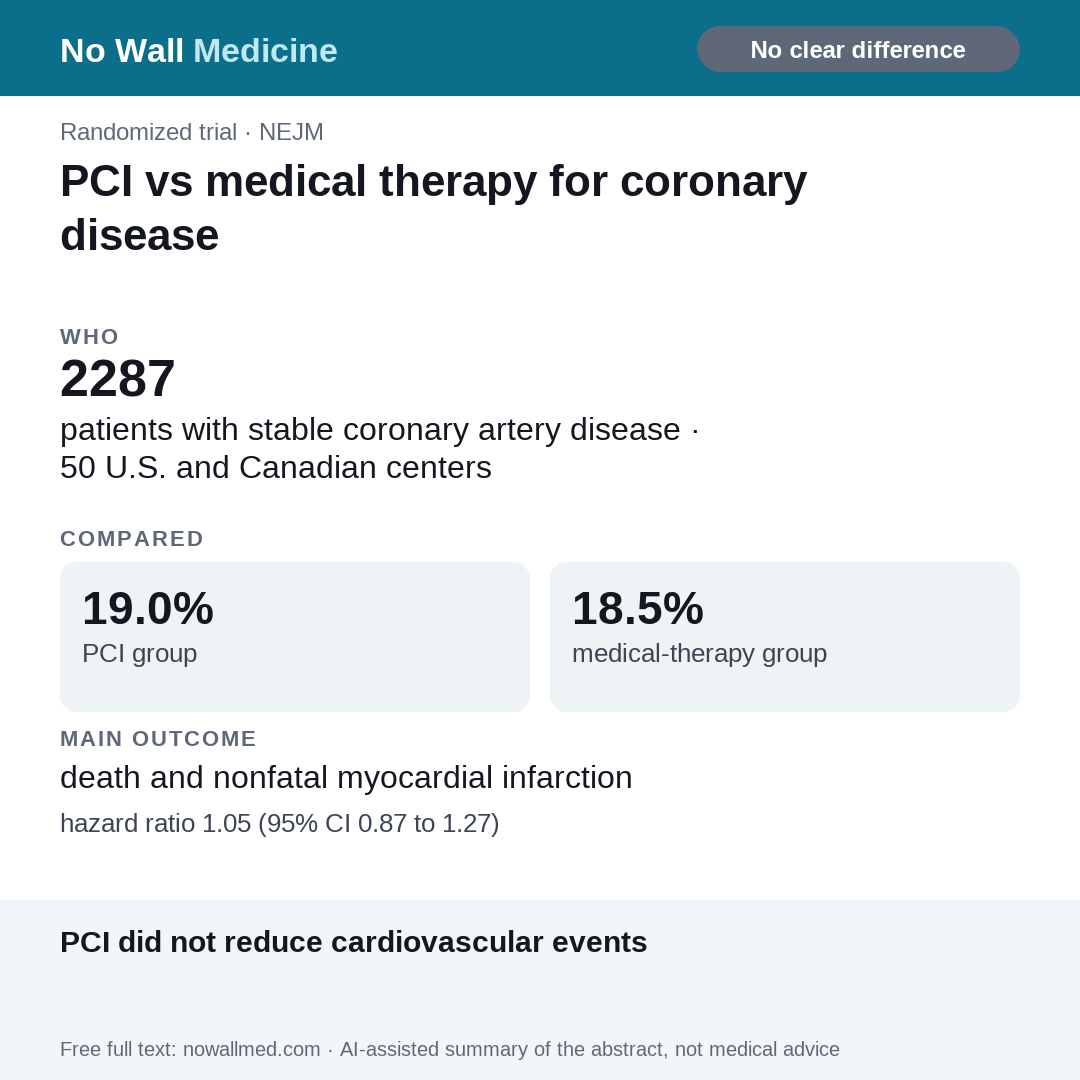
PCI vs medical therapy for coronary disease
Who
2287
patients with stable coronary artery disease · 50 U.S. and Canadian centers
Compared
19.0%PCI group
18.5%medical-therapy group
Main outcome
death and nonfatal myocardial infarction
Result: hazard ratio 1.05 (95% CI 0.87 to 1.27)
Bottom line: PCI did not reduce cardiovascular events
NEJM · 2007-03-26Download image
Trial at a glance
Bottom line: PCI did not reduce risk of death, myocardial infarction, or major cardiovascular events.
Clinical question
Does PCI reduce cardiovascular events in stable coronary disease?
Design
Randomized trial. 50 U.S. and Canadian centers, 1999-2004
Who was studied
2287 patients with stable coronary artery disease
Key inclusion criteria
- objective evidence of myocardial ischemia
- significant coronary artery disease
Interventions
- PCI group: PCI with optimal medical therapy
- medical-therapy group: optimal medical therapy alone
Primary outcome
death and nonfatal myocardial infarction. 19.0% in PCI group, 18.5% in medical-therapy group
Secondary outcomes
- death, myocardial infarction, and stroke: 20.0% vs. 19.5%
- hospitalization for acute coronary syndrome: 12.4% vs. 11.8%
- myocardial infarction: 13.2% vs. 12.3%
Harms
no significant differences in adverse events
Written with AI from the abstract; every number was checked against it. Details such as eligibility criteria may be missing because the abstract does not give them. Read the paper before relying on it.
Key points
- Researchers studied 2287 patients with stable coronary artery disease.
- 19.0% in the PCI group and 18.5% in the medical-therapy group had primary events.
- No significant differences were found in death, myocardial infarction, or stroke rates.
Headline and key points written with AI from the paper’s abstract, with every number checked against it. Read the paper before relying on them.
Topics
Cite this article
Boden WE, O'Rourke RA, Teo KK, Hartigan PM, Maron DJ, Kostuk WJ. Optimal medical therapy with or without PCI for stable coronary disease. NEJM. 2007. doi:10.1056/NEJMoa070829
Spotted a mistake? Suggest a correction