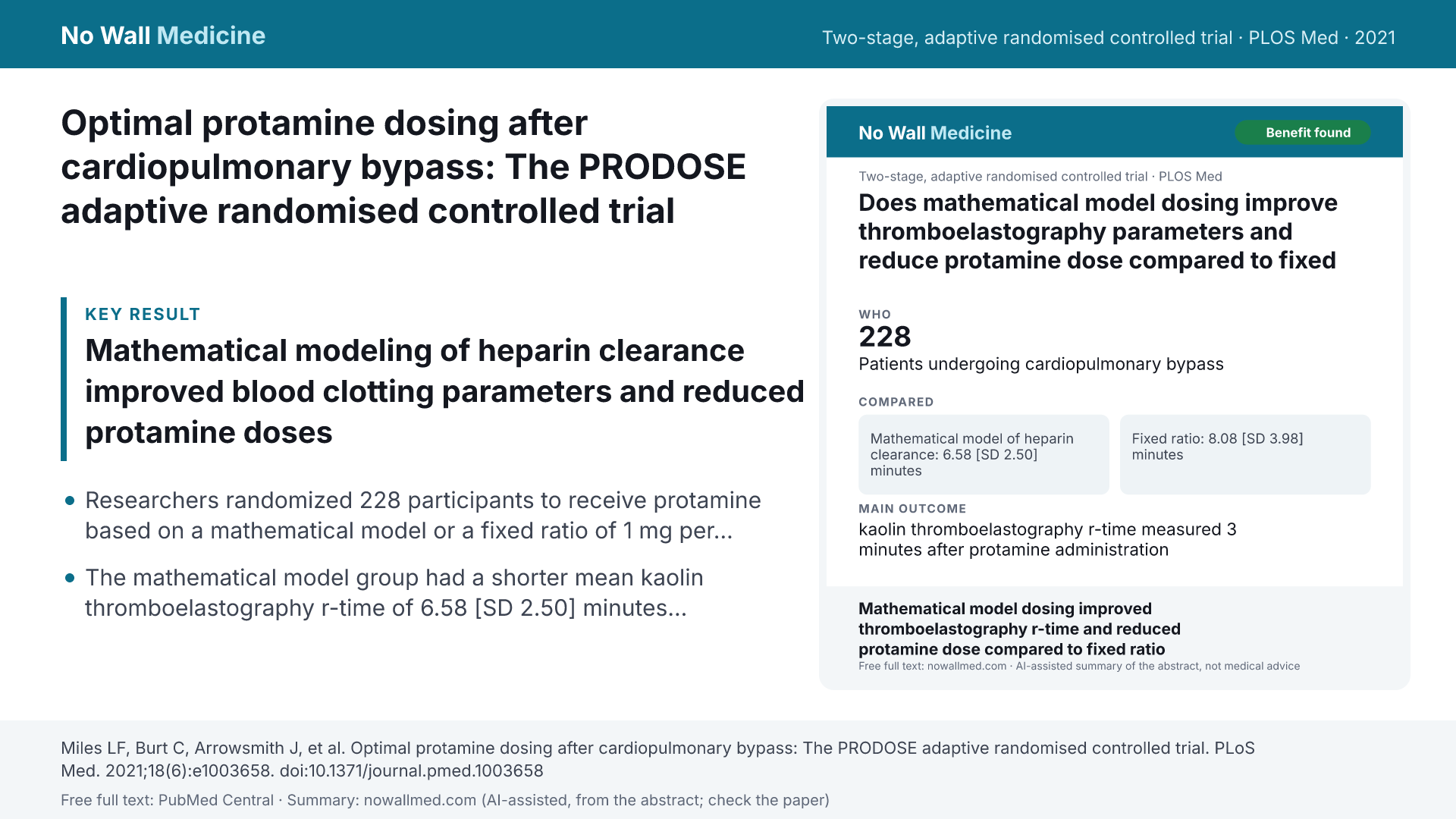
Mathematical modeling of heparin clearance improved blood clotting parameters and reduced protamine doses
Optimal protamine dosing after cardiopulmonary bypass: The PRODOSE adaptive randomised controlled trial
Two-stage, adaptive randomised controlled trialBenefit found
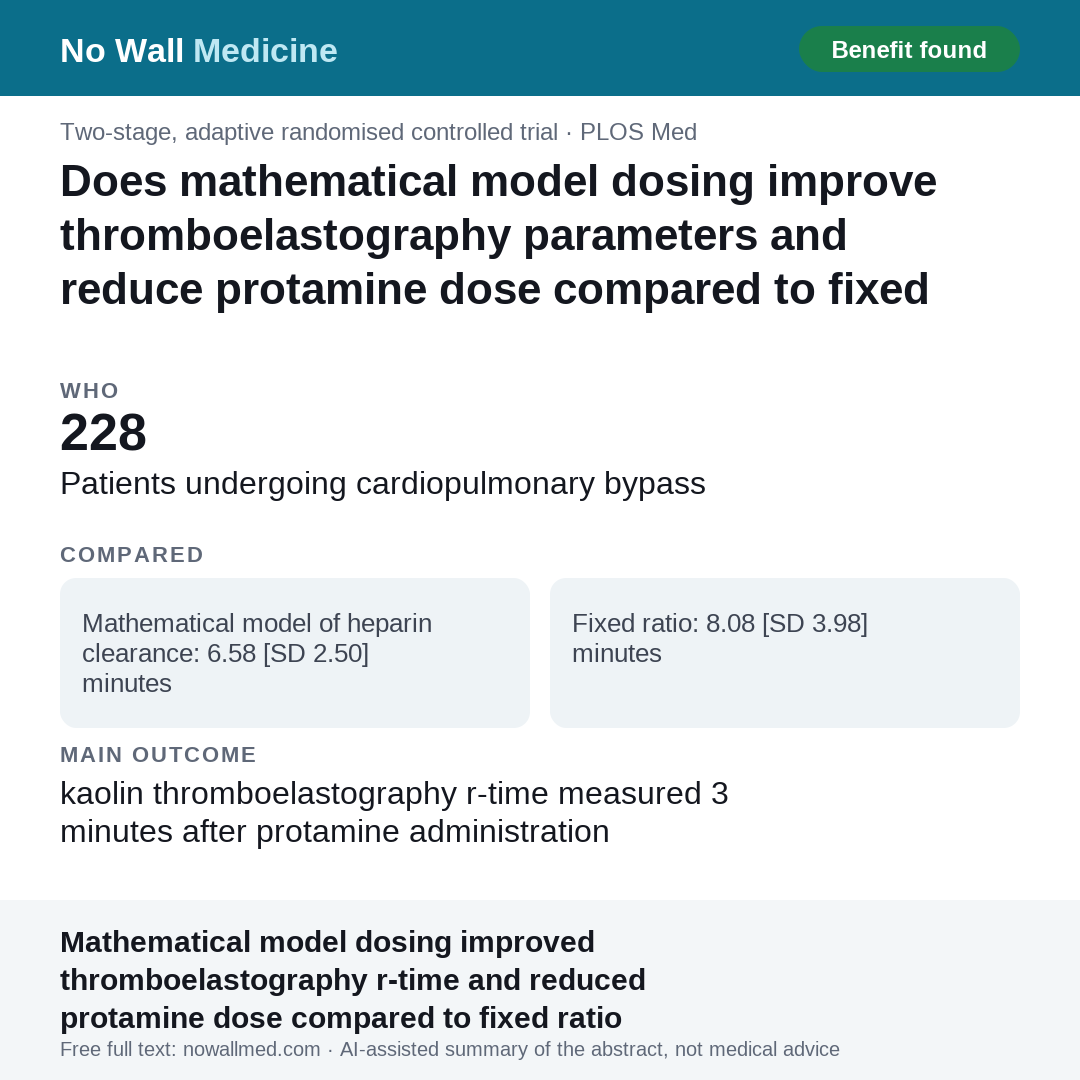
Does mathematical model dosing improve thromboelastography parameters and reduce protamine dose compared to fixed ratio dosing?
Who
228
Patients undergoing cardiopulmonary bypass
Compared
Mathematical model of heparin clearance: 6.58 [SD 2.50] minutes
Fixed ratio: 8.08 [SD 3.98] minutes
Main outcome
kaolin thromboelastography r-time measured 3 minutes after protamine administration
Bottom line: Mathematical model dosing improved thromboelastography r-time and reduced protamine dose compared to fixed ratio dosing.
Limitation: Unblinded design and lack of generalisability to children, very heavy patients, or those requiring therapeutic hypothermia.
PLOS Med · 2021-06-07Download image
Clinical question: Does mathematical model dosing improve thromboelastography parameters and reduce protamine dose compared to fixed ratio dosing?
Why it matters: It is unknown if dosing protamine based on mathematical models of heparin clearance is more precise than using a fixed ratio after heart-lung machine use.
Key points
- Researchers randomized 228 participants to receive protamine based on a mathematical model or a fixed ratio of 1 mg per 100 IU of heparin.
- The mathematical model group had a shorter mean kaolin thromboelastography r-time of 6.58 [SD 2.50] minutes compared to 8.08 [SD 3.98] minutes in the fixed ratio group.
- The model group received a lower median protamine dose of 180 [IQR 160-210] mg compared to 280 [IQR 250-300] mg in the control group.
Limitation the authors note: The study used an unblinded design and excluded children, patients weighing over 120 kg, and patients requiring therapeutic hypothermia to below 28°C.
Headline and key points written with AI from the paper’s abstract, with every number checked against it. Read the paper before relying on them.
Was this summary helpful?
Subject terms
Cite this article
Miles LF, Burt C, Arrowsmith J, et al. Optimal protamine dosing after cardiopulmonary bypass: The PRODOSE adaptive randomised controlled trial. PLOS Med. 2021. doi:10.1371/journal.pmed.1003658
Spotted a mistake? Suggest a correction