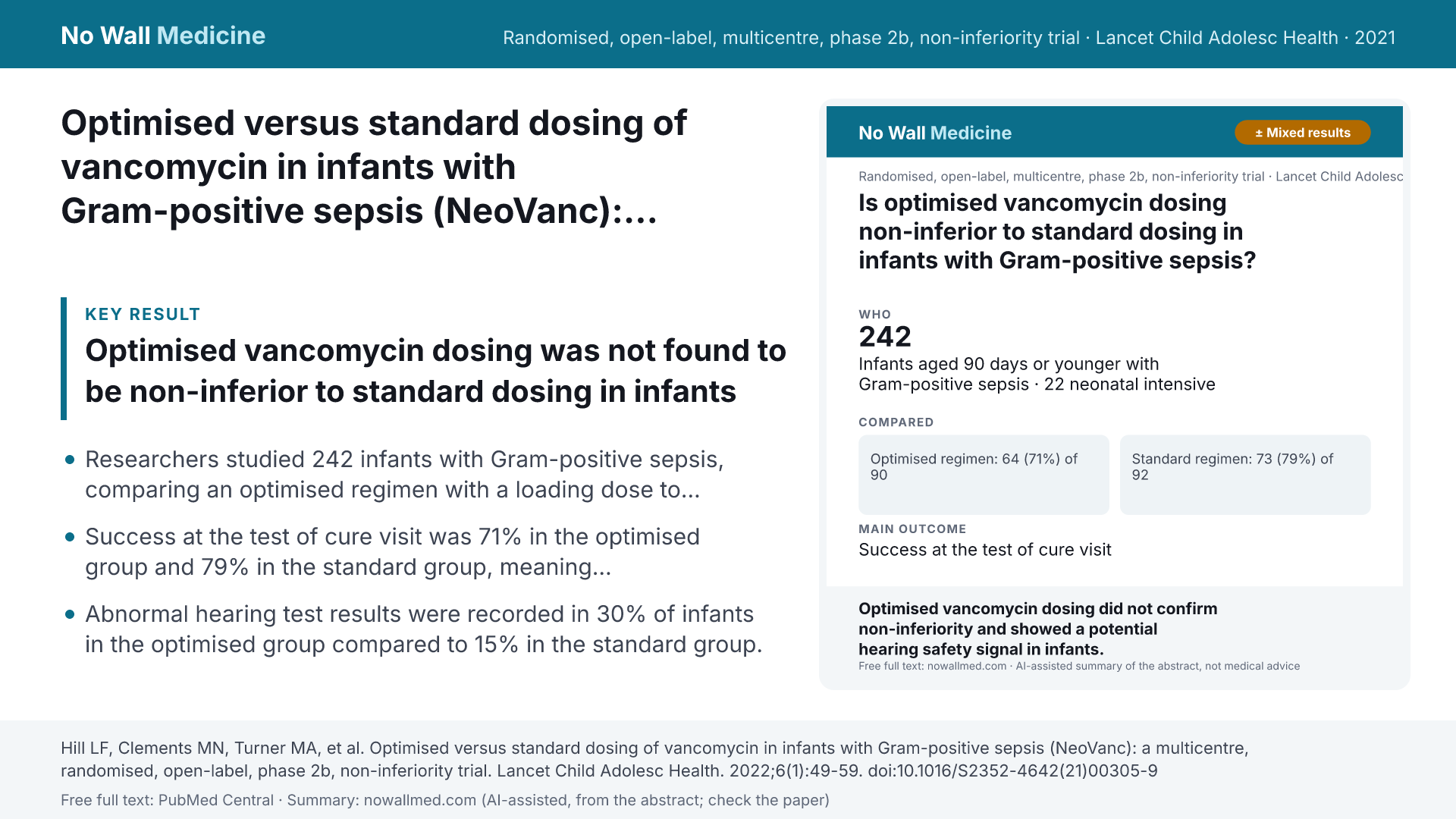
Optimised versus standard dosing of vancomycin in infants with Gram-positive sepsis (NeoVanc): a multicentre, randomised, open-label, phase 2b, non-inferiority trial
Key result: Optimised vancomycin dosing was not found to be non-inferior to standard dosing in infants
Key points
- Researchers studied 242 infants with Gram-positive sepsis, comparing an optimised regimen with a loading dose to a standard regimen without a loading dose.
- Success at the test of cure visit was 71% in the optimised group and 79% in the standard group, meaning non-inferiority was not confirmed.
- Abnormal hearing test results were recorded in 30% of infants in the optimised group compared to 15% in the standard group.
Why it matters: Clinical outcome data regarding the best dosing strategies for vancomycin in infants with Gram-positive sepsis are scarce.
Discussion prompts
- Would these patients look like yours? Who was left out?
- Is the main outcome one that matters to patients?
- Is the difference large enough to change what you do?
Cite: Hill LF, Clements MN, Turner MA, et al. Optimised versus standard dosing of vancomycin in infants with Gram-positive sepsis (NeoVanc): a multicentre, randomised, open-label, phase 2b, non-inferiority trial. Lancet Child Adolesc Health. 2022;6(1):49-59. doi:10.1016/S2352-4642(21)00305-9
Free full text: PubMed Central · Summary and visual abstract: nowallmed.com/a/optimised-versus-standard-dosing-of-vancomycin-in-infants-with-gram-vqhdjv/ (AI-assisted from the abstract; check the paper before relying on it).