Complex medication review intervention did not reduce inappropriate prescribing in patients with polypharmacy
Optimising polypharmacy management in primary care through general practitioner-pharmacist collaboration, informatics, and enhancing clinician engagement: the IMPPP cluster-randomised trial
Pragmatic, open-label, two-arm, parallel cluster-randomised trialNo clear difference
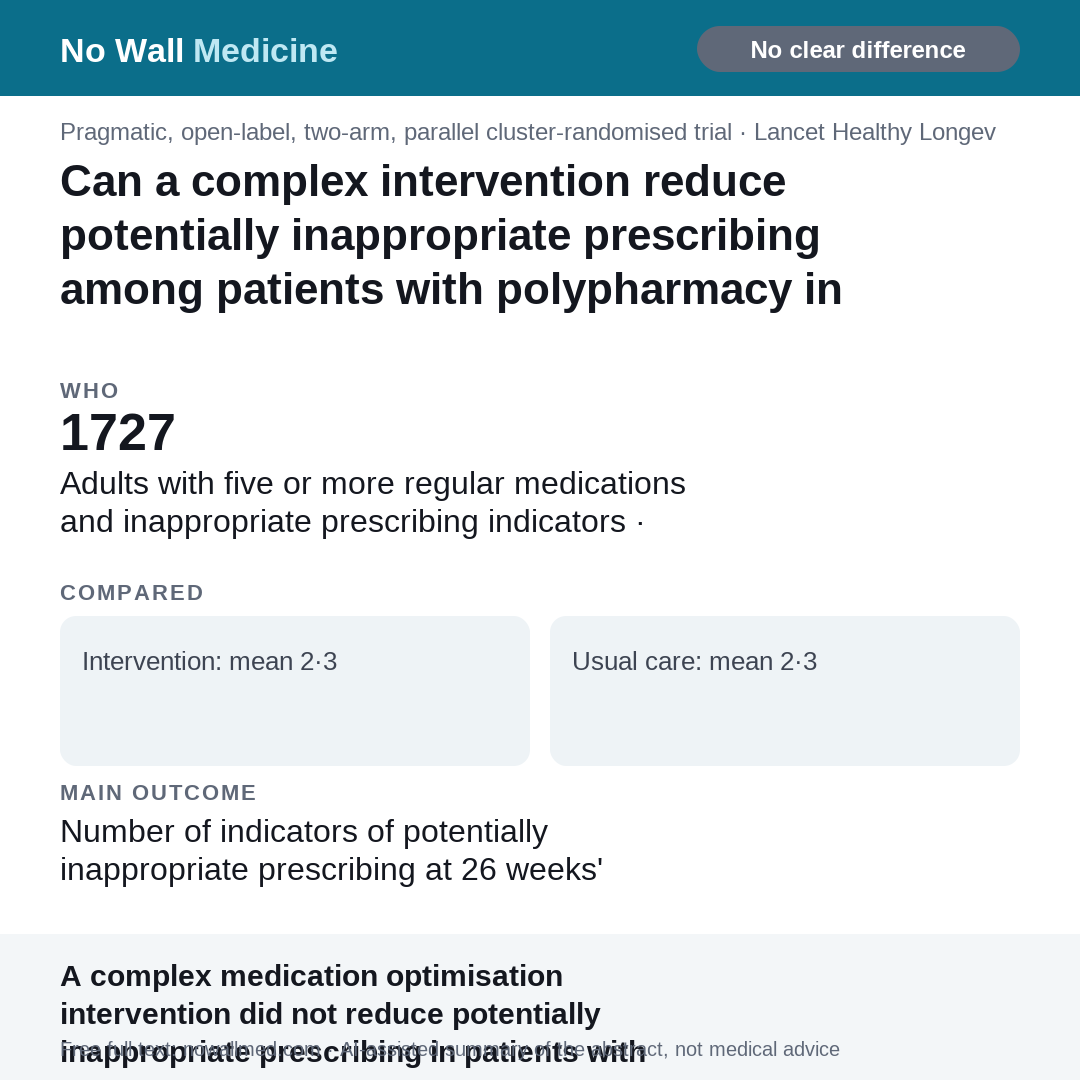
Can a complex intervention reduce potentially inappropriate prescribing among patients with polypharmacy in primary care?
Who
1727
Adults with five or more regular medications and inappropriate prescribing indicators · United Kingdom general practices
Compared
Intervention: mean 2·3
Usual care: mean 2·3
Main outcome
Number of indicators of potentially inappropriate prescribing at 26 weeks' follow-up
Result: difference in means -0·007 (95% CI -0·21 to 0·20)
Bottom line: A complex medication optimisation intervention did not reduce potentially inappropriate prescribing in patients with polypharmacy.
Funded by: National Institute for Health and Care Research
Lancet Healthy Longev · 2025-10-16Download image
Clinical question: Can a complex intervention reduce potentially inappropriate prescribing among patients with polypharmacy in primary care?
Why it matters: High-quality evidence is scarce regarding whether complex interventions can reduce potentially inappropriate prescribing among patients experiencing polypharmacy in primary care.
Key points
- Researchers conducted a cluster-randomised trial involving 1727 patients across 37 UK general practices who were taking five or more regular medications.
- The intervention group and the usual care group both had a mean of 2.3 indicators of potentially inappropriate prescribing at the 26-week follow-up.
- There was no evidence of a difference in the primary outcome between the intervention and control groups (difference in means -0.007; 95% CI -0.21 to 0.20; p=0.95).
Headline and key points written with AI from the paper’s abstract, with every number checked against it. Read the paper before relying on them.
Topics
Cite this article
Payne RA, Blair PS, Caddick B, Chew-Graham CA, Dreischulte T, Duncan LJ. Optimising polypharmacy management in primary care through general practitioner-pharmacist collaboration, informatics, and enhancing clinician engagement: the IMPPP cluster-randomised trial. Lancet Healthy Longev. 2025. doi:10.1016/j.lanhl.2025.100774
Spotted a mistake? Suggest a correction