Medication review using electronic decision support showed no clear improvement in medication appropriateness or omissions
Optimising prescribing in older adults with multimorbidity and polypharmacy in primary care (OPTICA): cluster randomised clinical trial
Cluster randomised clinical trialUnclear result
Does an electronic clinical decision support system improve medication appropriateness and reduce prescribing omissions?
Who
323
Patients aged 65 or older with three or more chronic conditions · Swiss primary care
Compared
Intervention group
Control group
Main outcome
Medication Appropriateness Index and Assessment of Underutilisation at 12 months
Result: odds ratio 1.05 (95% confidence interval 0.59 to 1.87)
Bottom line: The electronic clinical decision support system intervention led to inconclusive results for medication appropriateness and prescribing omissions.
BMJ · 2023-05-24Download image
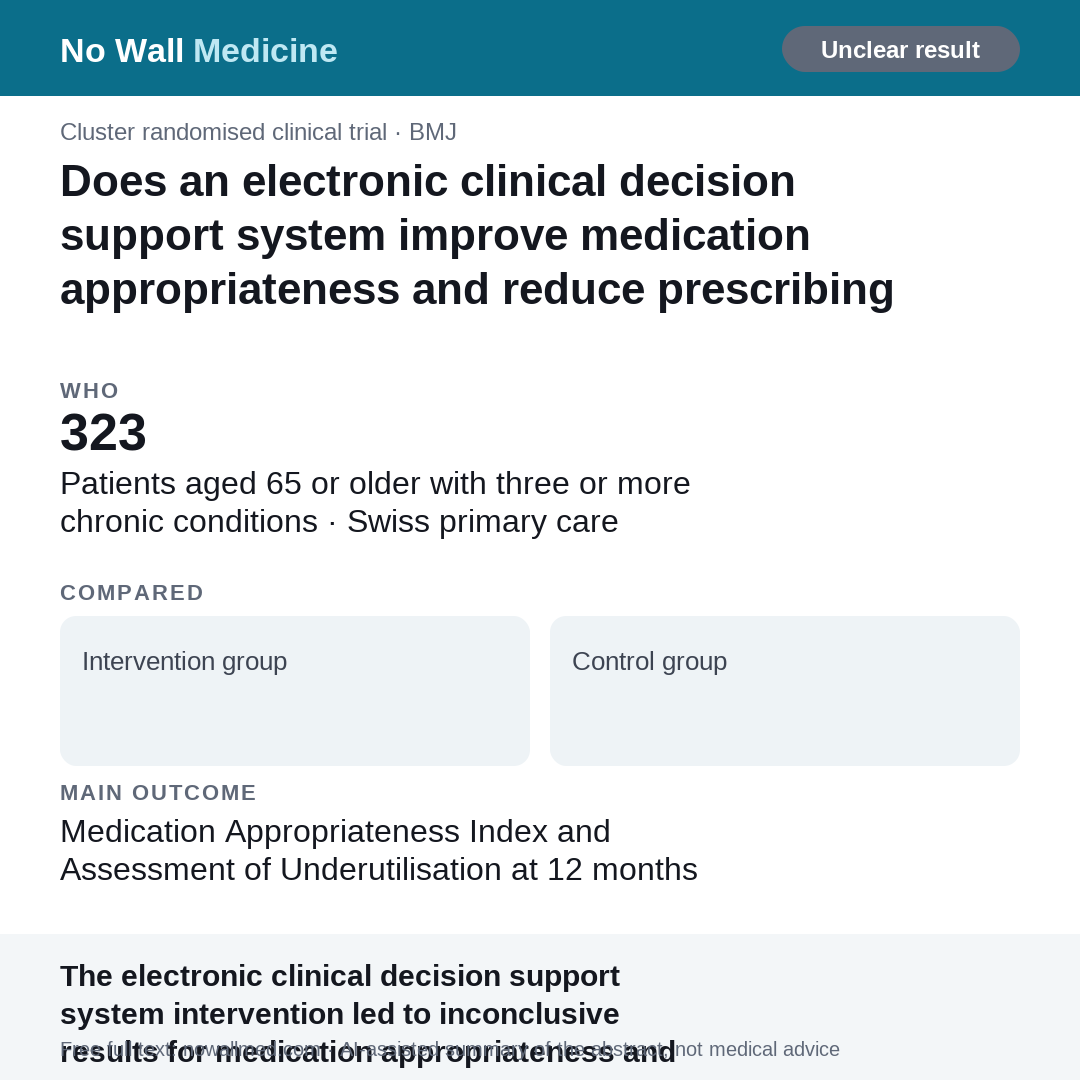
Clinical question: Does an electronic clinical decision support system improve medication appropriateness and reduce prescribing omissions?
Why it matters: It is unclear if using an electronic clinical decision support system during medication reviews improves prescribing appropriateness or reduces missed medications in older adults with multiple chronic conditions.
Key points
- The study involved 323 patients aged 65 years or older with three or more chronic conditions and five or more long term medications across 43 general practitioner clusters.
- At 12 months, the intervention showed inconclusive results for improving the Medication Appropriateness Index (a tool for measuring medication quality) and the Assessment of Underutilisation (a tool for measuring missed medications).
- The intervention was reported to be safe, with fewer safety events reported in the intervention group than in the control group at six and 12 months.
Headline and key points written with AI from the paper’s abstract, with every number checked against it. Read the paper before relying on them.
Abstract
Objective
To study the effects of a primary care medication review intervention centred around an electronic clinical decision support system (eCDSS) on appropriateness of medication and the number of prescribing omissions in older adults with multimorbidity and polypharmacy compared with a discussion about medication in line with usual care. Design
Cluster randomised clinical trial. Setting
Swiss primary care, between December 2018 and February 2021. Participants
Eligible patients were ≥65 years of age with three or more chronic conditions and five or more long term medications. Intervention
The intervention to optimise pharmacotherapy centred around an eCDSS was conducted by general practitioners, followed by shared decision making between general practitioners and patients, and was compared with a discussion about medication in line with usual care between patients and general practitioners. Main outcome measures
Primary outcomes were improvement in the Medication Appropriateness Index (MAI) and the Assessment of Underutilisation (AOU) at 12 months. Secondary outcomes included number of medications, falls, fractures, and quality of life. Results
In 43 general practitioner clusters, 323 patients were recruited (median age 77 (interquartile range 73-83) years; 45% (n=146) women). Twenty one general practitioners with 160 patients were assigned to the intervention group and 22 general practitioners with 163 patients to the control group. On average, one recommendation to stop or start a medication was reported to be implemented per patient. At 12 months, the results of the intention-to-treat analysis of the improvement in appropriateness of medication (odds ratio 1.05, 95% confidence interval 0.59 to 1.87) and the number of prescribing omissions (0.90, 0.41 to 1.96) were inconclusive. The same was the case for the per protocol analysis. No clear evidence was found for a difference in safety outcomes at the 12 month follow-up, but fewer safety events were reported in the intervention group than in the control group at six and 12 months. Conclusions
In this randomised trial of general practitioners and older adults, the results were inconclusive as to whether the medication review intervention centred around the use of an eCDSS led to an improvement in appropriateness of medication or a reduction in prescribing omissions at 12 months compared with a discussion about medication in line with usual care. Nevertheless, the intervention could be safely delivered without causing any harm to patients. Trial registration
NCT03724539Clinicaltrials.gov NCT03724539.
Abstract reproduced under the article’s CC BY licence.
Topics
Cite this article
Jungo KT, Ansorg AK, Floriani C, Rozsnyai Z, Schwab N, Meier R. Optimising prescribing in older adults with multimorbidity and polypharmacy in primary care (OPTICA): cluster randomised clinical trial. BMJ. 2023. doi:10.1136/bmj-2022-074054
Spotted a mistake? Suggest a correction
Top studies every Monday
The week’s key trials and guidelines in your specialties, plus any topics you follow. By email, free.
Get the weekly digest