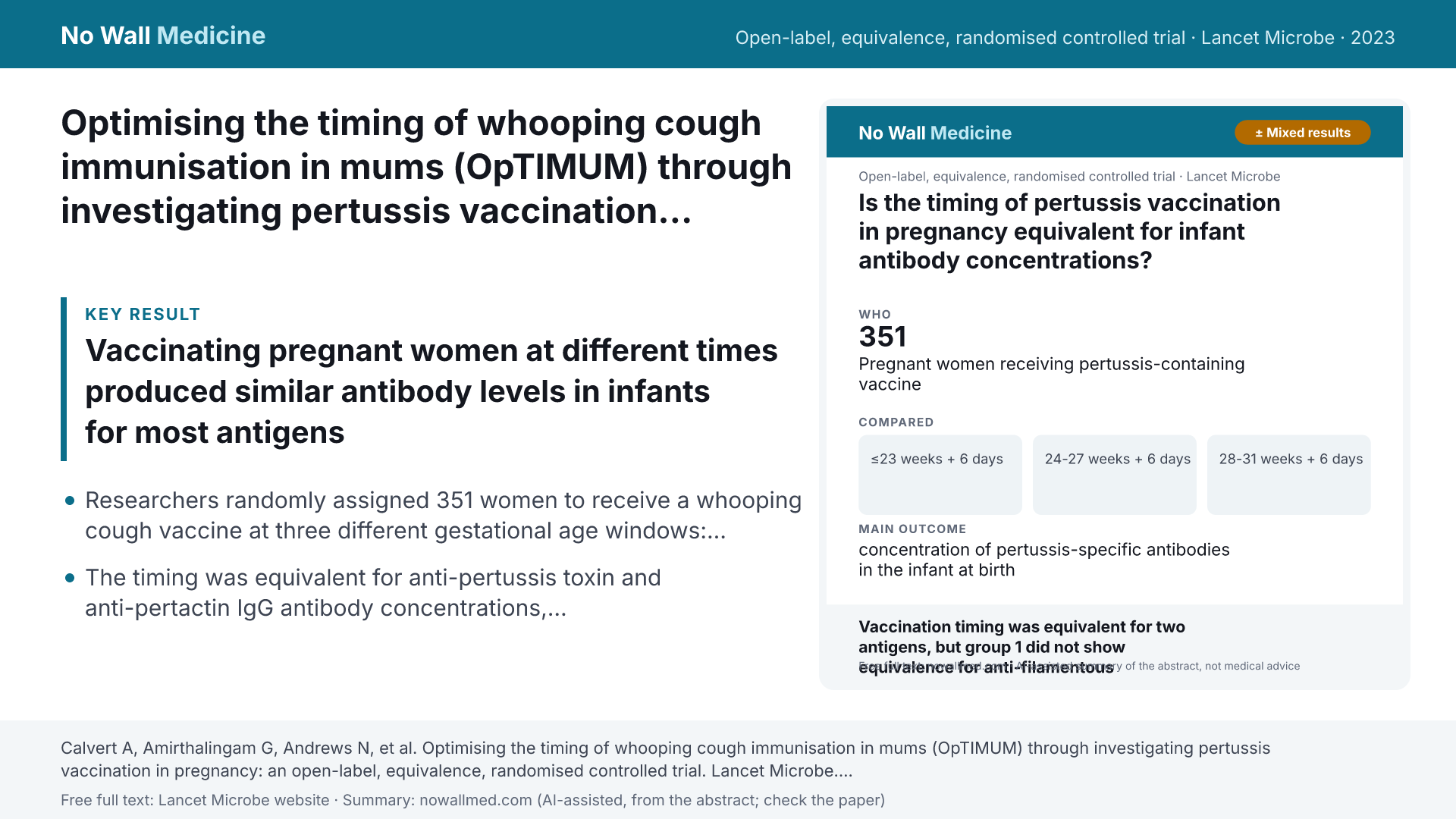
Vaccinating pregnant women at different times produced similar antibody levels in infants for most antigens
Optimising the timing of whooping cough immunisation in mums (OpTIMUM) through investigating pertussis vaccination in pregnancy: an open-label, equivalence, randomised controlled trial
Open-label, equivalence, randomised controlled trialMixed results
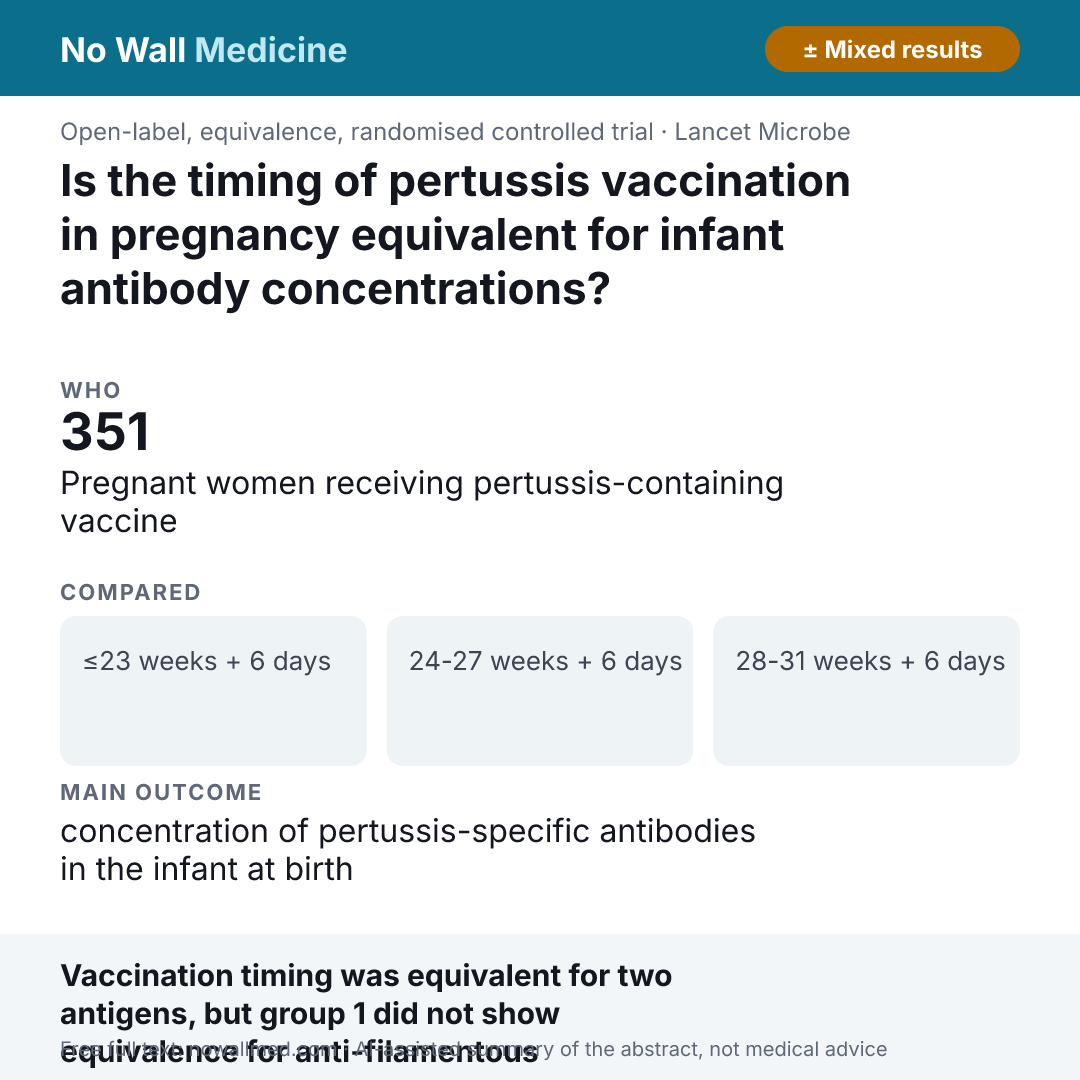
Is the timing of pertussis vaccination in pregnancy equivalent for infant antibody concentrations?
Who
351
Pregnant women receiving pertussis-containing vaccine
Compared
≤23 weeks + 6 days
24-27 weeks + 6 days
28-31 weeks + 6 days
Main outcome
concentration of pertussis-specific antibodies in the infant at birth
Bottom line: Vaccination timing was equivalent for two antigens, but group 1 did not show equivalence for anti-filamentous haemagglutinin IgG.
Funded by: Thrasher Research Fund and National Institute for Health and Care Research
Lancet Microbe · 2023-04-17 · Save PNG
Clinical question: Is the timing of pertussis vaccination in pregnancy equivalent for infant antibody concentrations?
Why it matters: The optimal timing for administering whooping cough vaccination during pregnancy to protect infants is currently uncertain.
Key points
- Researchers randomly assigned 351 women to receive a whooping cough vaccine at three different gestational age windows: ≤23 weeks + 6 days, 24-27 weeks + 6 days, or 28-31 weeks + 6 days.
- The timing was equivalent for anti-pertussis toxin and anti-pertactin IgG antibody concentrations, though anti-filamentous haemagglutinin IgG levels were higher with increasing gestational age.
- Equivalence for anti-filamentous haemagglutinin IgG was not shown for infants in the group vaccinated at ≤23 weeks + 6 days compared to the 28-31 weeks + 6 days group.
Headline and key points written with AI from the paper’s abstract, with every number checked against it. Read the paper before relying on them.
Was this summary helpful?
Abstract
Background
Pertussis vaccination in pregnancy is recommended in many countries to provide protection to young infants. The best timing for this vaccination is uncertain. In the UK, vaccination is recommended between 16 weeks and 32 weeks of gestation. In this trial we aimed to investigate the equivalence of three time periods for pertussis vaccination in pregnancy. Methods
In this open-label, equivalence, randomised controlled trial to investigate equivalence of different time windows for pertussis vaccination in pregnancy, participants were randomly assigned (1:1:1 ratio) to receive a pertussis-containing vaccine (Boostrix-inactivated poliovirus vaccine) in one of three gestational age groups, comprising group 1 (≤23 weeks + 6 days), group 2 (24-27 weeks + 6 days), and group 3 (28-31 weeks + 6 days) using a computer-generated randomisation list. The primary outcome was concentration of pertussis-specific antibodies in the infant born at term at birth. Maternal blood sampling was done before and 2 weeks after vaccination and at delivery, together with a cord sample, and an infant sample was collected at least 4 weeks after primary vaccination. Reactogenicity was assessed for 7 days after vaccination. This trial was registered with ClinicalTrials.gov (NCT03908164). Findings
Between May 7, 2019, and Feb 13, 2020, of 1010 women assessed for eligibility, 364 women were recruited and 351 received the intervention (120 in group 1, 119 in group 2, and 112 in group 3). Equivalence of time periods was demonstrated for anti-pertussis toxin and anti-pertactin IgG concentrations. The cord blood geometric mean concentrations of anti-filamentous haemagglutinin IgG were higher with increasing gestational age at vaccination, such that for infants in group 1 (≤23 weeks + 6 days), equivalence to group 3 (28-31 weeks + 6 days) was not shown. Reported rates of fever were similar between study groups. Interpretation
Pertussis vaccination at three different time intervals in pregnancy resulted in equivalent concentrations of IgG antibodies in infants against two of the three pertussis antigens assessed. Overall, these findings support recommendations to vaccinate any time between 16 weeks and 32 weeks of gestation. Funding
The Thrasher Research Fund and the National Immunisation Schedule Evaluation Consortium through the National Institute for Health and Care Research policy research programme.
Abstract reproduced under the article’s CC BY licence.
Subject terms
Headline, design, result, key points, caveat and citation as plain text.
Cite this article
Calvert A, Amirthalingam G, Andrews N, et al. Optimising the timing of whooping cough immunisation in mums (OpTIMUM) through investigating pertussis vaccination in pregnancy: an open-label, equivalence, randomised controlled trial. Lancet Microbe. 2023;4(5):e300-e308. doi:10.1016/S2666-5247(22)00332-9
Spotted a mistake? Suggest a correction