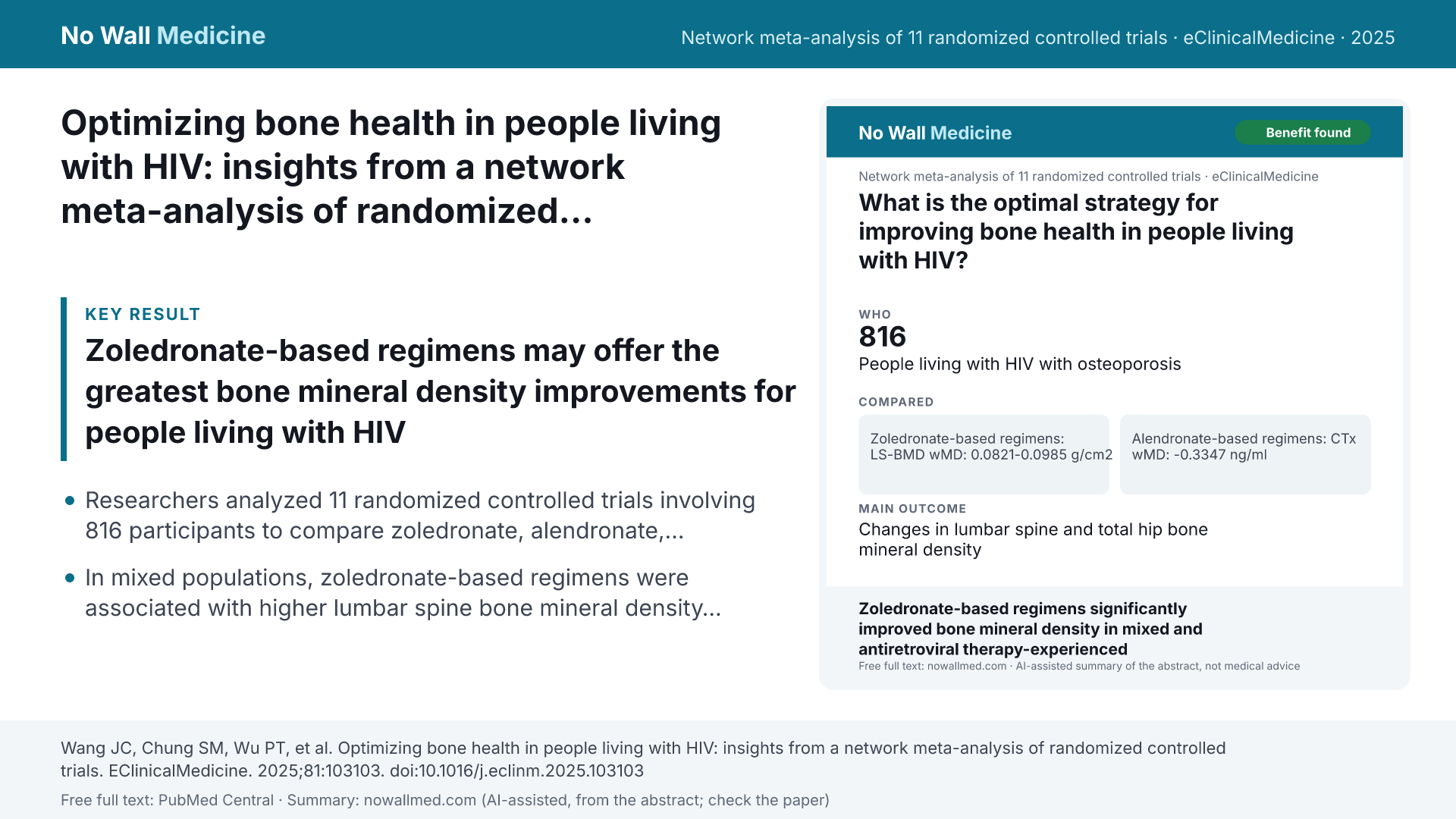
Zoledronate-based regimens may offer the greatest bone mineral density improvements for people living with HIV
Optimizing bone health in people living with HIV: insights from a network meta-analysis of randomized controlled trials
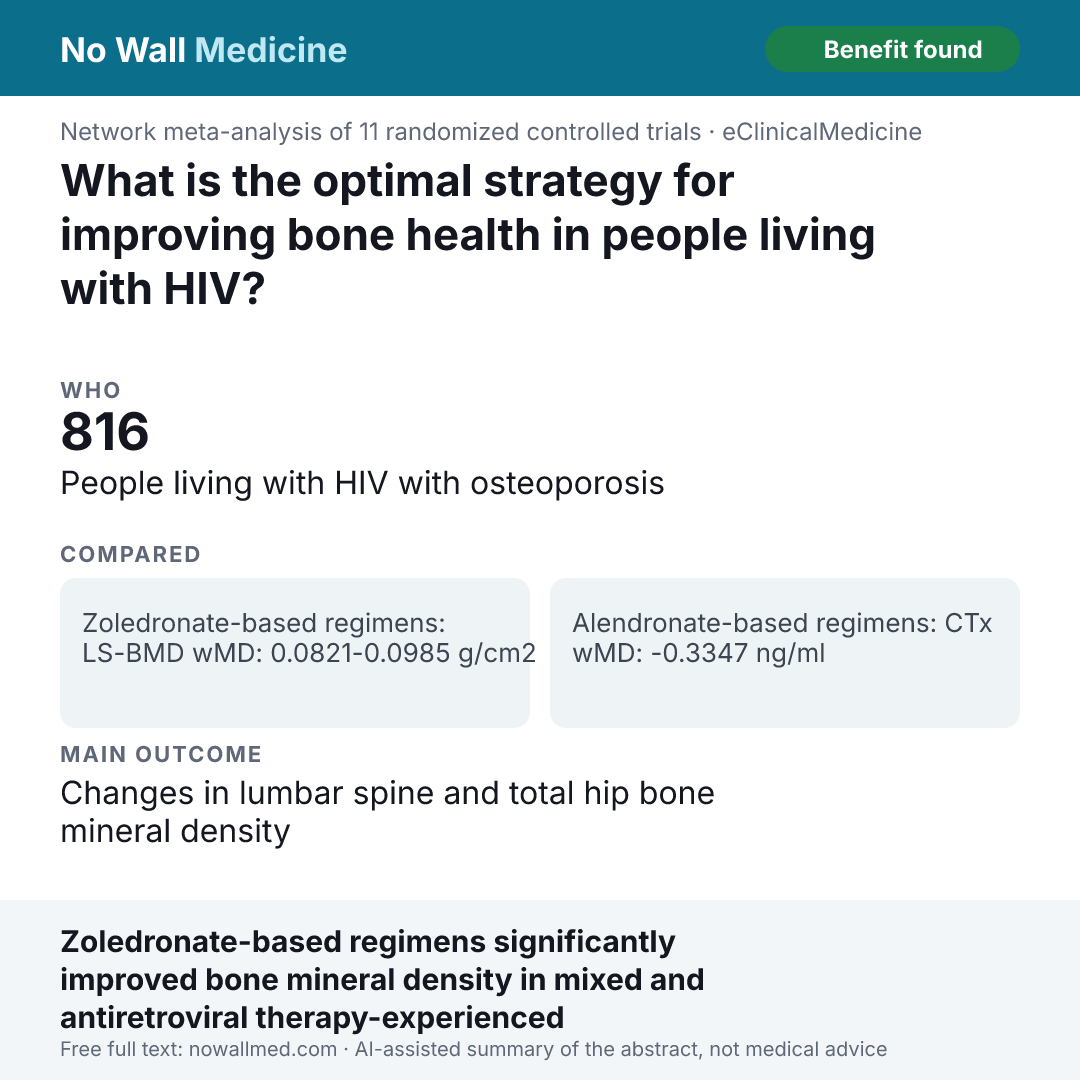
Network meta-analysis of 11 randomized controlled trialsBenefit found
What is the optimal strategy for improving bone health in people living with HIV?
Who
816
People living with HIV with osteoporosis
Compared
Zoledronate-based regimens: LS-BMD wMD: 0.0821-0.0985 g/cm2
Alendronate-based regimens: CTx wMD: -0.3347 ng/ml
Main outcome
Changes in lumbar spine and total hip bone mineral density
Bottom line: Zoledronate-based regimens significantly improved bone mineral density in mixed and antiretroviral therapy-experienced populations.
Limitation: Limited evidence and substantial heterogeneity, especially regarding antiretroviral therapy-naïve individuals.
Funded by: National Science and Technology Council and National Cheng Kung University Hospital
eClinicalMedicine · 2025-02-17 · Save PNG
Clinical question: What is the optimal strategy for improving bone health in people living with HIV?
Why it matters: The optimal strategy for improving bone health in people living with HIV remains unclear due to the impact of HIV and antiretroviral therapy on bone density.
Key points
- Researchers analyzed 11 randomized controlled trials involving 816 participants to compare zoledronate, alendronate, and calcium and vitamin D for osteoporosis.
- In mixed populations, zoledronate-based regimens were associated with higher lumbar spine bone mineral density (wMD: 0.0821-0.0985 g/cm2) and total hip bone mineral density (wMD: 0.0372-0.0606 g/cm2).
- Alendronate-based regimens were associated with the highest reduction in the bone turnover marker C-terminal telopeptide of type 1 collagen (wMD: -0.3347 ng/ml) but did not significantly improve bone mineral density.
Limitation the authors note: The authors noted limited evidence, substantial heterogeneity between populations, and a need for more trials, particularly in individuals who are antiretroviral therapy-naïve.
Headline and key points written with AI from the paper’s abstract, with every number checked against it. Read the paper before relying on them.
Was this summary helpful?
Headline, design, result, key points, caveat and citation as plain text.
Cite this article
Wang JC, Chung SM, Wu PT, et al. Optimizing bone health in people living with HIV: insights from a network meta-analysis of randomized controlled trials. EClinicalMedicine. 2025;81:103103. doi:10.1016/j.eclinm.2025.103103
Spotted a mistake? Suggest a correction