High slowly digestible starch diet reduced glucose fluctuations in people with type 2 diabetes
Optimizing glycemic variability in type 2 diabetes using simple dietary and culinary recommendations to modulate starch digestibility: a randomized controlled trial
Randomized, parallel, single-blind, controlled trialBenefit found
Does a high slowly digestible starch diet improve glycemic variability in type 2 diabetes?
Who
51
Patients with type 2 diabetes with suboptimal control
Compared
High slowly digestible starch diet: β = 30.4 [95% confidence interval (CI): 12.4, 48.5]
Low slowly digestible starch diet
Main outcome
Mean amplitude of glycemic excursions
Result: β = 30.4 [95% confidence interval (CI): 12.4, 48.5]
Bottom line: A high slowly digestible starch diet significantly lowers mean amplitude of glycemic excursions in patients with type 2 diabetes.
Am J Clin Nutr · 2025-10-13Download image
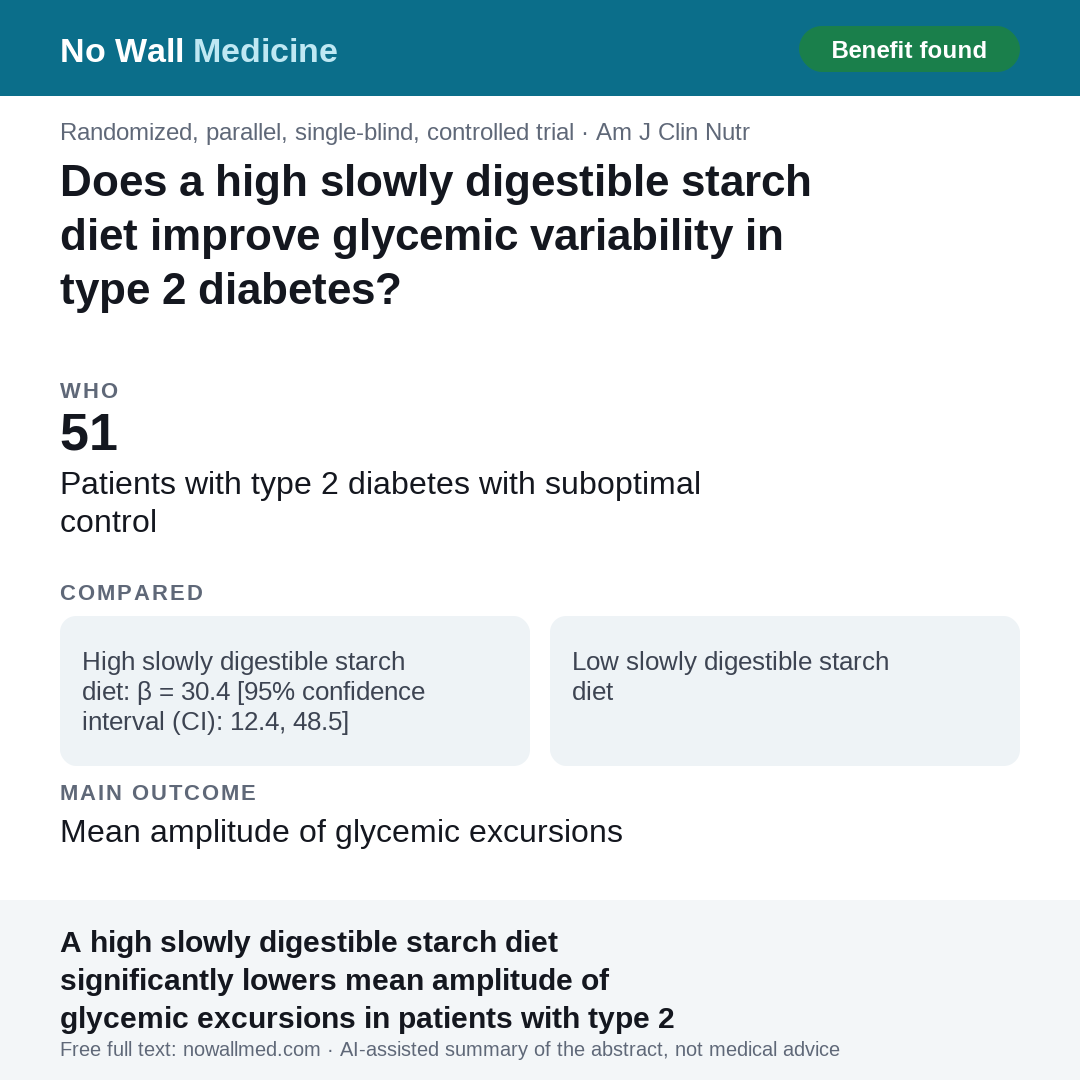
Clinical question: Does a high slowly digestible starch diet improve glycemic variability in type 2 diabetes?
Why it matters: Controlling starch digestibility may help manage glucose fluctuations and cardiovascular risk in patients with type 2 diabetes who have suboptimal blood sugar control.
Key points
- Researchers conducted a 12-week randomized trial with 51 patients with type 2 diabetes to compare a high slowly digestible starch diet against a low slowly digestible starch diet.
- The high slowly digestible starch group showed a significant reduction in the mean amplitude of glycemic excursions, which measures glucose fluctuations, with a value of β = 30.4.
- Both groups saw a decrease in glycated hemoglobin, a measure of long-term blood sugar, though the high slowly digestible starch group showed a trend toward a greater reduction.
Headline and key points written with AI from the paper’s abstract, with every number checked against it. Read the paper before relying on them.
Topics
Cite this article
Chisbert M, Castell AL, Van Den Berghe L, Breyton AE, Feugier N, Cuerq C. Optimizing glycemic variability in type 2 diabetes using simple dietary and culinary recommendations to modulate starch digestibility: a randomized controlled trial. Am J Clin Nutr. 2025. doi:10.1016/j.ajcnut.2025.10.007
Spotted a mistake? Suggest a correction