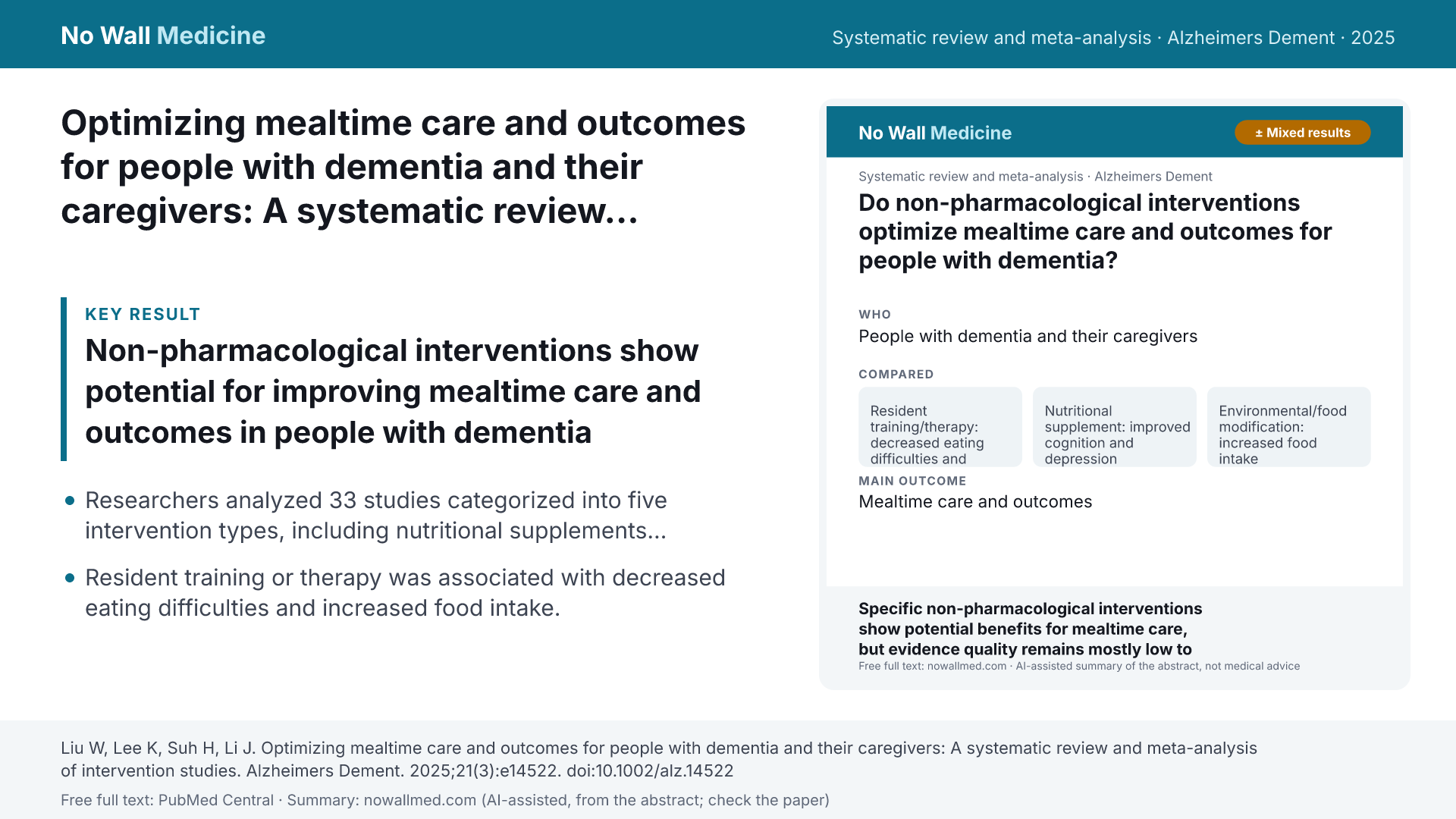
Non-pharmacological interventions show potential for improving mealtime care and outcomes in people with dementia
Optimizing mealtime care and outcomes for people with dementia and their caregivers: A systematic review and meta-analysis of intervention studies
Systematic review and meta-analysisMixed results
Do non-pharmacological interventions optimize mealtime care and outcomes for people with dementia?
Who
People with dementia and their caregivers
Compared
Resident training/therapy: decreased eating difficulties and increased food intake
Nutritional supplement: improved cognition and depression
Environmental/food modification: increased food intake
Main outcome
Mealtime care and outcomes
Bottom line: Specific non-pharmacological interventions show potential benefits for mealtime care, but evidence quality remains mostly low to very low.
Alzheimers Dement · 2025-03-20 · Save PNG
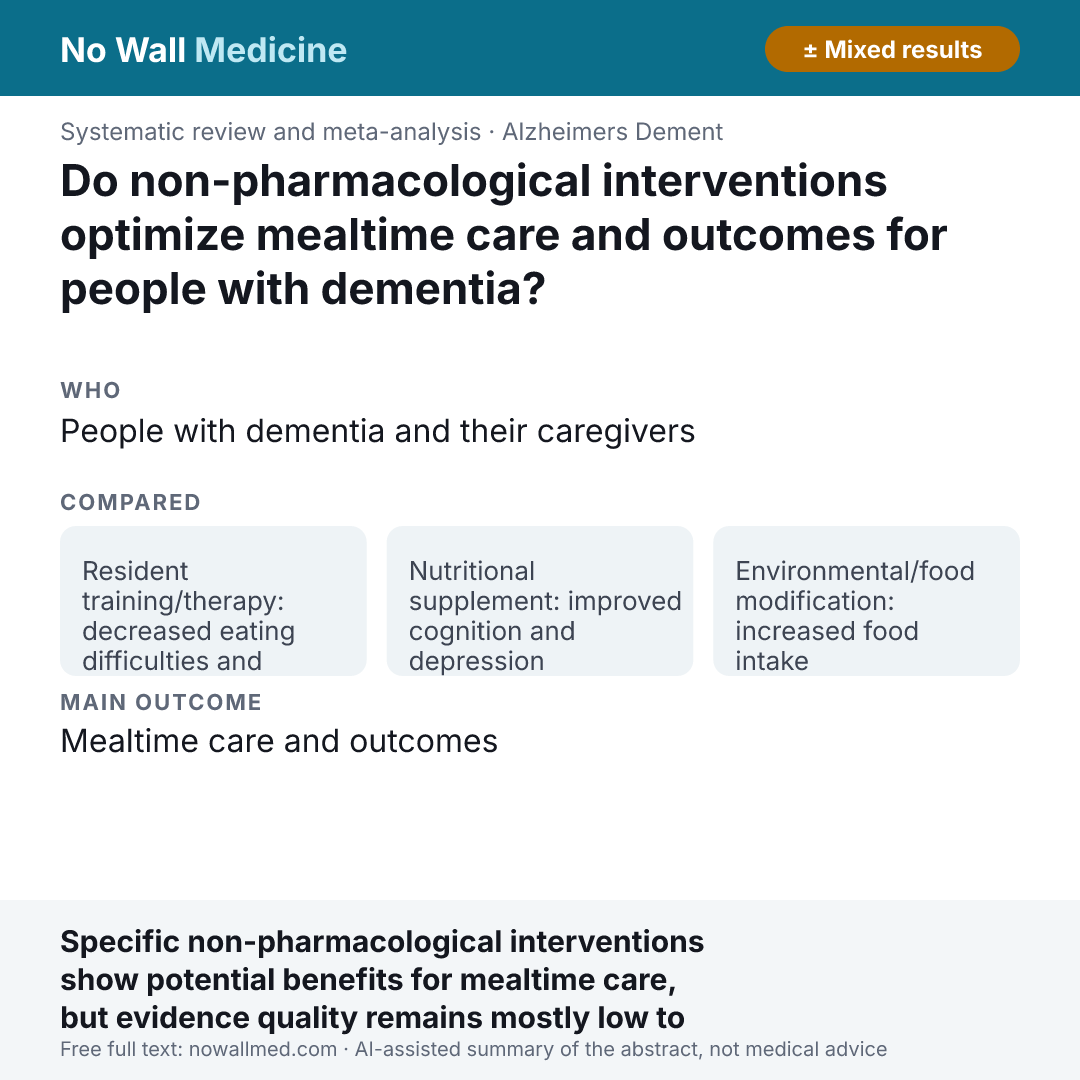
Clinical question: Do non-pharmacological interventions optimize mealtime care and outcomes for people with dementia?
Key points
- Researchers analyzed 33 studies categorized into five intervention types, including nutritional supplements and resident training or therapy.
- Resident training or therapy was associated with decreased eating difficulties and increased food intake.
- Nutritional supplements were associated with improved cognition and depression, while environmental or food modification was associated with increased food intake.
Headline and key points written with AI from the paper’s abstract, with every number checked against it. Read the paper before relying on them.
Was this summary helpful?
Subject terms
Headline, design, result, key points, caveat and citation as plain text.
Cite this article
Liu W, Lee K, Suh H, Li J. Optimizing mealtime care and outcomes for people with dementia and their caregivers: A systematic review and meta-analysis of intervention studies. Alzheimers Dement. 2025;21(3):e14522. doi:10.1002/alz.14522
Spotted a mistake? Suggest a correction