Higher antipsychotic doses were linked to smaller working memory improvements from brain stimulation in schizophrenia
Optimizing tDCS cognitive outcomes in schizophrenia: the role of dopaminergic tone and antipsychotic load
Randomized, double-blind, placebo-controlled trialMixed results
Does antipsychotic dose or profile affect working memory improvements from transcranial direct current stimulation?
Who
120
Clinically stable outpatients with schizophrenia
Compared
Active bifrontal transcranial direct current stimulation
Sham bifrontal transcranial direct current stimulation
Main outcome
Working memory performance using MATRICS Consensus Cognitive Battery
Result: r = -0.197, p = 0.031
Bottom line: Higher antipsychotic doses correlate with diminished working memory gains from transcranial direct current stimulation in schizophrenia.
Transl Psychiatry · 2026-06-12Download image
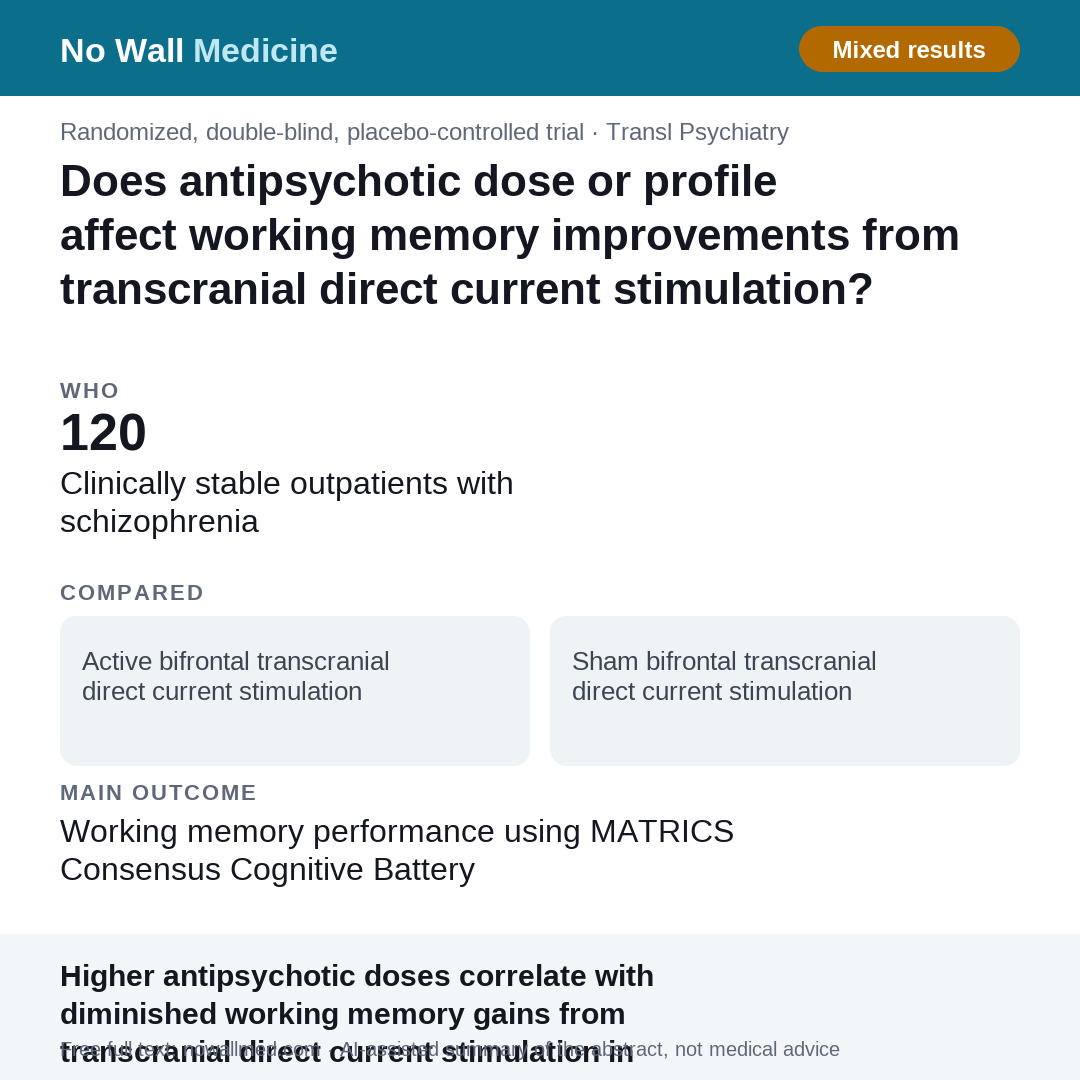
Clinical question: Does antipsychotic dose or profile affect working memory improvements from transcranial direct current stimulation?
Why it matters: The variability in how individuals respond to brain stimulation in schizophrenia is not well understood, specifically regarding how antipsychotic medications might influence these results.
Key points
- Researchers conducted a randomized, double-blind, placebo-controlled trial with 120 clinically stable outpatients receiving either active or sham bifrontal transcranial direct current stimulation (brain stimulation using low electrical currents).
- A significant negative correlation was found between antipsychotic dose and working memory enhancement (r = -0.197, p = 0.031), meaning higher doses were associated with smaller cognitive gains.
- No significant differences in working memory outcomes were found between patients taking full dopamine D2 antagonists versus partial D2 agonists.
Headline and key points written with AI from the paper’s abstract, with every number checked against it. Read the paper before relying on them.
Topics
Cite this article
García-Fernández L, Romero-Ferreiro V, Muñoz-Gualan AP, Cardona-Bejarano S, de Los Santos D, Ripoll Ayús I. Optimizing tDCS cognitive outcomes in schizophrenia: the role of dopaminergic tone and antipsychotic load. Transl Psychiatry. 2026. doi:10.1038/s41398-026-04160-w
Spotted a mistake? Suggest a correction