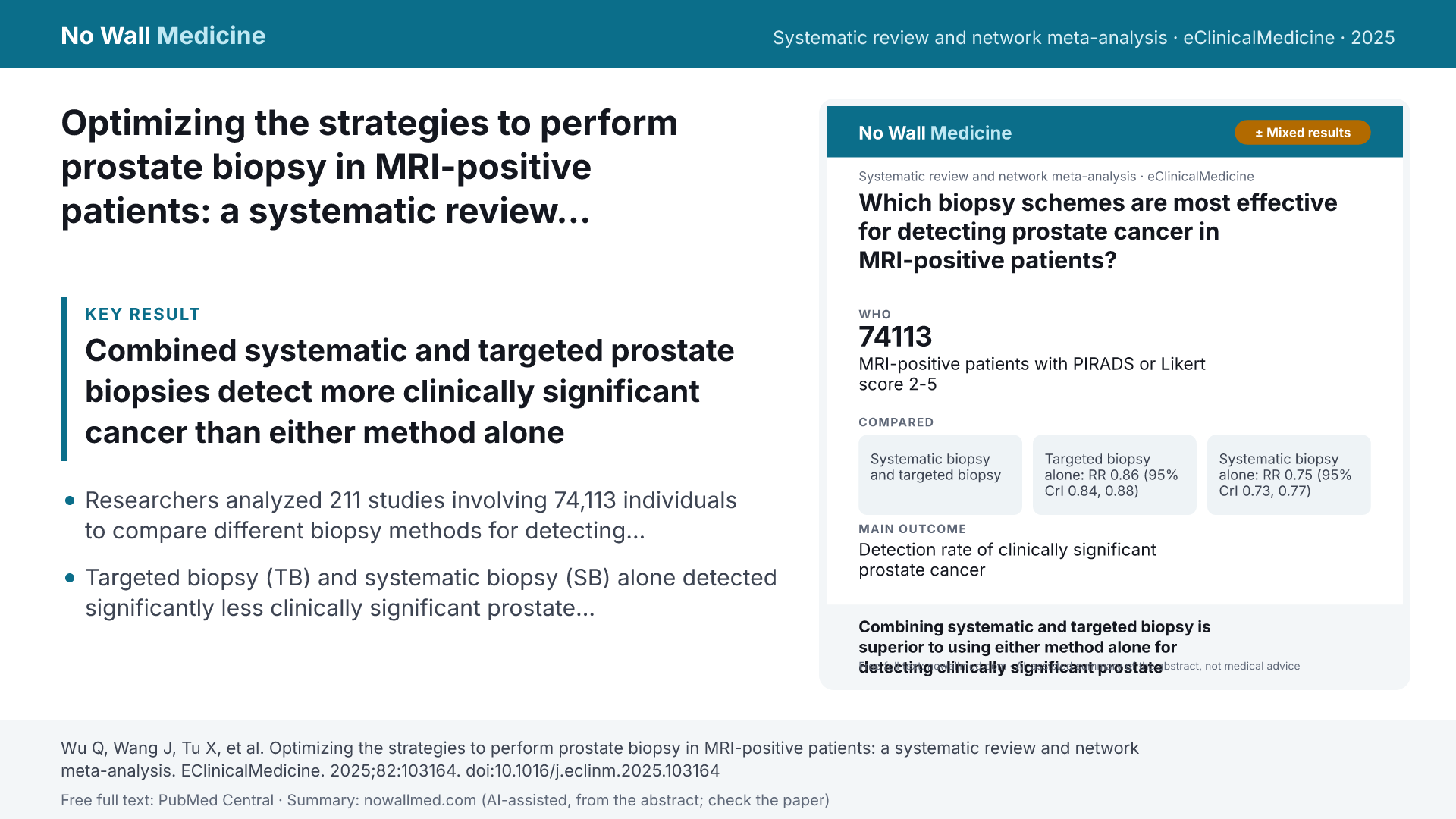
Combined systematic and targeted prostate biopsies detect more clinically significant cancer than either method alone
Optimizing the strategies to perform prostate biopsy in MRI-positive patients: a systematic review and network meta-analysis
Systematic review and network meta-analysisMixed results
Which biopsy schemes are most effective for detecting prostate cancer in MRI-positive patients?
Who
74113
MRI-positive patients with PIRADS or Likert score 2-5
Compared
Systematic biopsy and targeted biopsy
Targeted biopsy alone: RR 0.86 (95% CrI 0.84, 0.88)
Systematic biopsy alone: RR 0.75 (95% CrI 0.73, 0.77)
Main outcome
Detection rate of clinically significant prostate cancer
Bottom line: Combining systematic and targeted biopsy is superior to using either method alone for detecting clinically significant prostate cancer.
Funded by: National Natural Science Foundation of China and Sichuan Province
eClinicalMedicine · 2025-03-22Download image

Clinical question: Which biopsy schemes are most effective for detecting prostate cancer in MRI-positive patients?
Why it matters: Current biopsy strategies may lead to overdiagnosis, creating a need to refine how clinicians detect clinically significant versus clinically insignificant prostate cancer.
Key points
- Researchers analyzed 211 studies involving 74,113 individuals to compare different biopsy methods for detecting prostate cancer in patients with suspicious lesions on magnetic resonance imaging.
- Targeted biopsy (TB) and systematic biopsy (SB) alone detected significantly less clinically significant prostate cancer compared to combining both methods (TB: RR 0.86, 95% CrI 0.84, 0.88; SB: RR 0.75, 95% CrI 0.73, 0.77).
- Ipsilateral systematic biopsy with targeted biopsy and saturation targeted biopsy were associated with decreased detection of clinically insignificant prostate cancer.
Headline and key points written with AI from the paper’s abstract, with every number checked against it. Read the paper before relying on them.
Was this summary helpful?
Cite this article
Wu Q, Wang J, Tu X, Chen B, Jiang J, Ye J. Optimizing the strategies to perform prostate biopsy in MRI-positive patients: a systematic review and network meta-analysis. eClinicalMedicine. 2025. doi:10.1016/j.eclinm.2025.103164
Spotted a mistake? Suggest a correction
Top studies every Monday
The week’s key trials and guidelines in your specialties, plus any topics you follow. By email, free.
Get the weekly digest