Optimizing the use of twitter for research dissemination: The "Three Facts and a Story" randomized-controlled trial
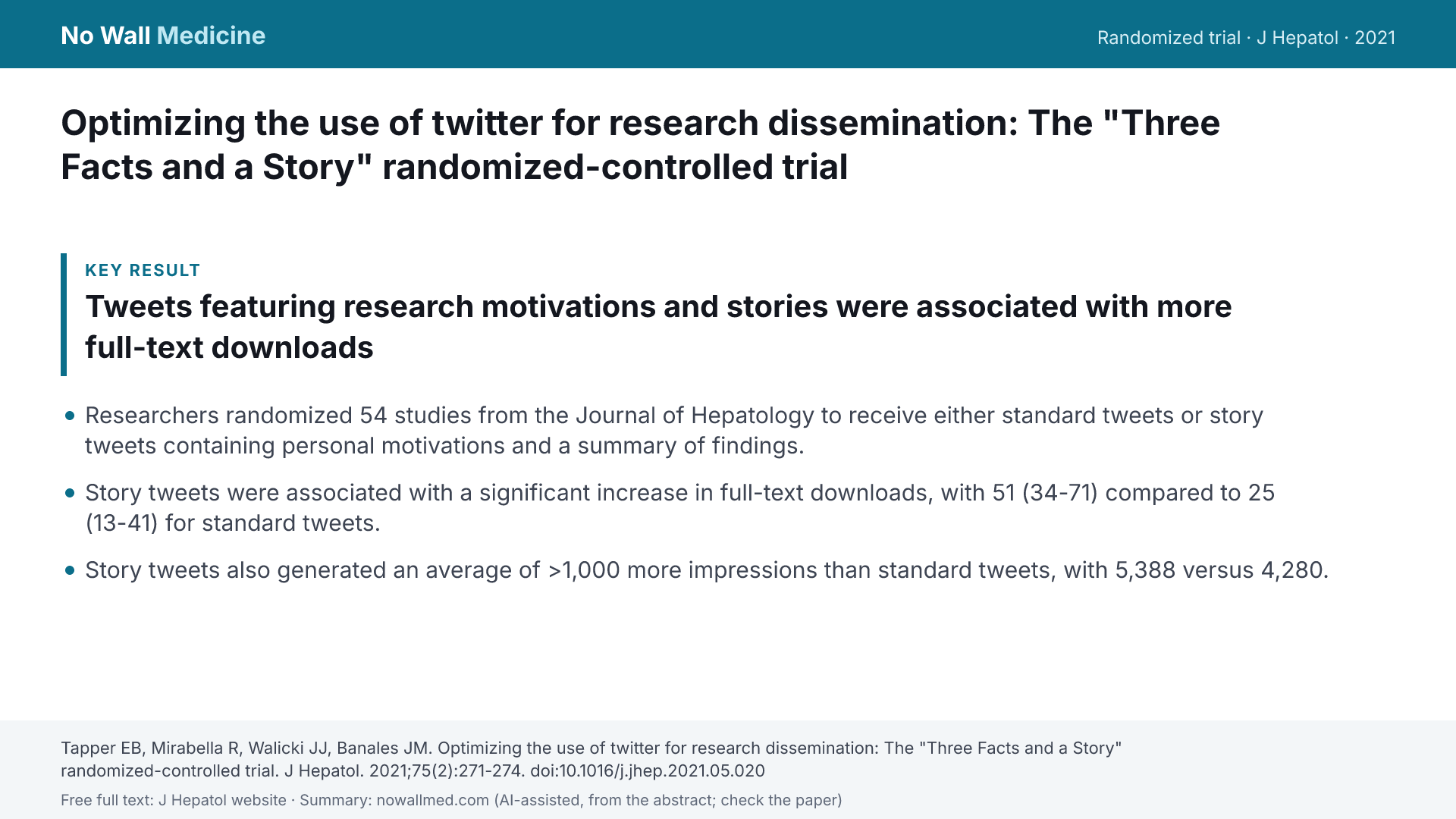
Key result: Tweets featuring research motivations and stories were associated with more full-text downloads
Key points
- Researchers randomized 54 studies from the Journal of Hepatology to receive either standard tweets or story tweets containing personal motivations and a summary of findings.
- Story tweets were associated with a significant increase in full-text downloads, with 51 (34-71) compared to 25 (13-41) for standard tweets.
- Story tweets also generated an average of >1,000 more impressions than standard tweets, with 5,388 versus 4,280.
Limitation the authors note: Five studies randomized to story tweets crossed over to standard tweets because authors did not participate.
Discussion prompts
- Would these patients look like yours? Who was left out?
- Is the main outcome one that matters to patients?
- Is the difference large enough to change what you do?
Cite: Tapper EB, Mirabella R, Walicki JJ, Banales JM. Optimizing the use of twitter for research dissemination: The "Three Facts and a Story" randomized-controlled trial. J Hepatol. 2021;75(2):271-274. doi:10.1016/j.jhep.2021.05.020
Free full text: J Hepatol website · Summary and visual abstract: nowallmed.com/a/optimizing-the-use-of-twitter-for-research-dissemination-the-three-1393fm0/ (AI-assisted from the abstract; check the paper before relying on it).