Intervention design and content features influence the effectiveness of workplace digital mental health tools
Optimizing Workplace Digital Mental Health Interventions: Systematic Review and Meta-Analysis
Systematic review and Bayesian multilevel meta-regressionBenefit found
Do intervention design, therapeutic approaches, and content features associate with greater digital mental health intervention efficacy?
Who
25,500
Employed adults · 4 electronic databases
Compared
Depression: θ=0.167 (95% credible interval -0.31 to -0.03)
Anxiety: θ=-0.211 (95% CI -0.36 to -0.07)
Stress: θ=-0.165 (95% CI -0.28 to -0.05)
Main outcome
Standardized measures of depression, anxiety, or stress
Bottom line: Workplace digital mental health interventions show small significant benefits, with efficacy influenced by therapeutic approach, design, and content features.
Limitation: 71 trials had high risk bias due to waitlist controls and inability to blind participants.
J Med Internet Res · 2025-11-17Download image
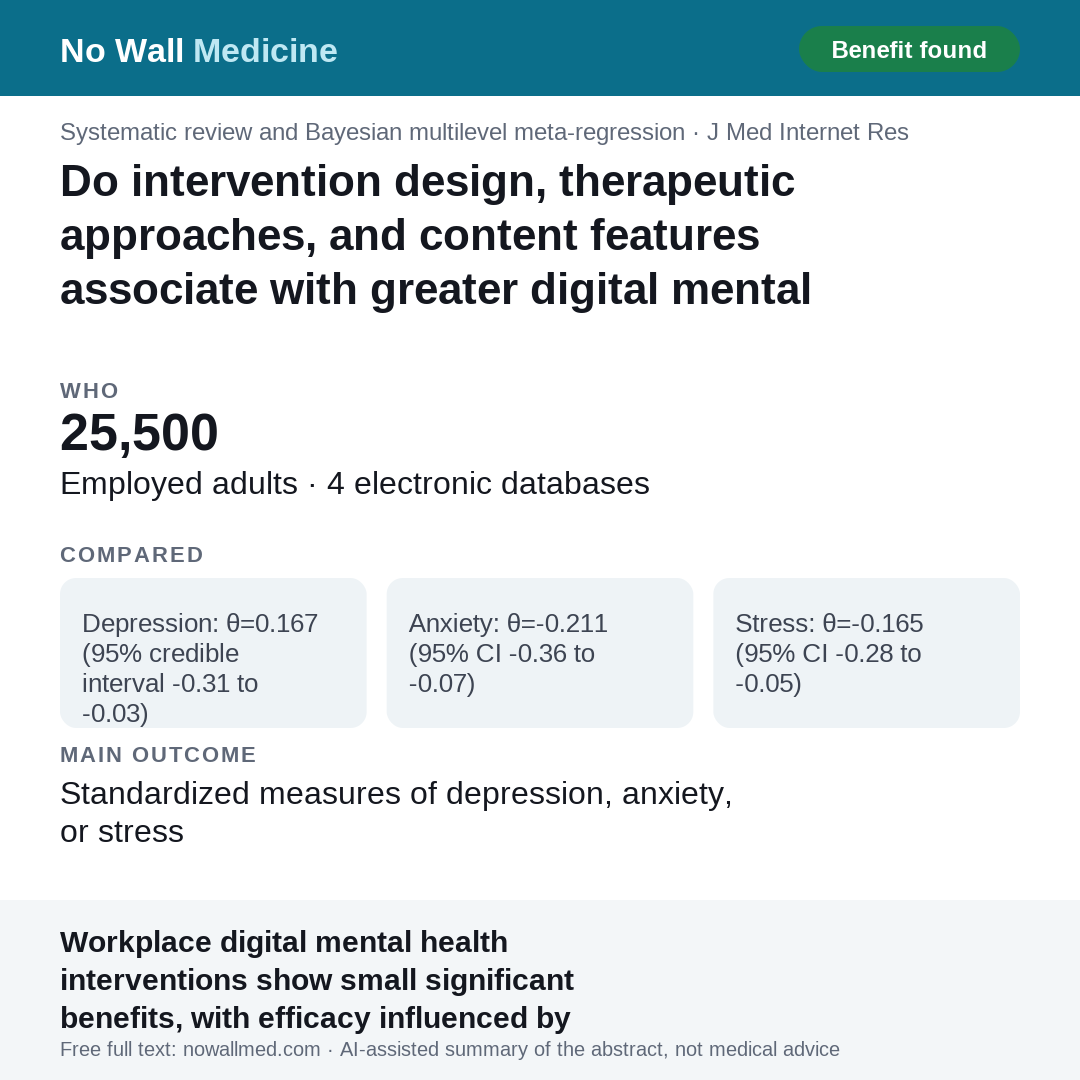
Clinical question: Do intervention design, therapeutic approaches, and content features associate with greater digital mental health intervention efficacy?
Why it matters: There is no systematic evaluation of how different content and design features in digital mental health interventions compare regarding their effectiveness in the workplace.
Key points
- Researchers analyzed 81 randomized controlled trials involving 25,500 participants to evaluate 98 different digital mental health interventions for depression, anxiety, and stress.
- Mindfulness and stress management approaches were more effective than cognitive behavioral therapy for anxiety and stress, while video content and person support also enhanced benefits.
- A high risk of bias was found in 71 trials (82.70%) due to the use of waitlist controls and the inability to blind participants.
Limitation the authors note: A large majority of the included trials had a high risk of bias because participants could not be blinded and many used waitlist controls.
Headline and key points written with AI from the paper’s abstract, with every number checked against it. Read the paper before relying on them.
Topics
Cite this article
Stratton E, Morris RW, Milton A, Deady M, Choi I, Glozier N. Optimizing Workplace Digital Mental Health Interventions: Systematic Review and Meta-Analysis. J Med Internet Res. 2025. doi:10.2196/71253
Spotted a mistake? Suggest a correction