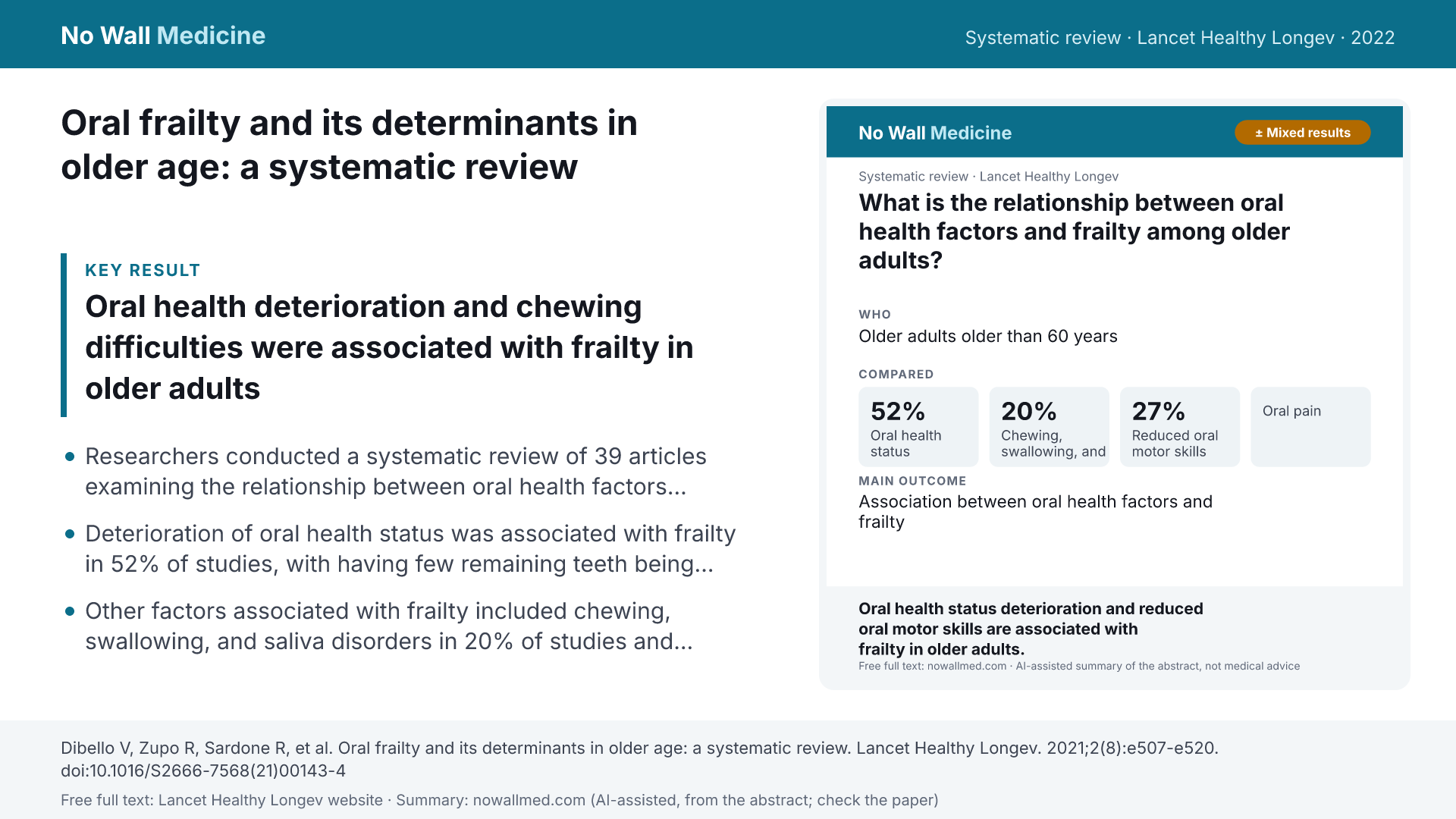
Oral health deterioration and chewing difficulties were associated with frailty in older adults
Oral frailty and its determinants in older age: a systematic review
Systematic reviewMixed results
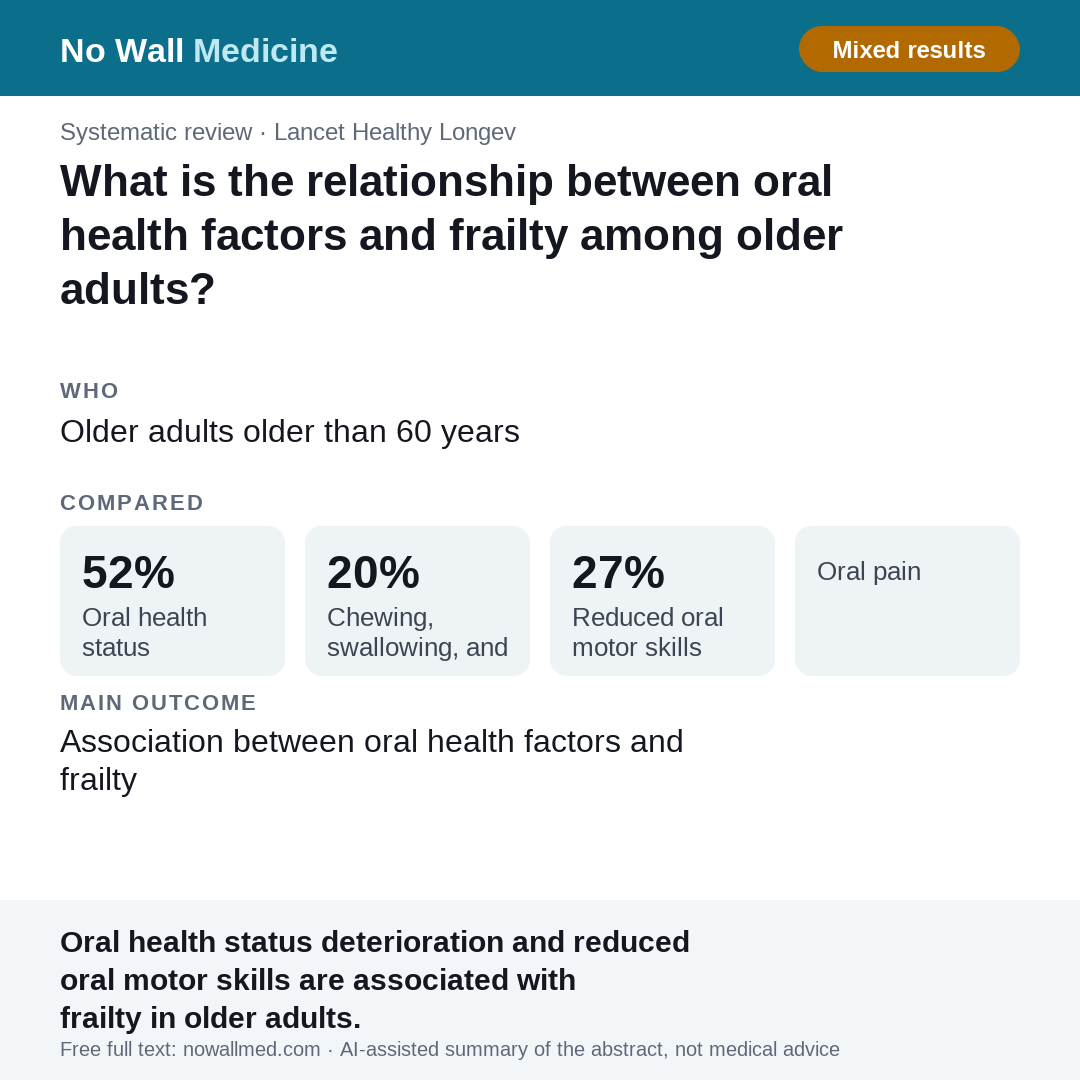
What is the relationship between oral health factors and frailty among older adults?
Who
Older adults older than 60 years
Compared
52%Oral health status deterioration
20%Chewing, swallowing, and saliva disorders
27%Reduced oral motor skills
Oral pain
Main outcome
Association between oral health factors and frailty
Bottom line: Oral health status deterioration and reduced oral motor skills are associated with frailty in older adults.
Lancet Healthy Longev · 2022-09-13Download image
Clinical question: What is the relationship between oral health factors and frailty among older adults?
Why it matters: It was unknown how specific oral health factors relate to the development of frailty in older populations.
Key points
- Researchers conducted a systematic review of 39 articles examining the relationship between oral health factors and frailty in adults over 60 years old.
- Deterioration of oral health status was associated with frailty in 52% of studies, with having few remaining teeth being linked to frailty in 29%.
- Other factors associated with frailty included chewing, swallowing, and saliva disorders in 20% of studies and reduced oral motor skills in 27%.
Headline and key points written with AI from the paper’s abstract, with every number checked against it. Read the paper before relying on them.
Was this summary helpful?
Abstract
Poor oral health is common among older adults and can impair essential activities of daily living and contribute to frailty. We did a systematic review of studies on the relationship between oral health factors and frailty among older adults (>60 years), consulting six different electronic databases for studies published from database inception to March 20, 2021. In total, 39 articles met the eligibility requirements, including 12 different indicators of poor oral health related to frailty, which we grouped in four different categories: oral health status deterioration; deterioration of oral motor skills; chewing, swallowing, and saliva disorders; and oral pain. Factors of oral health status deterioration (52%), in particular few remaining teeth (29%), were most frequently associated with frailty. Reduced oral motor skills (27%), especially masticatory function (9%), oral diadochokinesis (5%), occlusal force (7%), and chewing, swallowing, and saliva disorders (20%), especially chewing difficulties [11%]), were less frequent but were similarly considered to be associated with frailty. Our findings could help to assess the contribution of each oral health item to a possible operational definition of this novel frailty phenotype, defined as an age-related gradual loss of oral function together with a decline in cognitive and physical functions.
Abstract reproduced under the article’s CC BY NC ND licence.
Subject terms
Cite this article
Dibello V, Zupo R, Sardone R, Lozupone M, Castellana F, Dibello A. Oral frailty and its determinants in older age: a systematic review. Lancet Healthy Longev. 2022. doi:10.1016/S2666-7568(21)00143-4
Spotted a mistake? Suggest a correction
Top studies every Monday
The week’s key trials and guidelines in your specialties, plus any topics you follow. By email, free.
Get the weekly digest