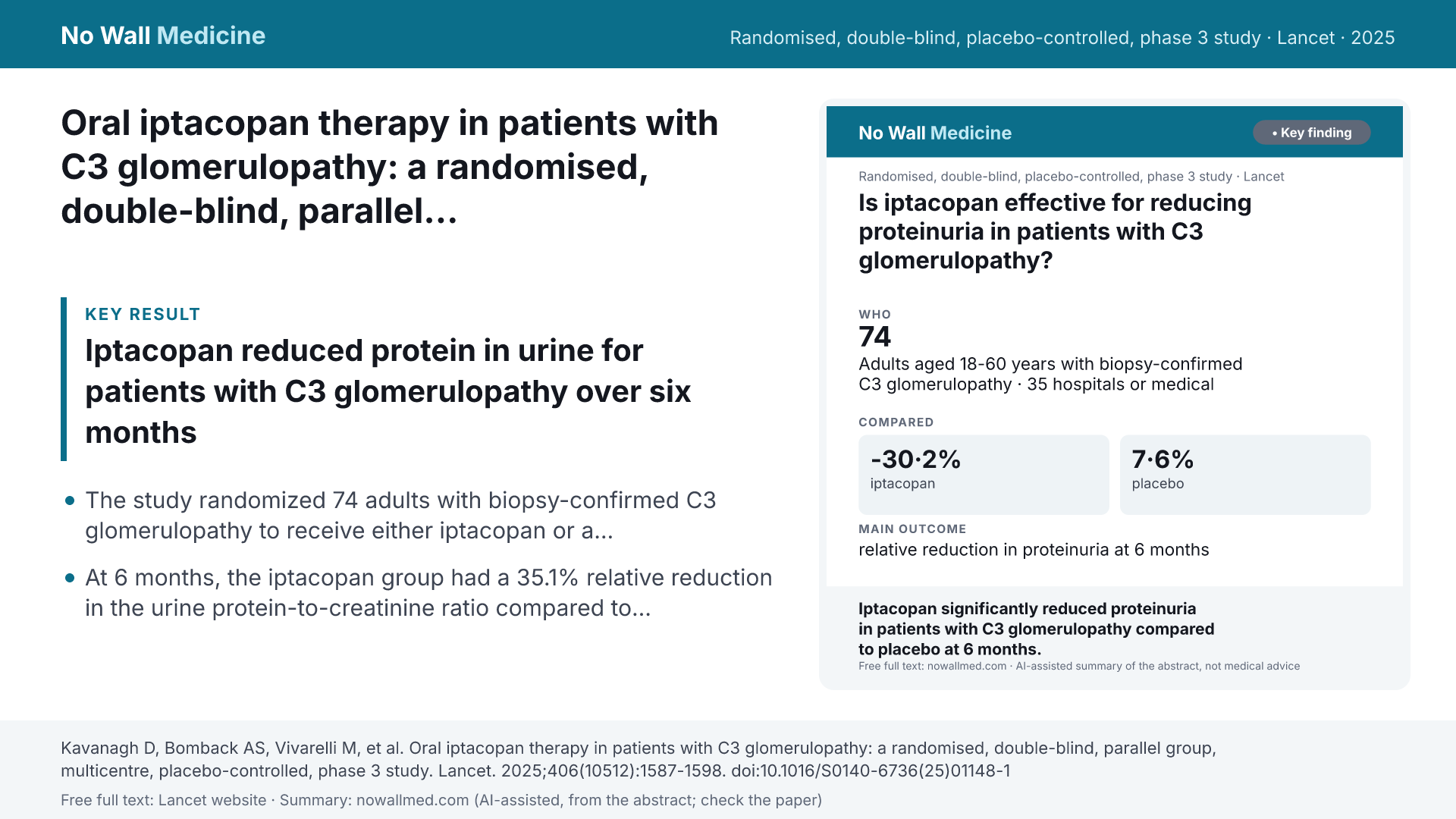
Iptacopan reduced protein in urine for patients with C3 glomerulopathy over six months
Oral iptacopan therapy in patients with C3 glomerulopathy: a randomised, double-blind, parallel group, multicentre, placebo-controlled, phase 3 study
Randomised, double-blind, placebo-controlled, phase 3 studyKey finding
Is iptacopan effective for reducing proteinuria in patients with C3 glomerulopathy?
Who
74
Adults aged 18-60 years with biopsy-confirmed C3 glomerulopathy · 35 hospitals or medical centres in 18 countries
Compared
-30·2%iptacopan (95% CI -42·8 to -14·8)
7·6%placebo (-11·9 to 31·3)
Main outcome
relative reduction in proteinuria at 6 months
Result: 35·1% (13·8 to 51·1; p=0·0014)
Bottom line: Iptacopan significantly reduced proteinuria in patients with C3 glomerulopathy compared to placebo at 6 months.
Funded by: Novartis Pharma
Lancet · 2025-09-25 · Save PNG
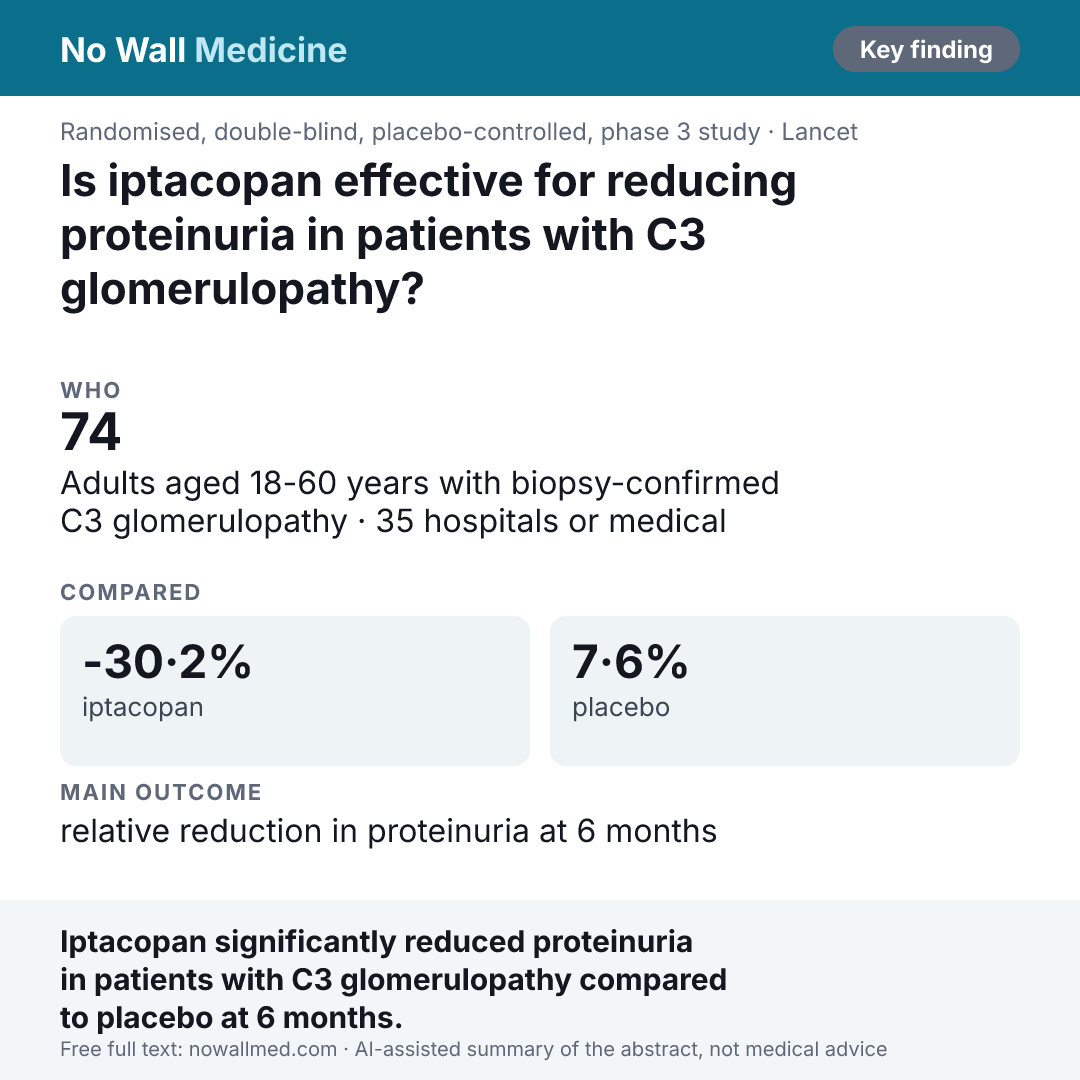
Clinical question: Is iptacopan effective for reducing proteinuria in patients with C3 glomerulopathy?
Why it matters: C3 glomerulopathy is an ultra-rare kidney disease caused by overactivation of the alternative complement pathway, and effective treatments are needed.
Key points
- The study randomized 74 adults with biopsy-confirmed C3 glomerulopathy to receive either iptacopan or a placebo alongside standard supportive care.
- At 6 months, the iptacopan group had a 35.1% relative reduction in the urine protein-to-creatinine ratio compared to the placebo group.
- Treatment-emergent adverse events occurred in 79% of the iptacopan group and 67% of the placebo group, though most were mild or moderate.
Headline and key points written with AI from the paper’s abstract, with every number checked against it. Read the paper before relying on them.
Was this summary helpful?
Abstract
Background
C3 glomerulopathy is an ultra-rare, severe form of glomerulonephritis caused by overactivation of the alternative complement pathway. We aimed to assess efficacy and safety of iptacopan (LNP023), an oral, proximal complement inhibitor that targets factor B to selectively inhibit the alternative pathway of the complement cascade. Methods
APPEAR-C3G was a multicentre, randomised, double-blind, placebo-controlled, phase 3 study of iptacopan versus placebo (both in addition to supportive care [renin-angiotensin-aldosterone system (RAAS) inhibitors] and immunosuppression). Adult participants (aged 18-60 years) with biopsy-confirmed C3 glomerulopathy were enrolled from 35 hospitals or medical centres in 18 countries. Inclusion criteria included reduced serum C3 concentration (ie, <77 mg/dL [defined as <0·85 × lower limit of the central laboratory normal range]) at screening, urine protein-creatinine ratio (UPCR) of 1·0 g/g or higher at day -75 and day -15 before randomisation, estimated glomerular filtration rate (eGFR) of 30 mL/min per 1·73 m2 or higher at screening and day -15, and vaccination against Neisseria meningitidis and Streptococcus pneumoniae. All eligible participants were randomised 1:1 via interactive response technology to either the iptacopan or the placebo group, stratified by treatment with corticosteroids, mycophenolic acid, or both (yes or no). During the 6-month double-blind period, participants orally received either iptacopan 200 mg twice daily or placebo; this was followed by a 6-month open-label period in which all participants received iptacopan 200 mg twice daily. The primary endpoint was relative reduction in proteinuria (measured by log-transformed ratio to baseline in UPCR sampled from a 24-h urine collection) at 6 months. The primary analyses were done in the full analysis set (ie, all participants to whom study treatment was assigned by randomisation); all participants who received at least one dose of study treatment were included in the safety analysis. This trial was registered with ClinicalTrials.gov (NCT04817618) and the adult cohort has been completed. Findings
Between July 28, 2021, and Feb 15, 2023, 132 participants were screened, of whom 58 did not complete the screening period and 74 (64% male; 69% White) were randomised 1:1 to receive either iptacopan (n=38) or placebo (n=36). One participant in the placebo group discontinued treatment during the open-label period. The 24-h UPCR percentage change relative to baseline at 6 months was -30·2% (95% CI -42·8 to -14·8) in the iptacopan group and 7·6% (-11·9 to 31·3) in the placebo group. In the iptacopan group, the geometric mean of 24-h UPCR was 3·33 g/g (95% CI 2·79 to 3·97) at baseline and 2·17 g/g (1·62 to 2·91) at 6 months; in the placebo group, this was 2·58 g/g (2·18 to 3·05) at baseline and 2·80 g/g (2·37 to 3·30) at 6 months. The primary endpoint was met with a relative reduction in 24-h UPCR at 6 months for iptacopan versus placebo of 35·1% (13·8 to 51·1; p=0·0014). 30 (79%) of 38 participants in the iptacopan group had treatment-emergent adverse events, compared with 24 (67%) of 36 participants in the placebo group; most of these were of mild or moderate severity. There were no deaths, no treatment discontinuations due to treatment-emergent adverse events, and no meningococcal infections. Serious adverse events were reported in three (8%) participants in the iptacopan group and one (3%) participant in the placebo group. Interpretation
Iptacopan showed a statistically significant, clinically meaningful proteinuria reduction in addition to RAAS inhibitors and immunosuppression at 6 months. Iptacopan was well tolerated with an acceptable safety profile in patients with C3 glomerulopathy. Funding
Novartis Pharma.
Abstract reproduced under the article’s CC BY licence.
Subject terms
Headline, design, result, key points, caveat and citation as plain text.
Cite this article
Kavanagh D, Bomback AS, Vivarelli M, et al. Oral iptacopan therapy in patients with C3 glomerulopathy: a randomised, double-blind, parallel group, multicentre, placebo-controlled, phase 3 study. Lancet. 2025;406(10512):1587-1598. doi:10.1016/S0140-6736(25)01148-1
Spotted a mistake? Suggest a correction