Oral Prolonged-Release Ketamine for Treatment-Resistant Depression: Two Randomized Clinical Trials
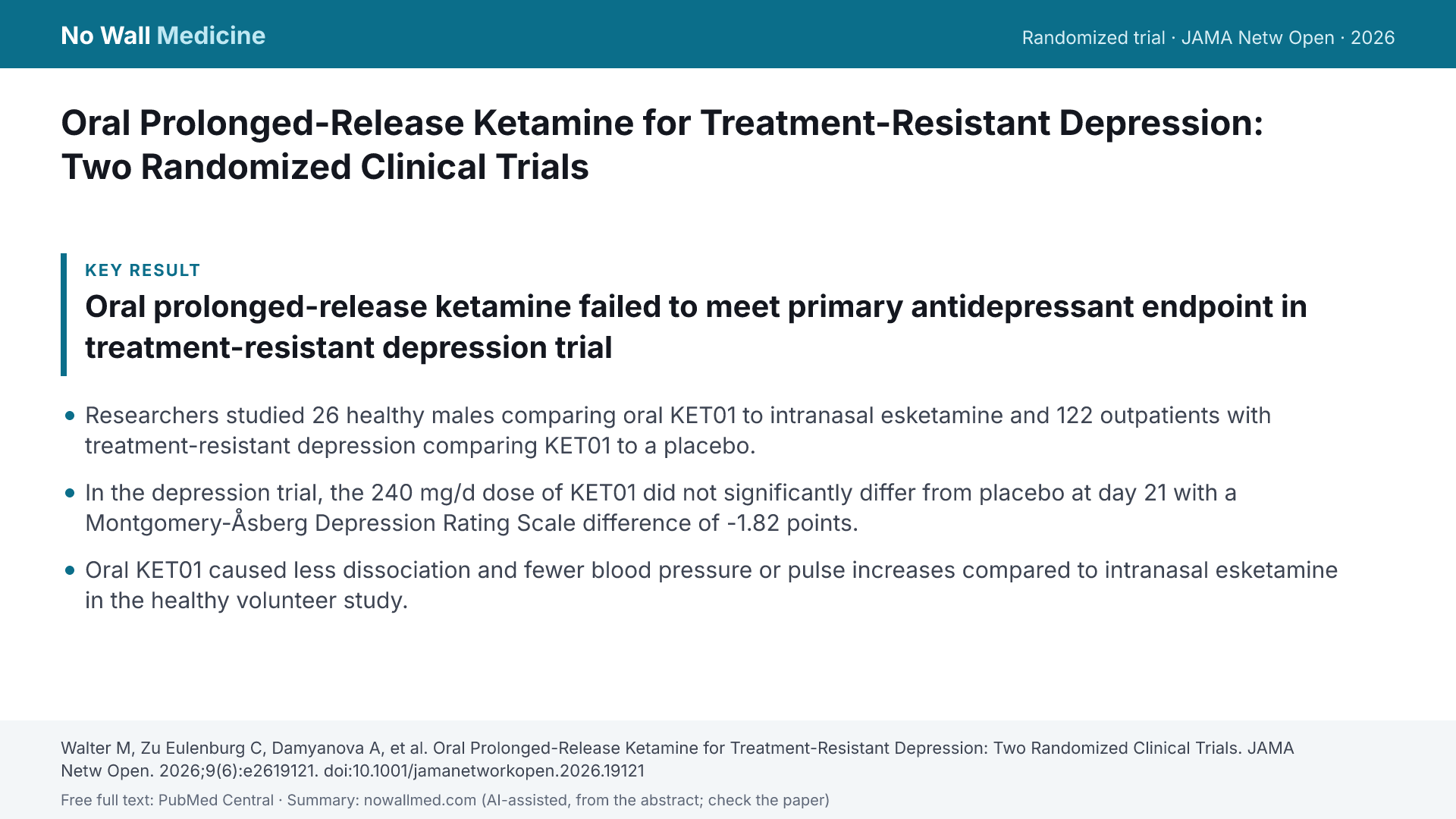
Key result: Oral prolonged-release ketamine failed to meet primary antidepressant endpoint in treatment-resistant depression trial
Key points
- Researchers studied 26 healthy males comparing oral KET01 to intranasal esketamine and 122 outpatients with treatment-resistant depression comparing KET01 to a placebo.
- In the depression trial, the 240 mg/d dose of KET01 did not significantly differ from placebo at day 21 with a Montgomery-Åsberg Depression Rating Scale difference of -1.82 points.
- Oral KET01 caused less dissociation and fewer blood pressure or pulse increases compared to intranasal esketamine in the healthy volunteer study.
Why it matters: Current ketamine-based treatments for depression are associated with side effects like dissociation and cardiovascular issues.
Discussion prompts
- Would these patients look like yours? Who was left out?
- Is the main outcome one that matters to patients?
- Is the difference large enough to change what you do?
Cite: Walter M, Zu Eulenburg C, Damyanova A, et al. Oral Prolonged-Release Ketamine for Treatment-Resistant Depression: Two Randomized Clinical Trials. JAMA Netw Open. 2026;9(6):e2619121. doi:10.1001/jamanetworkopen.2026.19121
Free full text: PubMed Central · Summary and visual abstract: nowallmed.com/a/oral-prolonged-release-ketamine-for-treatment-resistant-depression-1s5p5rq/ (AI-assisted from the abstract; check the paper before relying on it).