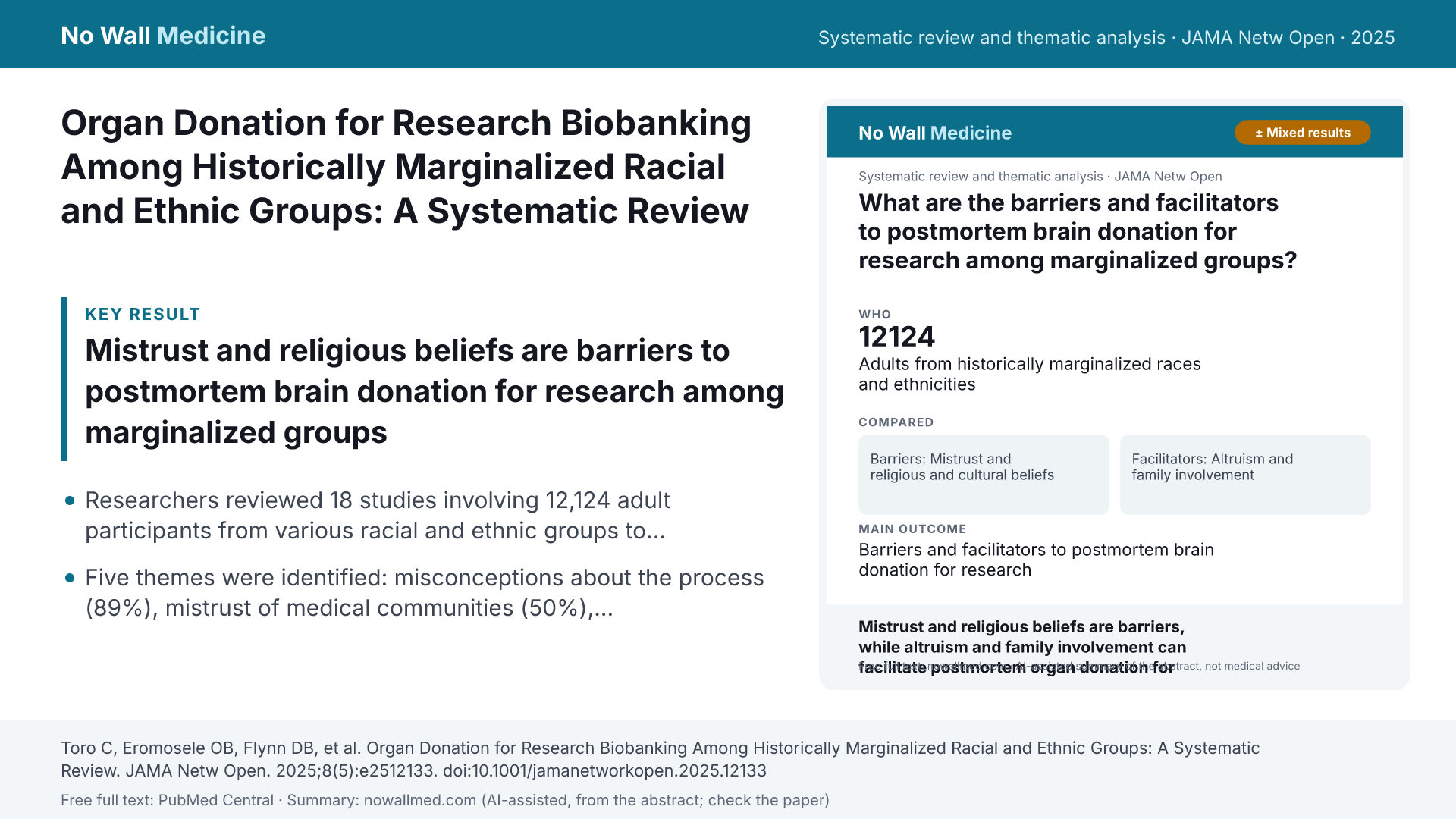
Mistrust and religious beliefs are barriers to postmortem brain donation for research among marginalized groups
Organ Donation for Research Biobanking Among Historically Marginalized Racial and Ethnic Groups: A Systematic Review
General MedicineAdult and pediatric
Systematic review and thematic analysisMixed results
What are the barriers and facilitators to postmortem brain donation for research among marginalized groups?
Who
12124
Adults from historically marginalized races and ethnicities
Compared
Barriers: Mistrust and religious and cultural beliefs
Facilitators: Altruism and family involvement
Main outcome
Barriers and facilitators to postmortem brain donation for research
Bottom line: Mistrust and religious beliefs are barriers, while altruism and family involvement can facilitate postmortem organ donation for research.
JAMA Netw Open · 2025-05-01 · Save PNG
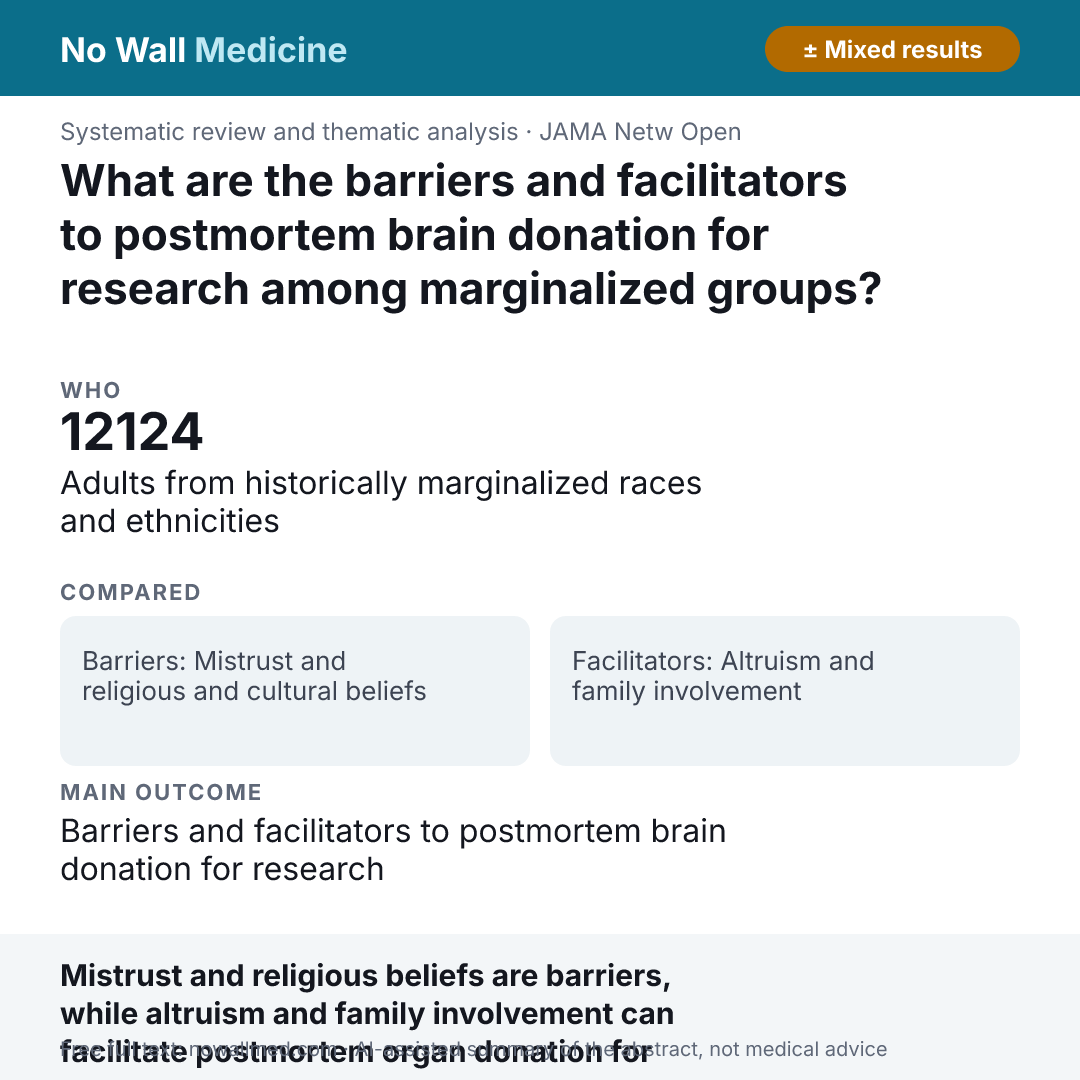
Clinical question: What are the barriers and facilitators to postmortem brain donation for research among marginalized groups?
Why it matters: Research biobanks lack tissues from diverse populations, which limits how well findings can be applied to different races and ethnicities.
Key points
- Researchers reviewed 18 studies involving 12,124 adult participants from various racial and ethnic groups to identify factors influencing postmortem brain donation for research.
- Five themes were identified: misconceptions about the process (89%), mistrust of medical communities (50%), family involvement (50%), religious or cultural beliefs (50%), and altruism (39%).
- Mistrust and religious or cultural beliefs were linked to barriers in considering donation, while altruism and family involvement acted as facilitators or barriers.
Headline and key points written with AI from the paper’s abstract, with every number checked against it. Read the paper before relying on them.
Was this summary helpful?
Subject terms
Headline, design, result, key points, caveat and citation as plain text.
Cite this article
Toro C, Eromosele OB, Flynn DB, et al. Organ Donation for Research Biobanking Among Historically Marginalized Racial and Ethnic Groups: A Systematic Review. JAMA Netw Open. 2025;8(5):e2512133. doi:10.1001/jamanetworkopen.2025.12133
Spotted a mistake? Suggest a correction