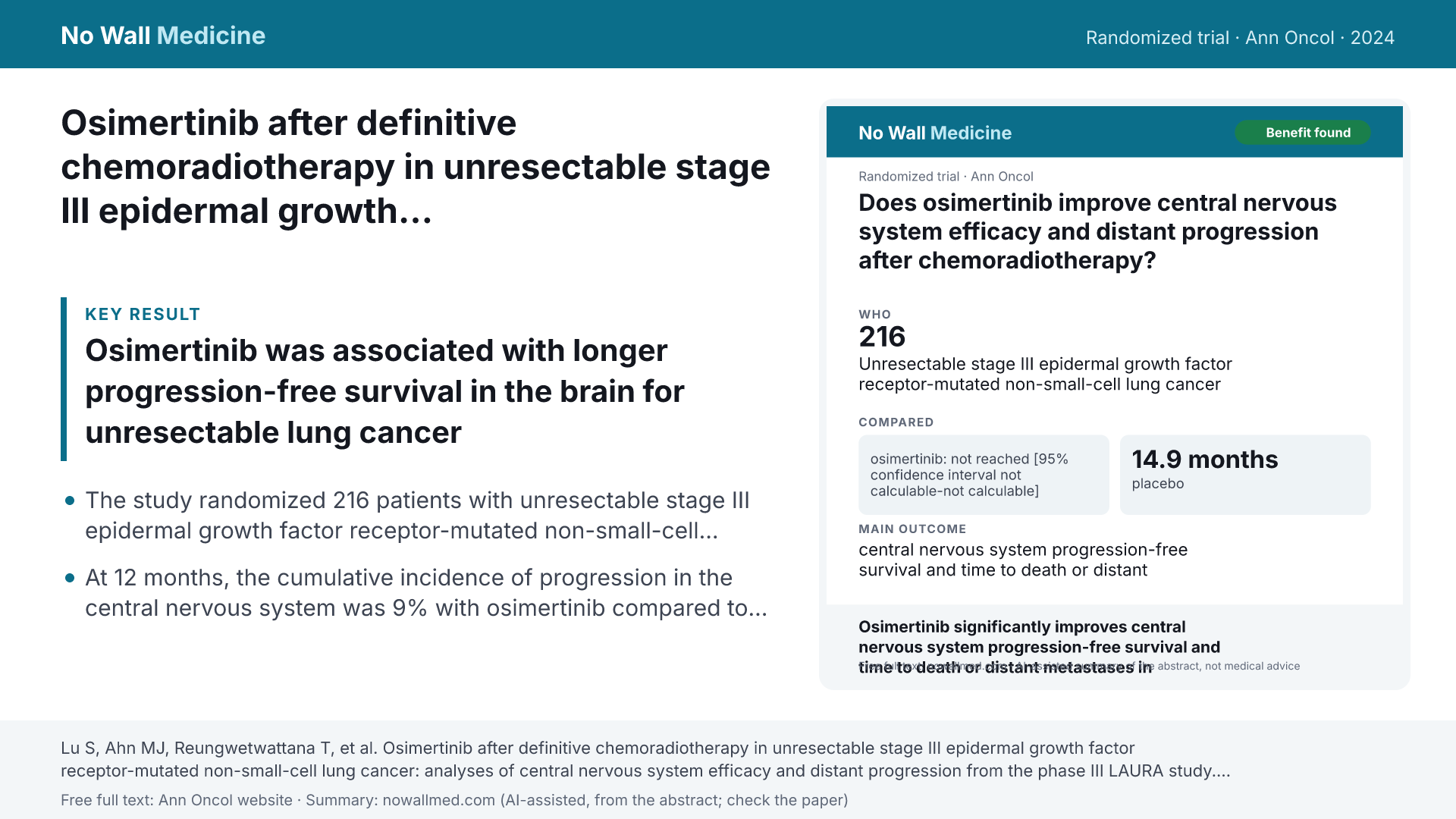
Osimertinib was associated with longer progression-free survival in the brain for unresectable lung cancer
Osimertinib after definitive chemoradiotherapy in unresectable stage III epidermal growth factor receptor-mutated non-small-cell lung cancer: analyses of central nervous system efficacy and distant progression from the phase III LAURA study
Randomized trialBenefit found
Does osimertinib improve central nervous system efficacy and distant progression after chemoradiotherapy?
Who
216
Unresectable stage III epidermal growth factor receptor-mutated non-small-cell lung cancer
Compared
osimertinib: not reached [95% confidence interval not calculable-not calculable]
14.9 monthsplacebo (95% CI 7.4 months-NC)
Main outcome
central nervous system progression-free survival and time to death or distant metastases
Result: hazard ratio 0.17 (95% CI 0.09-0.32)
Bottom line: Osimertinib significantly improves central nervous system progression-free survival and time to death or distant metastases in unresectable stage III lung cancer.
Ann Oncol · 2024-09-16Download image
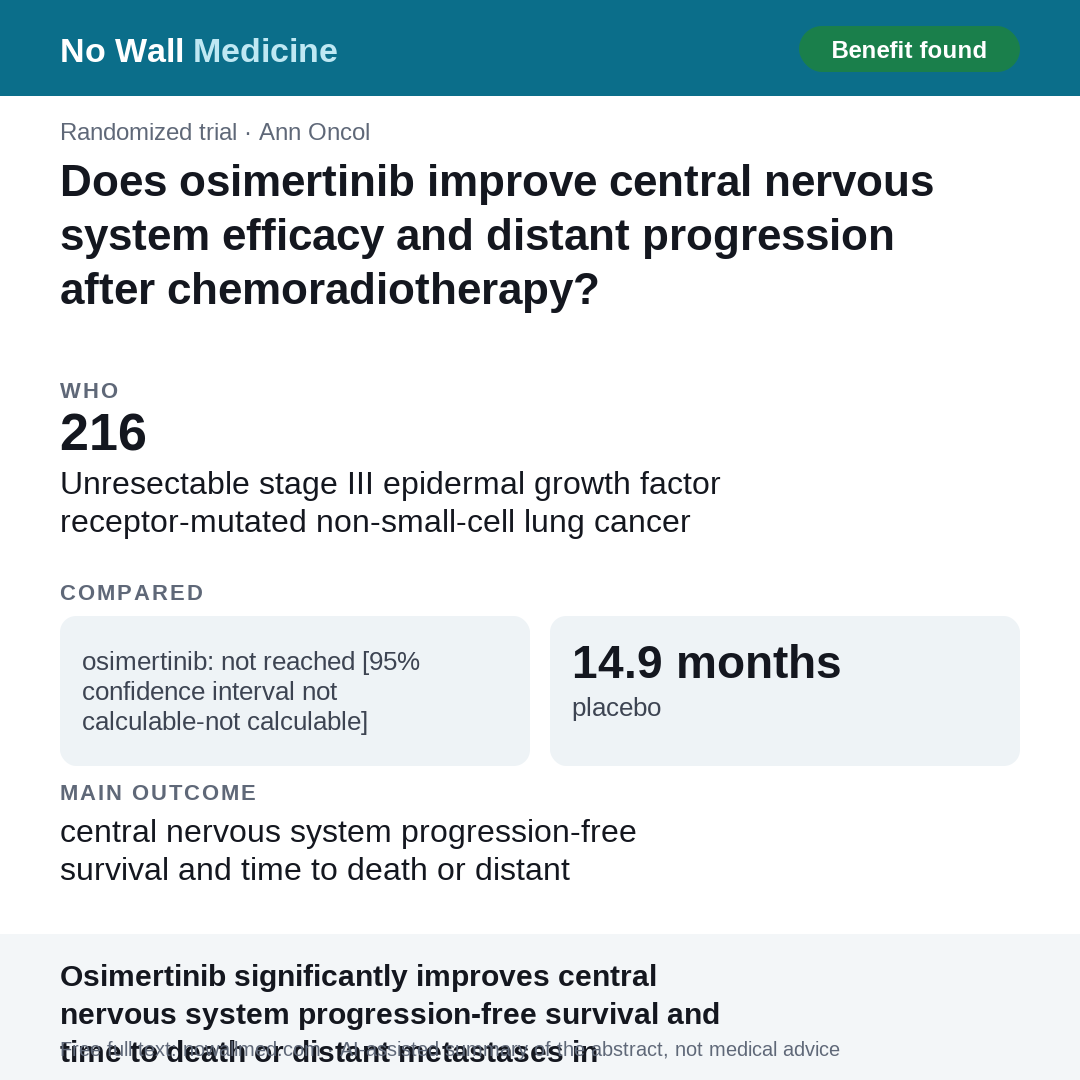
Clinical question: Does osimertinib improve central nervous system efficacy and distant progression after chemoradiotherapy?
Why it matters: It was unknown how osimertinib affects central nervous system progression and the time to death or distant metastases in patients following chemoradiotherapy.
Key points
- The study randomized 216 patients with unresectable stage III epidermal growth factor receptor-mutated non-small-cell lung cancer to receive either osimertinib or a placebo.
- At 12 months, the cumulative incidence of progression in the central nervous system was 9% with osimertinib compared to 36% with placebo.
- The cumulative incidence of distant metastases at 12 months was 11% for the osimertinib group and 37% for the placebo group.
Headline and key points written with AI from the paper’s abstract, with every number checked against it. Read the paper before relying on them.
Was this summary helpful?
Subject terms
Cite this article
Lu S, Ahn MJ, Reungwetwattana T, et al. Osimertinib after definitive chemoradiotherapy in unresectable stage III epidermal growth factor receptor-mutated non-small-cell lung cancer: analyses of central nervous system efficacy and distant progression from the phase III LAURA study. Ann Oncol. 2024. doi:10.1016/j.annonc.2024.08.2243
Spotted a mistake? Suggest a correction