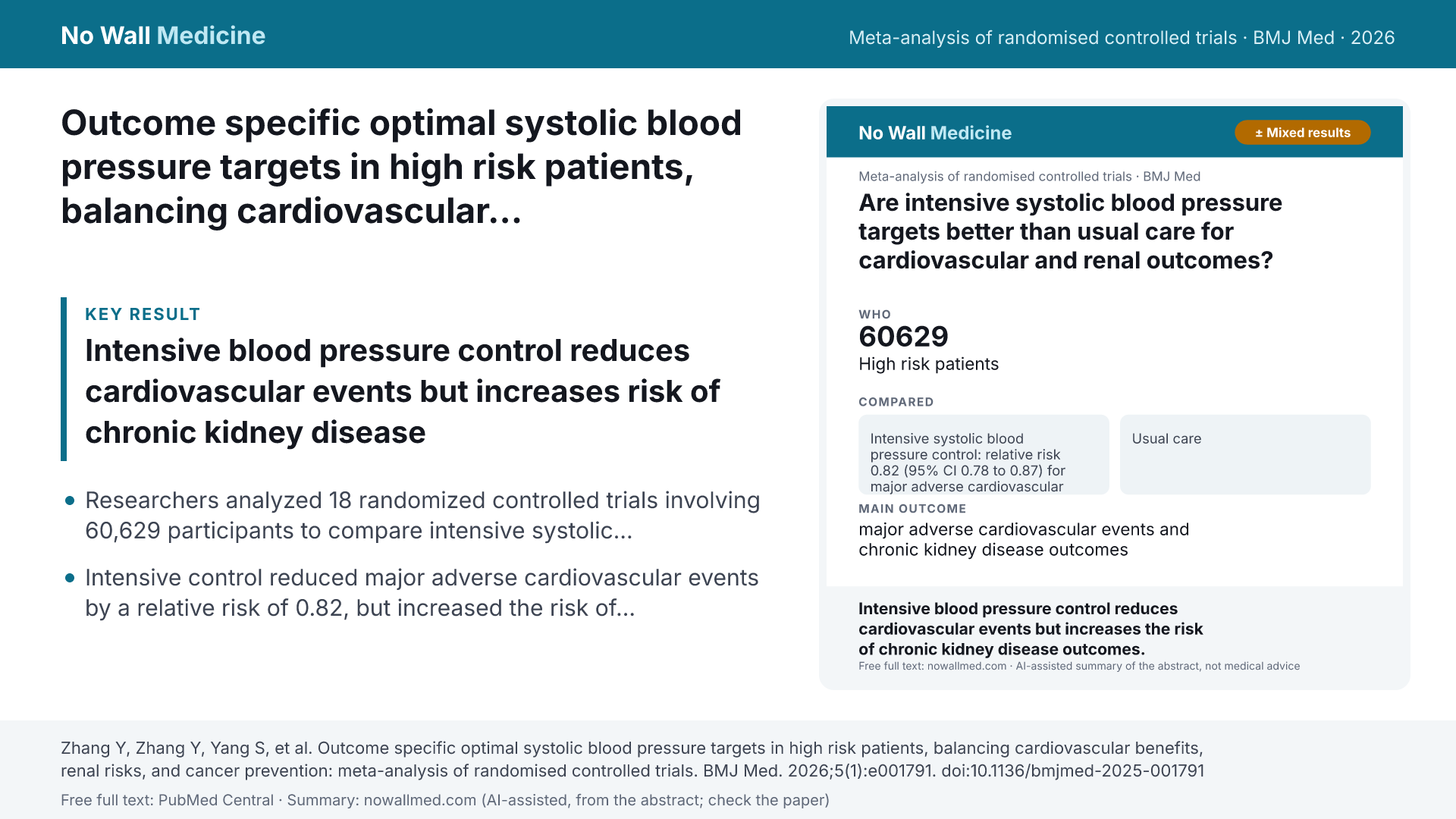
Intensive blood pressure control reduces cardiovascular events but increases risk of chronic kidney disease
Outcome specific optimal systolic blood pressure targets in high risk patients, balancing cardiovascular benefits, renal risks, and cancer prevention: meta-analysis of randomised controlled trials
Meta-analysis of randomised controlled trialsMixed results
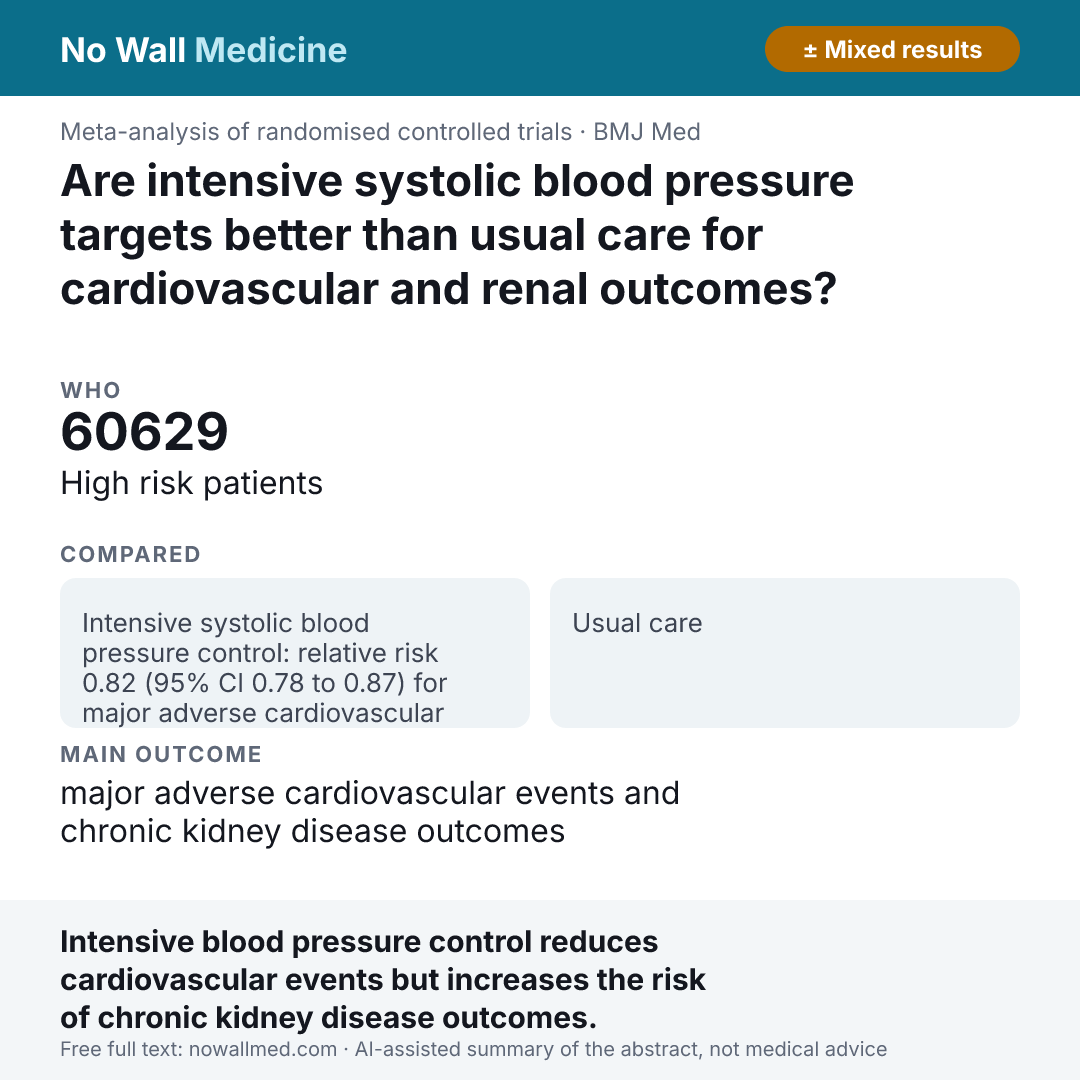
Are intensive systolic blood pressure targets better than usual care for cardiovascular and renal outcomes?
Who
60629
High risk patients
Compared
Intensive systolic blood pressure control: relative risk 0.82 (95% CI 0.78 to 0.87) for major adverse cardiovascular events
Usual care
Main outcome
major adverse cardiovascular events and chronic kidney disease outcomes
Result: relative risk 0.82 (95% CI 0.78 to 0.87) for cardiovascular events; relative risk 1.40 (95% CI 1.01 to 1.94) for chronic kidney disease
Bottom line: Intensive blood pressure control reduces cardiovascular events but increases the risk of chronic kidney disease outcomes.
BMJ Med · 2026-01-29 · Save PNG
Clinical question: Are intensive systolic blood pressure targets better than usual care for cardiovascular and renal outcomes?
Why it matters: Clinicians need to balance the cardiovascular benefits of intensive blood pressure targets against potential risks to kidney function.
Key points
- Researchers analyzed 18 randomized controlled trials involving 60,629 participants to compare intensive systolic blood pressure targets against usual care.
- Intensive control reduced major adverse cardiovascular events by a relative risk of 0.82, but increased the risk of composite chronic kidney disease by a relative risk of 1.40.
- A target of less than 120 mm Hg provided similar cardiovascular protection to less than 130 mm Hg but increased risks of bradycardia (slow heart rate) and hypotension (low blood pressure).
Headline and key points written with AI from the paper’s abstract, with every number checked against it. Read the paper before relying on them.
Was this summary helpful?
Abstract
Objective
To directly compare the efficacy and safety of different intensive systolic blood pressure targets (<120 or <130 mm Hg) versus usual care on cardiovascular and renal outcomes. Design
Meta-analysis of randomised controlled trials. Data sources
Web of Science and Medline, from inception to 20 May 2025. Eligibility criteria for selecting studies
Randomised controlled trials comparing intensive versus usual systolic blood pressure targets. Studies reported cardiovascular disease or kidney outcomes, or both. Results
The study included 18 randomised controlled trials of 60 629 participants. Intensive control of systolic blood pressure significantly reduced the risk of major adverse cardiovascular events (relative risk 0.82, 95% confidence interval (CI) 0.78 to 0.87, P<0.001), including myocardial infarction, stroke, heart failure, and death from cardiovascular disease. Systolic blood pressure targets of <120 mm Hg and <130 mm Hg provided comparable cardiovascular protection. Intensive control of systolic blood pressure increased the risk of the composite chronic kidney disease outcome (relative risk 1.40, 95% CI 1.01 to 1.94, P=0.046), but with a likely higher risk for the target of <120 mm Hg. A systolic blood pressure target of <120 mm Hg also reduced the risk of albuminuria, but increased the risk of bradycardia and hypotension. Conclusions
Intensive control of systolic blood pressure provided substantial cardiovascular benefits but increased the risk of renal adverse events. A systolic blood pressure target of <130 mm Hg had a similar degree of cardiovascular protection as <120 mm Hg with a more favourable renal safety profile, supporting a personalised risk based approach to treatment intensification. Trial registration
PROSPERO CRD42025629962.
Abstract reproduced under the article’s CC BY NC licence.
Headline, design, result, key points, caveat and citation as plain text.
Cite this article
Zhang Y, Zhang Y, Yang S, et al. Outcome specific optimal systolic blood pressure targets in high risk patients, balancing cardiovascular benefits, renal risks, and cancer prevention: meta-analysis of randomised controlled trials. BMJ Med. 2026;5(1):e001791. doi:10.1136/bmjmed-2025-001791
Spotted a mistake? Suggest a correction