Transcatheter aortic valve replacement showed lower primary endpoint rates than surgery at 2 years
Outcomes 2 Years After Transcatheter Aortic Valve Replacement in Patients at Low Surgical Risk
Randomized trialMixed results
What are the clinical and echocardiographic outcomes 2 years after TAVR versus surgery?
Who
1,000
Low surgical risk patients with symptomatic severe aortic stenosis
Compared
11.5%Transcatheter aortic valve replacement
17.4%Surgery
Main outcome
Death, stroke, or re-hospitalization
Result: hazard ratio 0.63 (95% confidence interval 0.45 to 0.88)
Bottom line: TAVR had lower primary endpoint rates at 2 years, but increased valve thrombosis and diminished differences in death and stroke.
JACC · 2021-03-05Download image
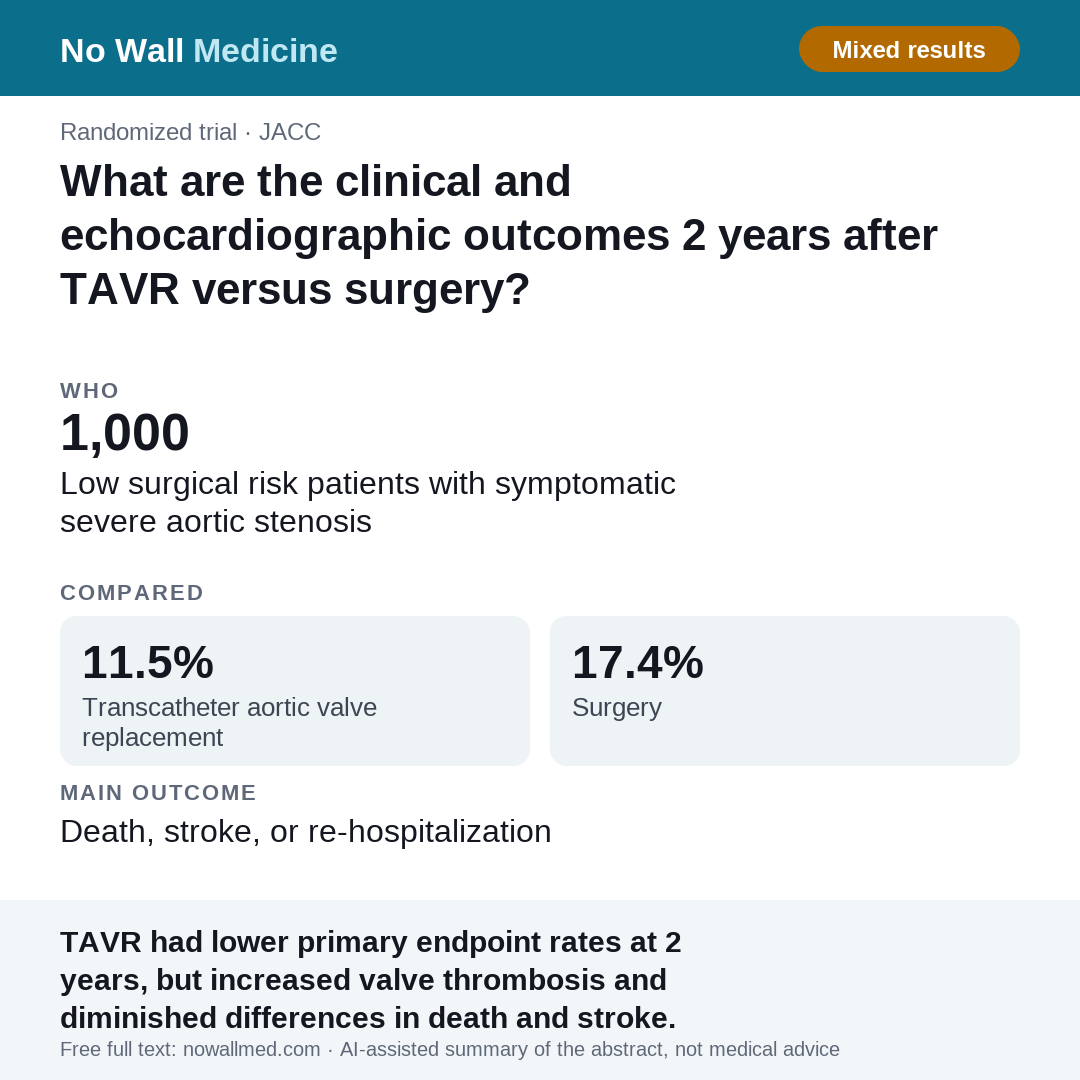
Clinical question: What are the clinical and echocardiographic outcomes 2 years after TAVR versus surgery?
Why it matters: It was unknown if the clinical and echocardiographic benefits of transcatheter aortic valve replacement versus surgery would persist between 1 and 2 years.
Key points
- Researchers randomly assigned 1,000 patients with symptomatic severe aortic stenosis to either transfemoral transcatheter aortic valve replacement (TAVR) or heart surgery.
- At 2 years, the primary endpoint of death, stroke, or re-hospitalization was 11.5% for TAVR compared to 17.4% for surgery.
- TAVR was associated with a higher rate of valve thrombosis at 2 years compared to surgery, with 2.6% versus 0.7%.
Headline and key points written with AI from the paper’s abstract, with every number checked against it. Read the paper before relying on them.
Was this summary helpful?
Subject terms
Cite this article
Leon MB, Mack MJ, Hahn RT, Thourani VH, Makkar R, Kodali SK. Outcomes 2 Years After Transcatheter Aortic Valve Replacement in Patients at Low Surgical Risk. JACC. 2021. doi:10.1016/j.jacc.2020.12.052
Spotted a mistake? Suggest a correction
Top studies every Monday
The week’s key trials and guidelines in your specialties, plus any topics you follow. By email, free.
Get the weekly digest