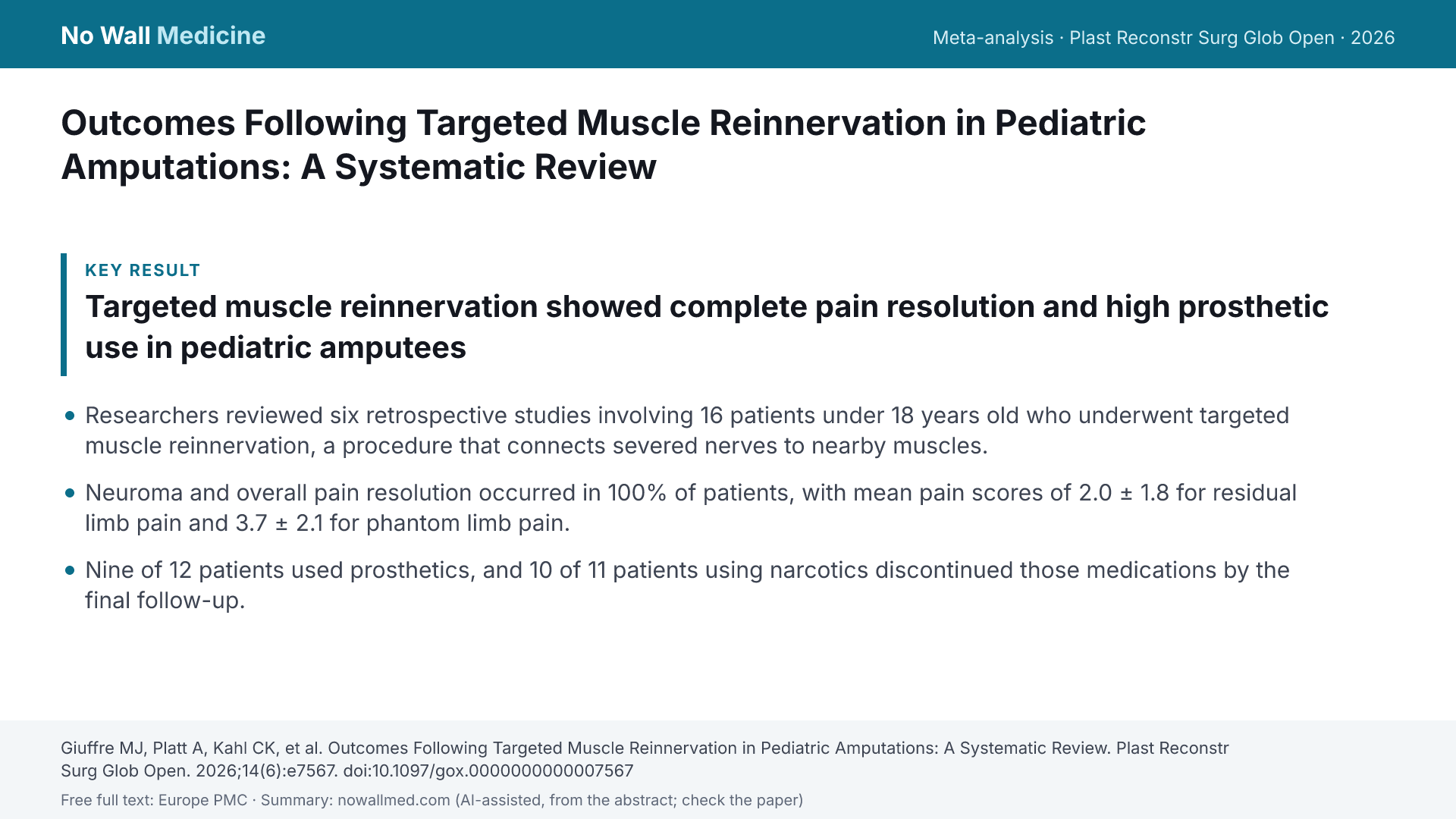
Targeted muscle reinnervation showed complete pain resolution and high prosthetic use in pediatric amputees
Outcomes Following Targeted Muscle Reinnervation in Pediatric Amputations: A Systematic Review
Why it matters: The role of targeted muscle reinnervation in pediatric patients remains unclear despite established benefits in adults.
Key points
- Researchers reviewed six retrospective studies involving 16 patients under 18 years old who underwent targeted muscle reinnervation, a procedure that connects severed nerves to nearby muscles.
- Neuroma and overall pain resolution occurred in 100% of patients, with mean pain scores of 2.0 ± 1.8 for residual limb pain and 3.7 ± 2.1 for phantom limb pain.
- Nine of 12 patients used prosthetics, and 10 of 11 patients using narcotics discontinued those medications by the final follow-up.
Limitation the authors note: The authors note that prospective studies with standardized measures are warranted.
Headline and key points written with AI from the paper’s abstract, with every number checked against it. Read the paper before relying on them.
Was this summary helpful?
Abstract
Background
Targeted muscle reinnervation (TMR) coapts transected peripheral nerves to nearby motor nerves in residual muscles, reducing neuroma formation and phantom limb pain (PLP). Although benefits are established in adults, its role in pediatric patients remains unclear. This systematic review evaluates outcomes of TMR in pediatric amputees. Methods
Following PRISMA guidelines, PubMed, MEDLINE, Embase, and Google Scholar were searched for studies of immediate or delayed TMR in amputees younger than 18 years. Outcomes included neuroma and pain resolution, numerical rating scale (NRS), patient-reported outcomes measurement information system scores, prosthetic use, narcotic use, and complications. Quality was assessed using Joanna Briggs Institute tools. Results
Six retrospective studies (16 patients) met inclusion criteria. Primary TMR was performed in 14 patients, and delayed TMR in 2. Neuroma and overall pain resolution were observed in 100% of patients. Mean NRS scores (0, no pain; 10, worst pain) for residual limb pain and PLP were 2.0 ± 1.8 and 3.7 ± 2.1. Patient-reported outcomes measurement information system mean scores scores corresponded with equivalent outcomes in adult studies (residual limb pain: 38.6, 42.7, 42.0; PLP: 44.0, 45.6, 44.6). Nine of 12 patients proceeded with prosthetic use (8 lower extremity; 1 upper extremity), indicating early adoption and function. Of 11 patients using narcotics, 10 discontinued by the final follow-up. Complications occurred in 12.5% (2 of 16) of patients and resolved after revision. Conclusions
TMR in pediatric amputations may reduce neuropathic pain, support prosthetic use, and decrease reliance on pain medication. Prospective studies with standardized measures are warranted.
Abstract reproduced under the article’s CC BY-NC-ND licence.
Headline, design, result, key points, caveat and citation as plain text.
Cite this article
Giuffre MJ, Platt A, Kahl CK, et al. Outcomes Following Targeted Muscle Reinnervation in Pediatric Amputations: A Systematic Review. Plast Reconstr Surg Glob Open. 2026;14(6):e7567. doi:10.1097/gox.0000000000007567
Spotted a mistake? Suggest a correction