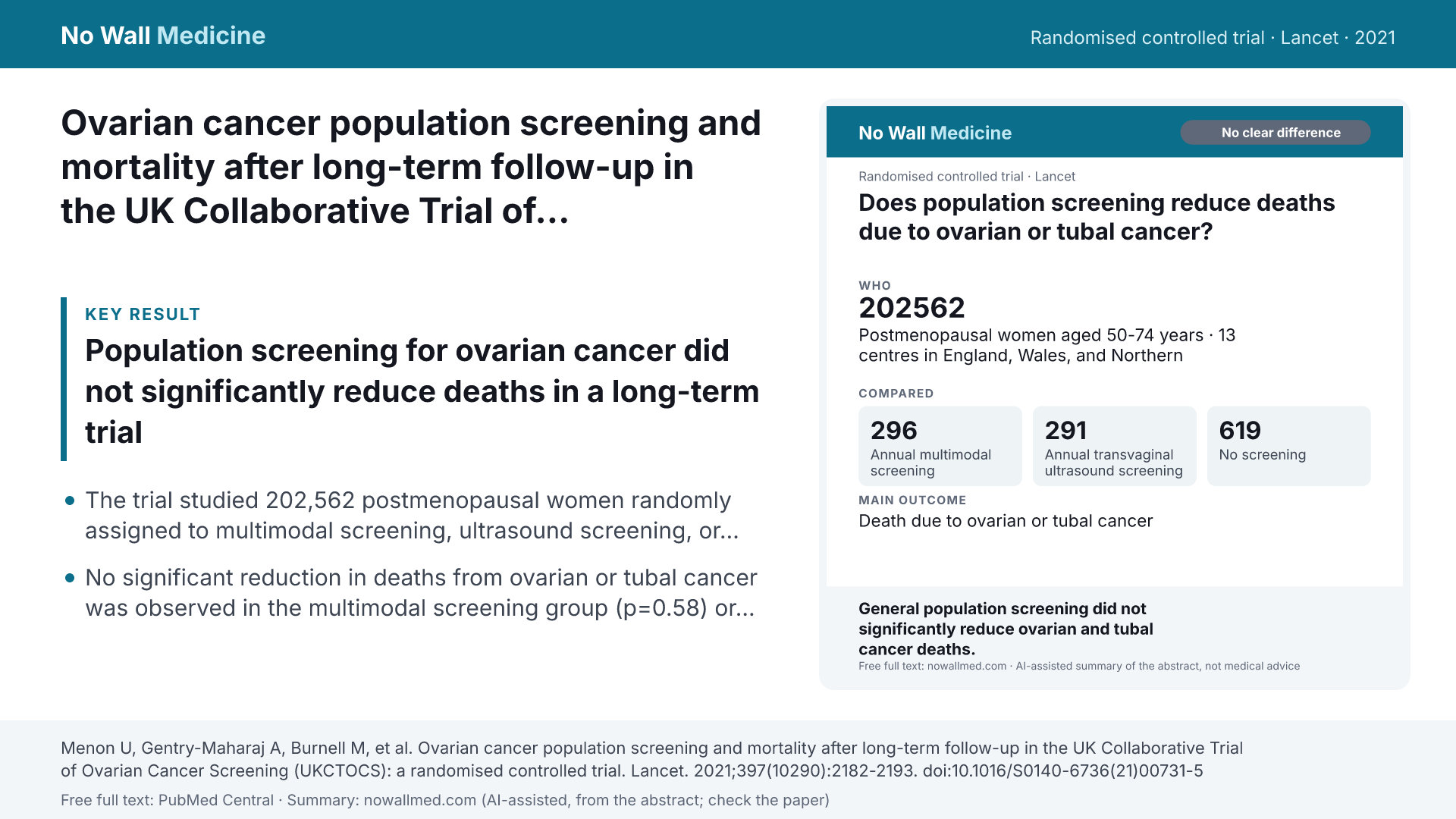
Population screening for ovarian cancer did not significantly reduce deaths in a long-term trial
Ovarian cancer population screening and mortality after long-term follow-up in the UK Collaborative Trial of Ovarian Cancer Screening (UKCTOCS): a randomised controlled trial
Randomised controlled trialNo clear difference
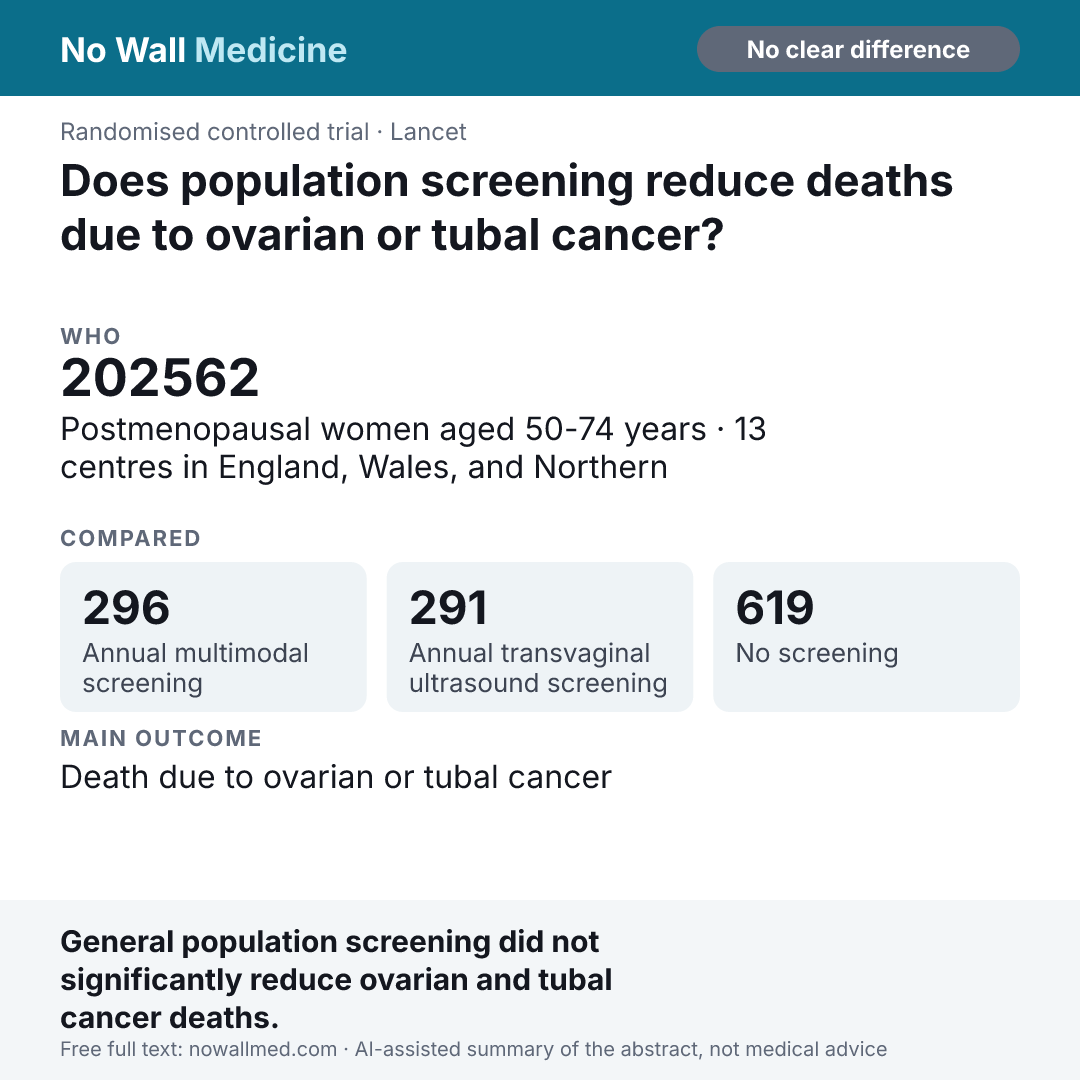
Does population screening reduce deaths due to ovarian or tubal cancer?
Who
202562
Postmenopausal women aged 50-74 years · 13 centres in England, Wales, and Northern Ireland
Compared
296Annual multimodal screening (0.6%)
291Annual transvaginal ultrasound screening (0.6%)
619No screening (0.6%)
Main outcome
Death due to ovarian or tubal cancer
Bottom line: General population screening did not significantly reduce ovarian and tubal cancer deaths.
Funded by: National Institute for Health Research, Cancer Research UK, and The Eve Appeal
Lancet · 2021-05-12 · Save PNG
Same trial (NCT00058032)
Papers we list that report this registered trial, oldest first. Read a secondary analysis alongside the main results.
- Longer follow-up No clear difference
This paper Lancet 2021-05 - Secondary analysis
Screening linked to earlier detection and better survival in high-grade serous ovarian cancer Lancet Oncol 2023-09
Clinical question: Does population screening reduce deaths due to ovarian or tubal cancer?
Key points
- The trial studied 202,562 postmenopausal women randomly assigned to multimodal screening, ultrasound screening, or no screening over a median of 16.3 years.
- No significant reduction in deaths from ovarian or tubal cancer was observed in the multimodal screening group (p=0.58) or the ultrasound screening group (p=0.36).
- In the multimodal screening group, stage I disease incidence was 47.2% higher and stage IV disease incidence was 24.5% lower than in the no screening group.
Headline and key points written with AI from the paper’s abstract, with every number checked against it. Read the paper before relying on them.
Was this summary helpful?
Abstract
Background
Ovarian cancer continues to have a poor prognosis with the majority of women diagnosed with advanced disease. Therefore, we undertook the UK Collaborative Trial of Ovarian Cancer Screening (UKCTOCS) to determine if population screening can reduce deaths due to the disease. We report on ovarian cancer mortality after long-term follow-up in UKCTOCS. Methods
In this randomised controlled trial, postmenopausal women aged 50-74 years were recruited from 13 centres in National Health Service trusts in England, Wales, and Northern Ireland. Exclusion criteria were bilateral oophorectomy, previous ovarian or active non-ovarian malignancy, or increased familial ovarian cancer risk. The trial management system confirmed eligibility and randomly allocated participants in blocks of 32 using computer generated random numbers to annual multimodal screening (MMS), annual transvaginal ultrasound screening (USS), or no screening, in a 1:1:2 ratio. Follow-up was through national registries. The primary outcome was death due to ovarian or tubal cancer (WHO 2014 criteria) by June 30, 2020. Analyses were by intention to screen, comparing MMS and USS separately with no screening using the versatile test. Investigators and participants were aware of screening type, whereas the outcomes review committee were masked to randomisation group. This study is registered with ISRCTN, 22488978, and ClinicalTrials.gov, NCT00058032. Findings
Between April 17, 2001, and Sept 29, 2005, of 1 243 282 women invited, 202 638 were recruited and randomly assigned, and 202 562 were included in the analysis: 50 625 (25·0%) in the MMS group, 50 623 (25·0%) in the USS group, and 101 314 (50·0%) in the no screening group. At a median follow-up of 16·3 years (IQR 15·1-17·3), 2055 women were diagnosed with tubal or ovarian cancer: 522 (1·0%) of 50 625 in the MMS group, 517 (1·0%) of 50 623 in the USS group, and 1016 (1·0%) of 101 314 in the no screening group. Compared with no screening, there was a 47·2% (95% CI 19·7 to 81·1) increase in stage I and 24·5% (-41·8 to -2·0) decrease in stage IV disease incidence in the MMS group. Overall the incidence of stage I or II disease was 39·2% (95% CI 16·1 to 66·9) higher in the MMS group than in the no screening group, whereas the incidence of stage III or IV disease was 10·2% (-21·3 to 2·4) lower. 1206 women died of the disease: 296 (0·6%) of 50 625 in the MMS group, 291 (0·6%) of 50 623 in the USS group, and 619 (0·6%) of 101 314 in the no screening group. No significant reduction in ovarian and tubal cancer deaths was observed in the MMS (p=0·58) or USS (p=0·36) groups compared with the no screening group. Interpretation
The reduction in stage III or IV disease incidence in the MMS group was not sufficient to translate into lives saved, illustrating the importance of specifying cancer mortality as the primary outcome in screening trials. Given that screening did not significantly reduce ovarian and tubal cancer deaths, general population screening cannot be recommended. Funding
National Institute for Health Research, Cancer Research UK, and The Eve Appeal.
Abstract reproduced under the article’s CC BY licence.
Subject terms
Headline, design, result, key points, caveat and citation as plain text.
Cite this article
Menon U, Gentry-Maharaj A, Burnell M, et al. Ovarian cancer population screening and mortality after long-term follow-up in the UK Collaborative Trial of Ovarian Cancer Screening (UKCTOCS): a randomised controlled trial. Lancet. 2021;397(10290):2182-2193. doi:10.1016/S0140-6736(21)00731-5
Spotted a mistake? Suggest a correction