Oxidative stress genes and gut microbiota interactions were linked to Crohn's disease risk
Oxidative stress gene expression, DNA methylation, and gut microbiota interaction trigger Crohn's disease: a multi-omics Mendelian randomization study
Multi-omics Mendelian randomization studyBenefit found
Do oxidative stress genes, DNA methylation, and gut microbiota interactions trigger Crohn's disease?
Who
Individuals with Crohn's disease and oxidative stress related genes · First Affiliated Hospital of Sun Yat-sen University
Compared
Oxidative stress genes
Crohn's disease
Main outcome
Causal effects and underlying mechanisms of oxidative stress genes
Bottom line: Oxidative stress genes causal to Crohn's disease are regulated by DNA methylation and host-microbiota interactions.
BMC Med · 2023-05-11Download image
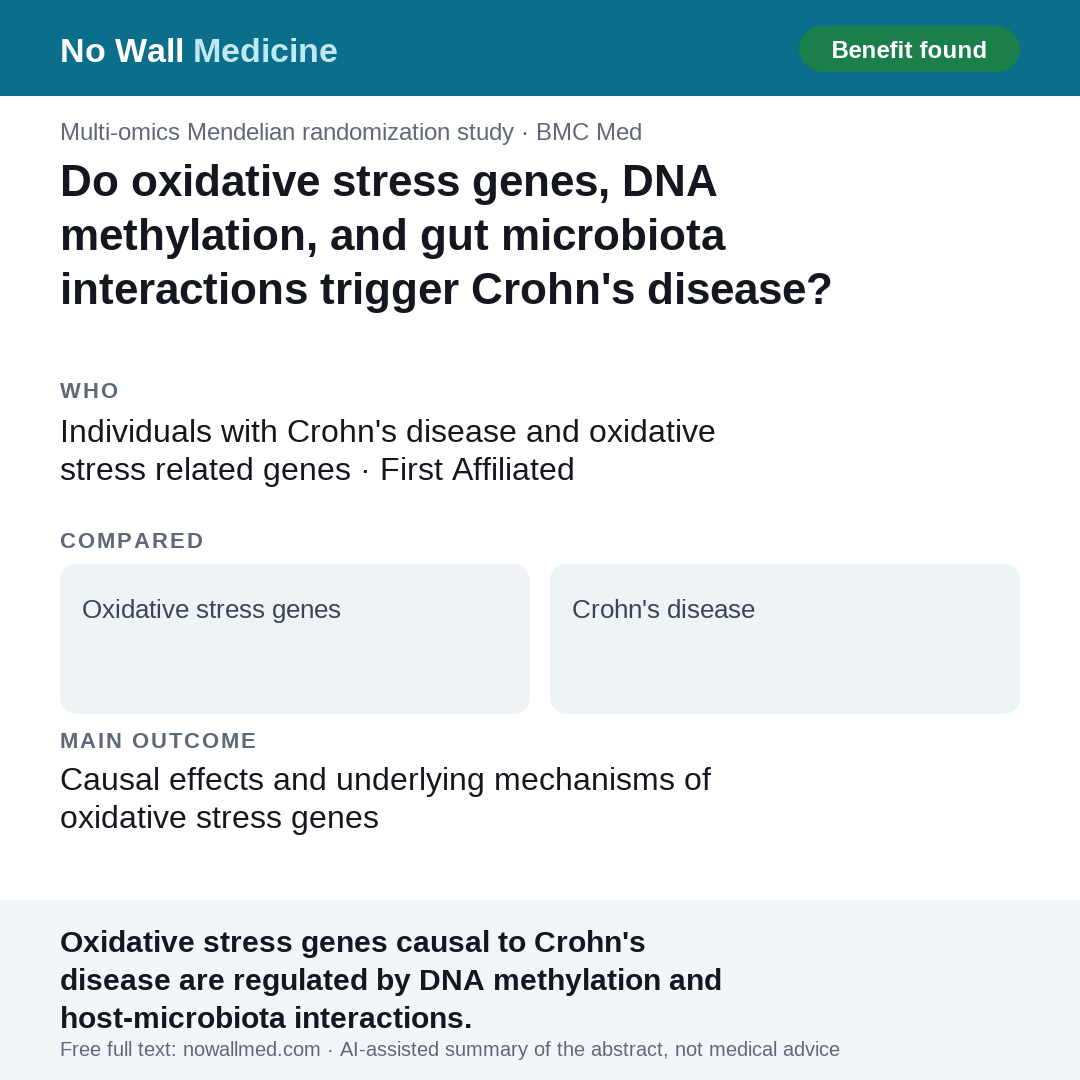
Clinical question: Do oxidative stress genes, DNA methylation, and gut microbiota interactions trigger Crohn's disease?
Why it matters: It is unknown whether oxidative stress is a cause of Crohn's disease or a result of intestinal inflammation.
Key points
- Researchers used Mendelian randomization to analyze oxidative stress genes, DNA methylation, and gut microbiota in relation to Crohn's disease.
- Five blood genes including BAD, SHC1, STAT3, MUC1, and GPX3 were identified as candidate causal genes for the disease.
- Three intestinal genes, MUC1, CD40, and PRKAB1, were linked to interactions between host gene expression and gut microbiota.
Headline and key points written with AI from the paper’s abstract, with every number checked against it. Read the paper before relying on them.
Was this summary helpful?
Subject terms
Cite this article
Xu S, Li X, Zhang S, Qi C, Zhang Z, Ma R. Oxidative stress gene expression, DNA methylation, and gut microbiota interaction trigger Crohn's disease: a multi-omics Mendelian randomization study. BMC Med. 2023. doi:10.1186/s12916-023-02878-8
Spotted a mistake? Suggest a correction
Top studies every Monday
The week’s key trials and guidelines in your specialties, plus any topics you follow. By email, free.
Get the weekly digest