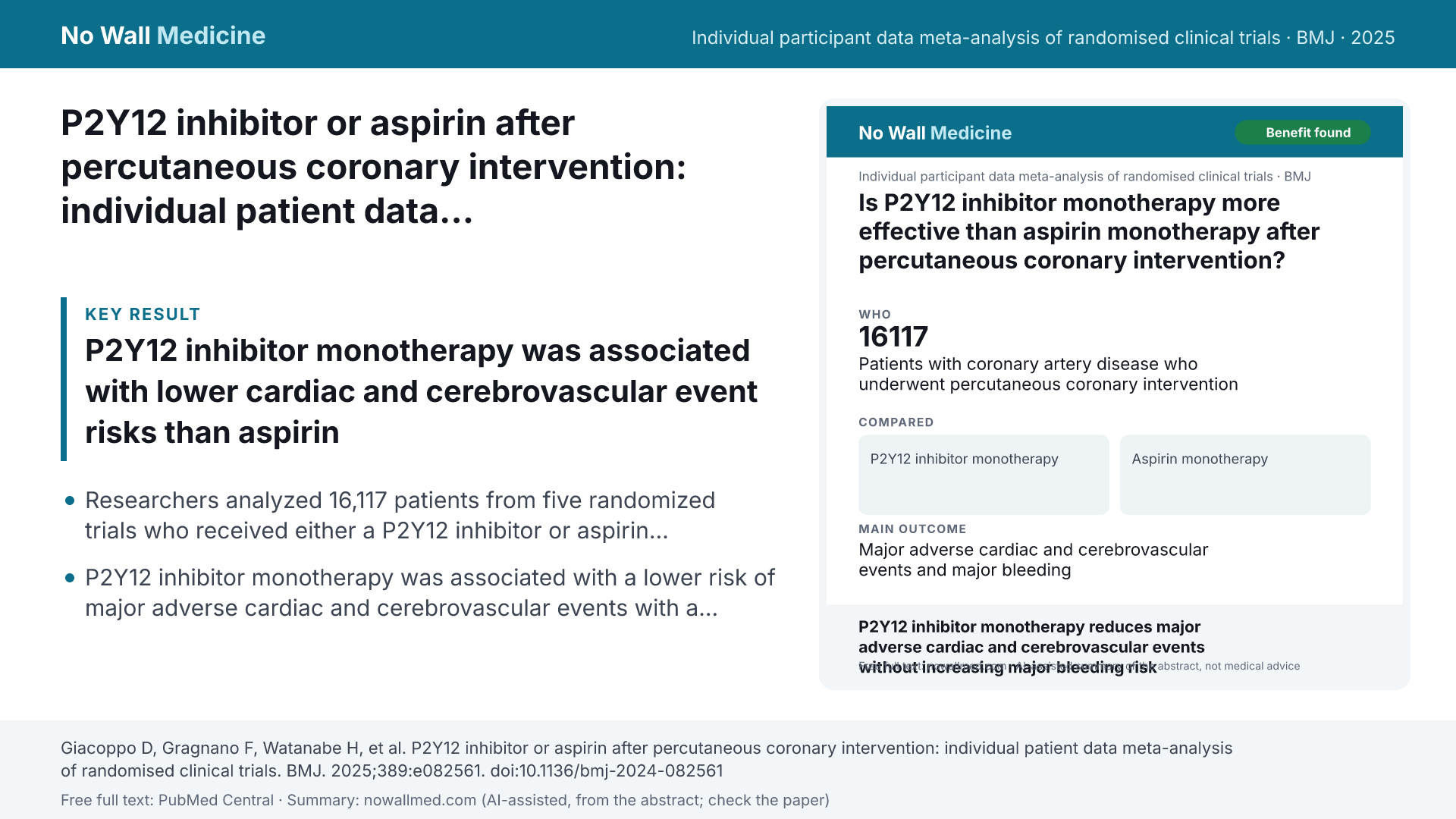
P2Y12 inhibitor monotherapy was associated with lower cardiac and cerebrovascular event risks than aspirin
P2Y12 inhibitor or aspirin after percutaneous coronary intervention: individual patient data meta-analysis of randomised clinical trials
Individual participant data meta-analysis of randomised clinical trialsBenefit found
Is P2Y12 inhibitor monotherapy more effective than aspirin monotherapy after percutaneous coronary intervention?
Who
16117
Patients with coronary artery disease who underwent percutaneous coronary intervention
Compared
P2Y12 inhibitor monotherapy
Aspirin monotherapy
Main outcome
Major adverse cardiac and cerebrovascular events and major bleeding
Result: hazard ratio 0.77 (95% CI 0.67 to 0.89)
Bottom line: P2Y12 inhibitor monotherapy reduces major adverse cardiac and cerebrovascular events without increasing major bleeding risk compared to aspirin.
BMJ · 2025-06-04 · Save PNG
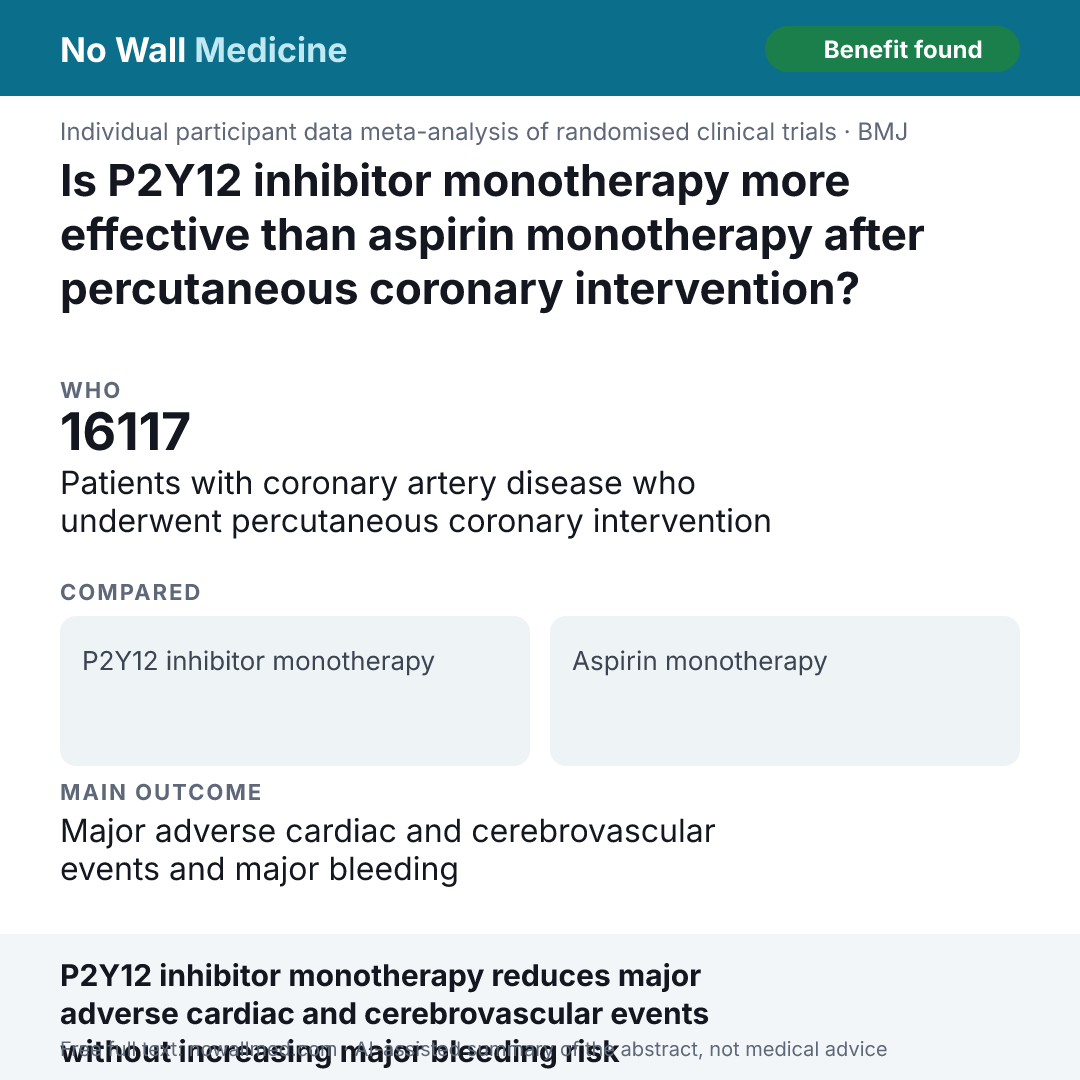
Clinical question: Is P2Y12 inhibitor monotherapy more effective than aspirin monotherapy after percutaneous coronary intervention?
Key points
- Researchers analyzed 16,117 patients from five randomized trials who received either a P2Y12 inhibitor or aspirin after completing dual antiplatelet therapy following a coronary artery procedure.
- P2Y12 inhibitor monotherapy was associated with a lower risk of major adverse cardiac and cerebrovascular events with a hazard ratio of 0.77 (95% CI 0.67 to 0.89).
- There was no significant difference in major bleeding between the two treatment groups, with a hazard ratio of 1.26 (95% CI 0.78 to 2.04).
Headline and key points written with AI from the paper’s abstract, with every number checked against it. Read the paper before relying on them.
Was this summary helpful?
Abstract
Objective
To assess the long term comparative effectiveness of P2Y12 inhibitor monotherapy compared with aspirin monotherapy in patients after percutaneous coronary intervention (PCI) and discontinuation of dual antiplatelet therapy (DAPT). Design
Individual participant data (IPD) meta-analysis of randomised clinical trials. Data sources
PubMed/Medline, Scopus, Web of Science, and Ovid/Embase. Eligibility criteria for selecting studies
Randomised trials investigating monotherapy with a P2Y12 inhibitor or aspirin for secondary prevention of ischaemic events in patients with coronary artery disease who underwent PCI. Data extraction and synthesis
Anonymised IPD were extracted and transferred to the coordinating centre by dedicated electronic spreadsheets. Data were primarily combined by mixed effects models (one stage analysis) and complemented with multivariable mixed effects models and two stage analyses based on random effects models. The primary and co-primary outcomes were a composite of major adverse cardiac and cerebrovascular events (MACCE) and major bleeding, respectively. The secondary outcomes included a net composite of adverse cardiac and cerebrovascular events (NACCE), derived from the combination of the primary and co-primary outcomes, and individual ischaemic and bleeding events. Results
A total of 16 117 patients assigned to P2Y12 inhibitor or aspirin monotherapy after PCI and completion of the recommended DAPT regimen (median duration of 12 months) in five randomised trials were included. At a median follow-up of 1351 days (interquartile range 373-1791 days), P2Y12 inhibitor monotherapy was associated with a lower risk of MACCE compared with aspirin monotherapy (one stage analysis: hazard ratio 0.77 (95% confidence interval (CI) 0.67 to 0.89), P<0.001; multivariable one stage analysis: adjusted hazard ratio 0.77 (0.67 to 0.89), P<0.001; two stage analysis: hazard ratio 0.77 (0.67 to 0.89), P<0.001), yielding a number needed to treat to benefit of 45.5 (95% CI 31.4 to 93.6). No significant difference in major bleeding (one stage analysis: hazard ratio 1.26 (0.78 to 2.04), P=0.35; multivariable one stage analysis: 1.12 (0.74 to 1.70), P=0.60; two stage analysis: 1.15 (0.69 to 1.92), P=0.59) was observed. NACCE, myocardial infarction, and stroke were lower in patients assigned to a P2Y12 inhibitor compared with those assigned to aspirin. These findings were confirmed across multiple sensitivity and subgroup analyses. Conclusions
In patients who had undergone PCI and discontinued DAPT, at a follow-up of about 5.5 years, P2Y12 inhibitor monotherapy with ticagrelor or clopidogrel was associated with lower MACCE, owing to reduced rates of myocardial infarction and stroke compared with aspirin monotherapy, without a concurrent increased risk of major bleeding. Review registration
PROSPERO CRD42024517983.
Abstract reproduced under the article’s CC BY NC licence.
Subject terms
Headline, design, result, key points, caveat and citation as plain text.
Cite this article
Giacoppo D, Gragnano F, Watanabe H, et al. P2Y12 inhibitor or aspirin after percutaneous coronary intervention: individual patient data meta-analysis of randomised clinical trials. BMJ. 2025;389:e082561. doi:10.1136/bmj-2024-082561
Spotted a mistake? Suggest a correction