Cell therapy showed no difference in amputation-free survival for patients with chronic limb-threatening ischaemia
PACE: randomized, controlled, multicentre, multinational, phase III study of PLX-PAD for critical limb ischaemia in patients unsuitable for revascularization: randomized clinical trial
Randomized, parallel-group, placebo-controlled, multinational, blinded trialNo clear difference
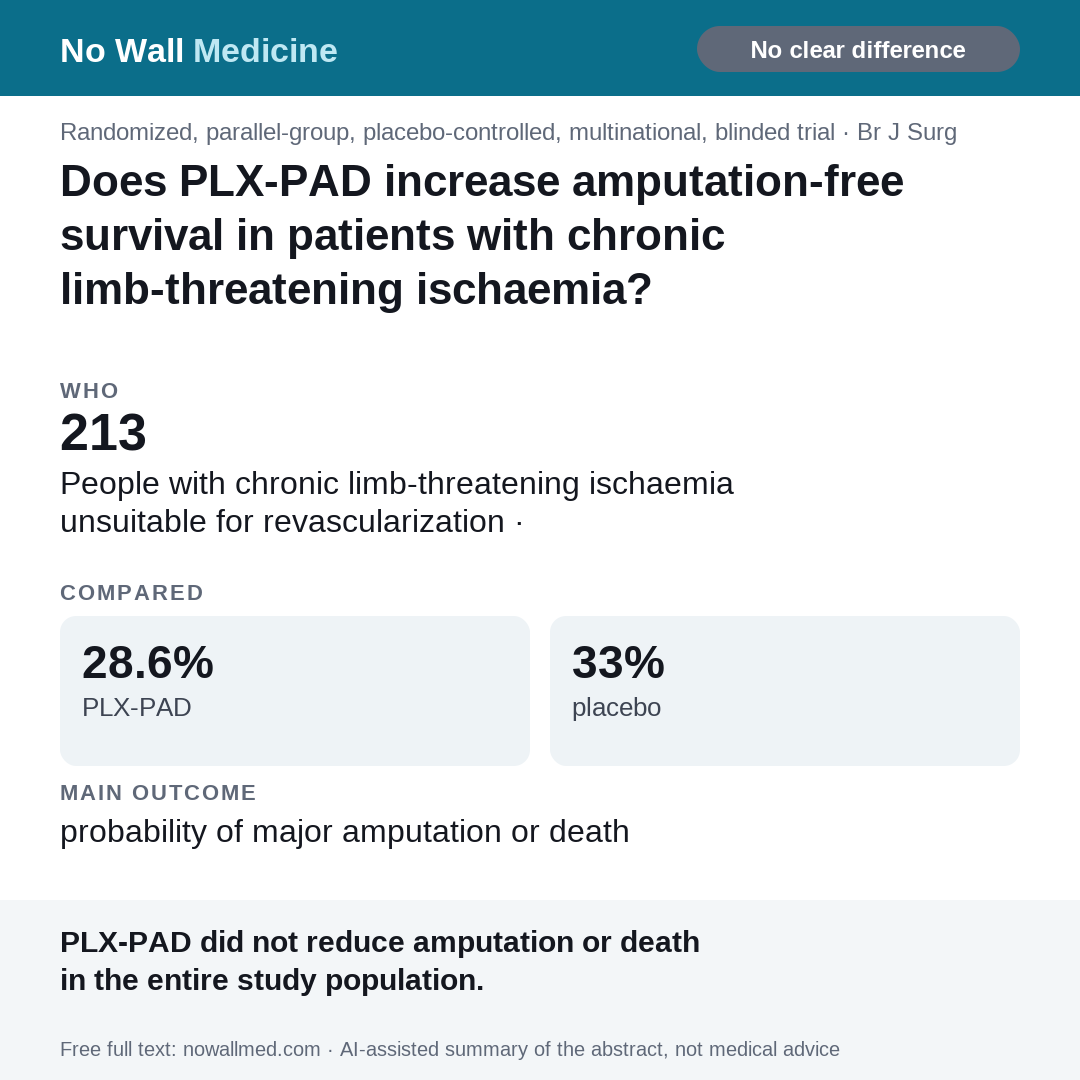
Does PLX-PAD increase amputation-free survival in patients with chronic limb-threatening ischaemia?
Who
213
People with chronic limb-threatening ischaemia unsuitable for revascularization · multinational
Compared
28.6%PLX-PAD
33%placebo
Main outcome
probability of major amputation or death
Result: hazard ratio 0.93 (95% c.i. 0.53 to 1.63)
Bottom line: PLX-PAD did not reduce amputation or death in the entire study population.
Br J Surg · 2024-01-31Download image
Clinical question: Does PLX-PAD increase amputation-free survival in patients with chronic limb-threatening ischaemia?
Why it matters: It is unknown if placental-derived mesenchymal stromal cell-like cell therapy can increase amputation-free survival in patients with chronic limb-threatening ischaemia who cannot undergo revascularization.
Key points
- Researchers studied 213 patients with chronic limb-threatening ischaemia, comparing 143 receiving PLX-PAD cell therapy to 70 receiving a placebo.
- The probability of major amputation or death was 33% for the placebo group and 28.6% for the PLX-PAD group, which was not a statistically significant difference.
- In a subpopulation of 121 patients with haemoglobin A1c levels below 6.5%, 12-month amputation-free survival was higher in the cell therapy group.
Headline and key points written with AI from the paper’s abstract, with every number checked against it. Read the paper before relying on them.
Topics
Cite this article
Norgren L, Weiss N, Nikol S, Lantis JC, Patel MR, Hinchliffe RJ. PACE: randomized, controlled, multicentre, multinational, phase III study of PLX-PAD for critical limb ischaemia in patients unsuitable for revascularization: randomized clinical trial. Br J Surg. 2024. doi:10.1093/bjs/znad437
Spotted a mistake? Suggest a correction
Top studies every Monday
The week’s key trials and guidelines in your specialties, plus any topics you follow. By email, free.
Get the weekly digest