Evidence remains inconclusive regarding pad size, orientation, and position for cardiac arrest defibrillation
Pad size, orientation, and placement for defibrillation during basic life support: A systematic review
Emergency MedicineAdult and pediatric
Systematic reviewUnclear result
How do pad size, orientation, and position impact clinical outcomes in cardiac arrest?
Who
1334
Adults and children with cardiac arrest and shockable rhythm
Compared
Anterior-posterior pad placement: adj. RR 1.71[1.01-2.88]
Anterior-lateral pad placement
Large vs small pads: OR 0.82[0.42-1.60]
Main outcome
Clinical outcomes in cardiac arrest
Result: adj. RR 1.71[1.01-2.88]
Bottom line: Evidence is inconclusive for pad size and orientation, though anterior-posterior placement may benefit refractory ventricular fibrillation.
Limitation: Sparse evidence, conflicting data, and high risk of bias in observational studies.
Resusc Plus · 2025-07-14Download image
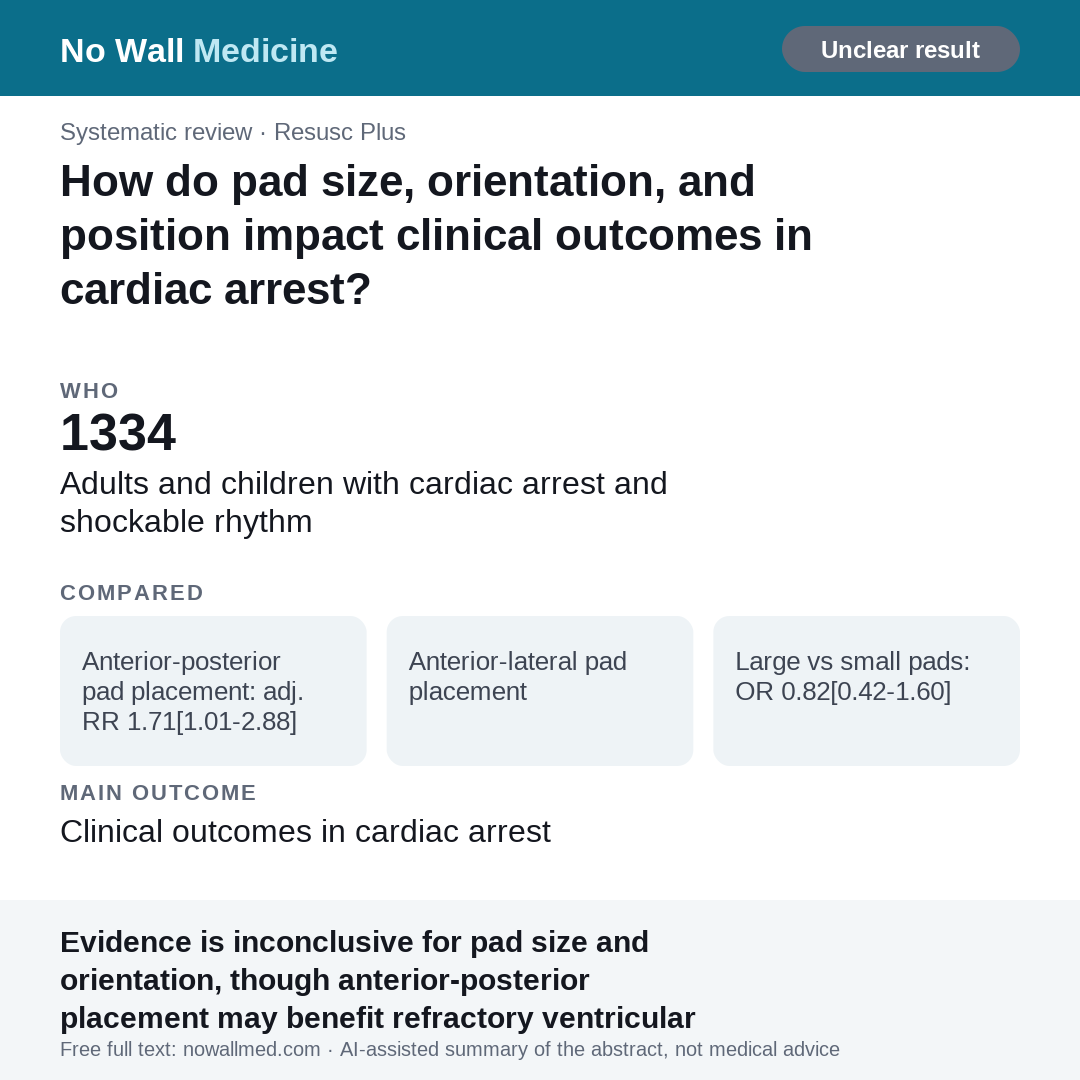
Clinical question: How do pad size, orientation, and position impact clinical outcomes in cardiac arrest?
Why it matters: It is unclear which pad size, orientation, or position provides the best clinical outcomes for adults and children during cardiac arrest.
Key points
- Researchers reviewed four studies involving 1334 adult cardiac arrest patients to evaluate pad size, orientation, and placement.
- An observational study of 314 patients showed no significant difference in defibrillation success between large and small pads (OR 0.82[0.42-1.60]).
- One randomized clinical trial of 280 patients suggested a potential survival benefit from anterior-posterior pad placement compared to anterior-lateral placement in refractory ventricular fibrillation (adj. RR 1.71[1.01-2.88]).
Limitation the authors note: The evidence was limited by a small number of studies, conflicting data, and a high risk of bias in observational studies.
Headline and key points written with AI from the paper’s abstract, with every number checked against it. Read the paper before relying on them.
Cite this article
Ristagno G, Semeraro F, Raffay V, Stirparo G, Lulic I, Deakin CD. Pad size, orientation, and placement for defibrillation during basic life support: A systematic review. Resusc Plus. 2025. doi:10.1016/j.resplu.2025.101030
Spotted a mistake? Suggest a correction
Top studies every Monday
The week’s key trials and guidelines in your specialties, plus any topics you follow. By email, free.
Get the weekly digest