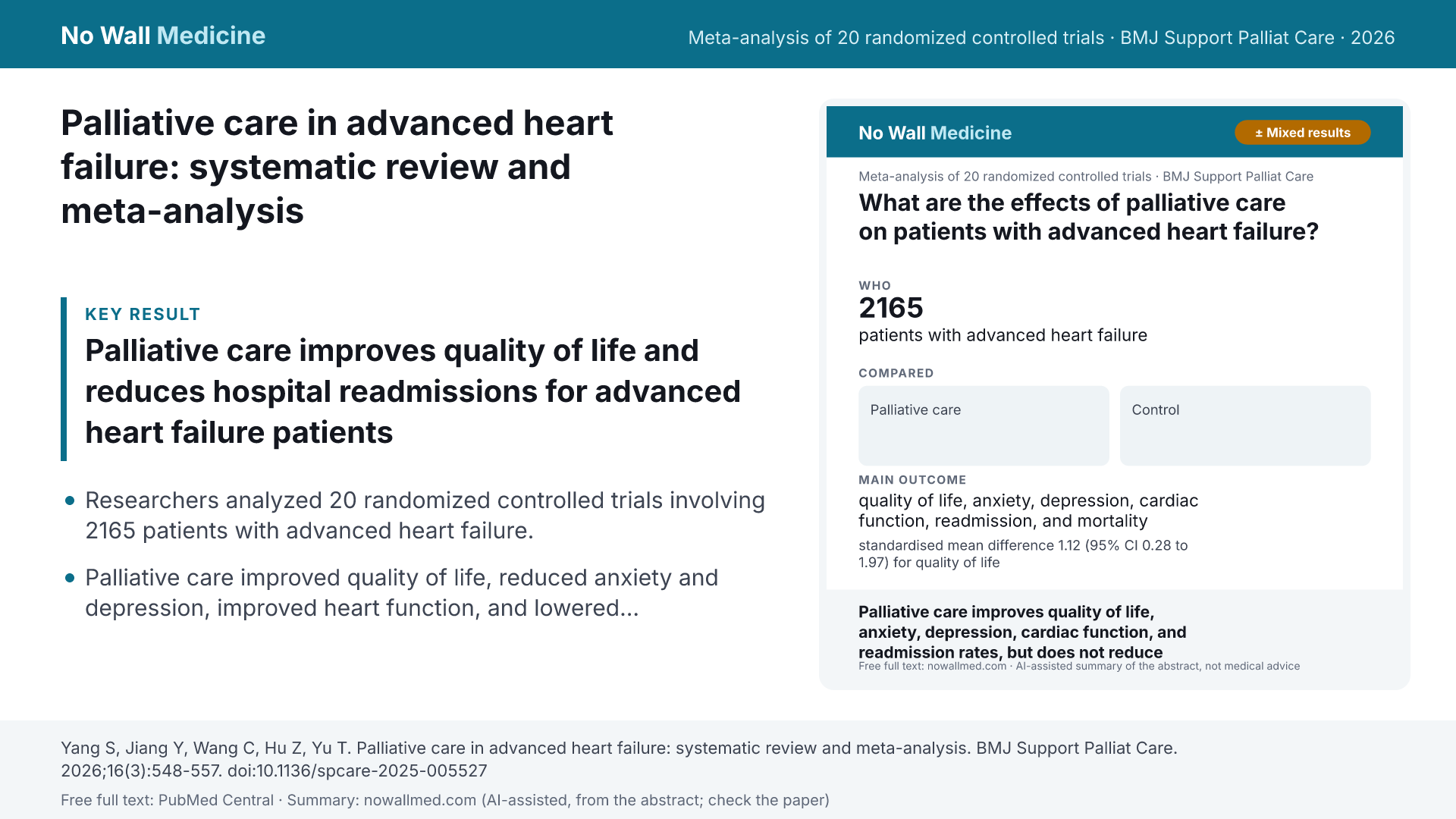
Palliative care improves quality of life and reduces hospital readmissions for advanced heart failure patients
Palliative care in advanced heart failure: systematic review and meta-analysis
Meta-analysis of 20 randomized controlled trialsMixed results
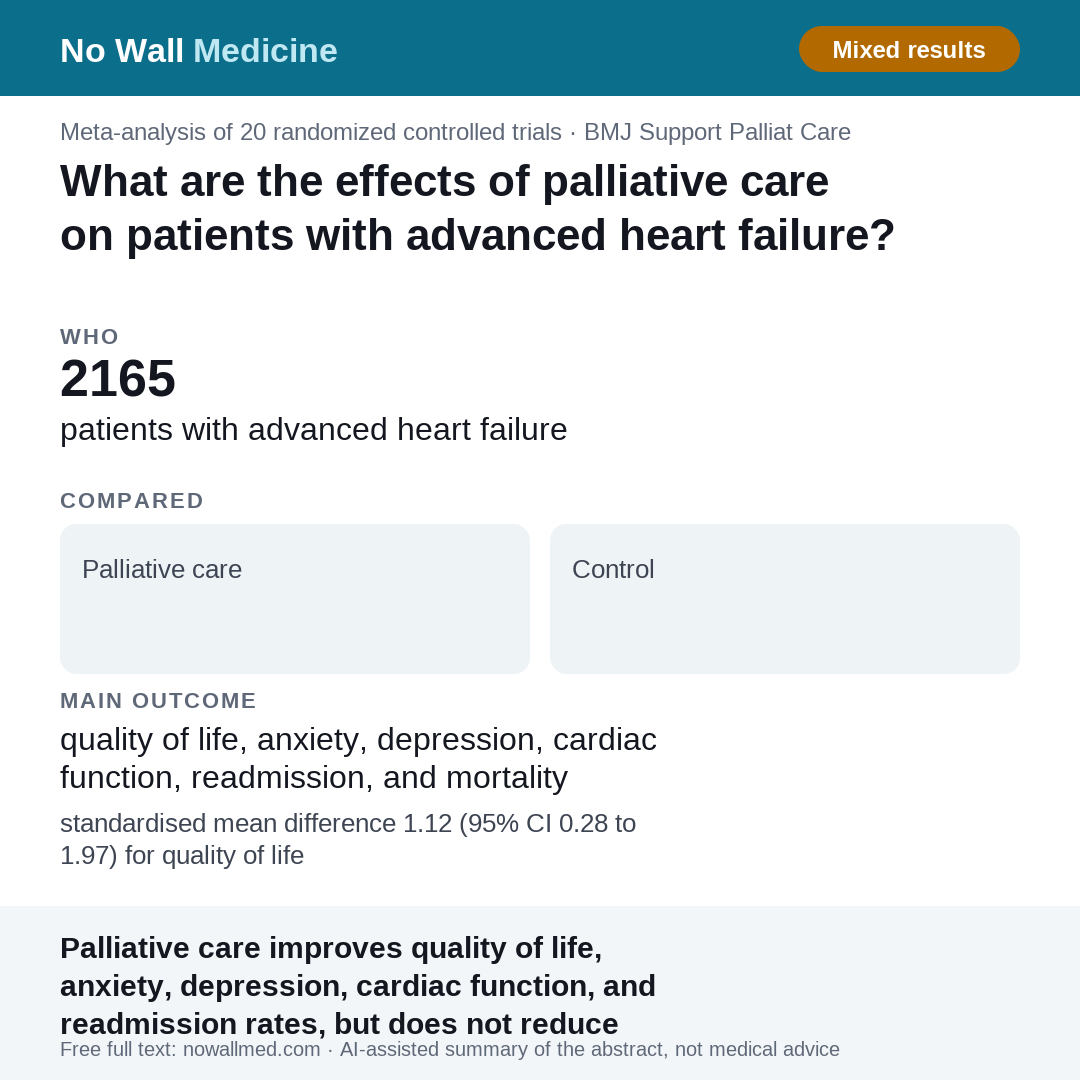
What are the effects of palliative care on patients with advanced heart failure?
Who
2165
patients with advanced heart failure
Compared
Palliative care
Control
Main outcome
quality of life, anxiety, depression, cardiac function, readmission, and mortality
Result: standardised mean difference 1.12 (95% CI 0.28 to 1.97) for quality of life
Bottom line: Palliative care improves quality of life, anxiety, depression, cardiac function, and readmission rates, but does not reduce mortality.
Limitation: The certainty of evidence across the outcomes ranged from low to moderate.
BMJ Support Palliat Care · 2026-04-28Download image
Clinical question: What are the effects of palliative care on patients with advanced heart failure?
Why it matters: Evidence is needed to support the use of palliative care for patients living with advanced heart failure.
Key points
- Researchers analyzed 20 randomized controlled trials involving 2165 patients with advanced heart failure.
- Palliative care improved quality of life, reduced anxiety and depression, improved heart function, and lowered readmission rates.
- The intervention did not show a significant reduction in the mortality rate among the studied patients.
Headline and key points written with AI from the paper’s abstract, with every number checked against it. Read the paper before relying on them.
Was this summary helpful?
Abstract
Aim
This study aims to systematically evaluate the effects of palliative care on the quality of life, anxiety level, depression level, cardiac function, readmission rate and mortality rate among patients with advanced heart failure, in order to provide evidence-based support for further research in this area. Methods
Randomised controlled trials of palliative care for patients with advanced heart failure were retrieved from CNKI, WANFANG DATA, CQVIP, SinoMed, CINAHL, Medline, PubMed, Web of Science and Embase, and references were traced. The search deadline was set as 17 July 2025. Two researchers independently screened literature, extracted data and evaluated the quality of included literature according to the Cochrane Handbook V.5.1.0. Meta-analysis was conducted using RevMan 5.3. Results
A total of 20 references were included, involving 2165 patients with advanced heart failure. The results of the meta-analysis showed that palliative care can improve the quality of life (standardised mean difference (SMD)=1.12, 95% CI 0.28 to 1.97, p=0.009), alleviate anxiety (SMD=-1.27, 95% CI -1.89 to -0.65, P<0.0001) and depression (SMD=-1.33, 95% CI -1.95 to -0.71, p<0.0001)), improve cardiac function (MD=4.41, 95% CI 2.73 to 6.09, p<0.00001) and reduce readmission rates (relative risk (RR)=0.70, 95% CI 0.52 to 0.94, p=0.02), but did not show a significant reduction in mortality rate (RR=1.29, 95% CI 0.82 to 2.05, p=0.28). The certainty of evidence across the outcomes ranged from low to moderate based on the GRADE approach. Conclusion
Palliative care can enhance the quality of life, alleviate anxiety and depression, improve heart function and reduce readmission rates for patients with advanced heart failure. However, it does not reduce the mortality rate. This article can provide a foundation for the widespread implementation of clinical palliative care. More high-quality and large-sample studies are needed in the future to further explore the impact of palliative care on patients with advanced heart failure. Prospero registration number
CRD42023489277.
Abstract reproduced under the article’s CC BY NC licence.
Subject terms
Cite this article
Yang S, Jiang Y, Wang C, Hu Z, Yu T. Palliative care in advanced heart failure: systematic review and meta-analysis. BMJ Support Palliat Care. 2026. doi:10.1136/spcare-2025-005527
Spotted a mistake? Suggest a correction