Integrated palliative care did not change the use of anticancer therapy at the end of life
PALLiative care in ONcology (PALLiON): A cluster-randomised trial investigating the effect of palliative care on the use of anticancer treatment at the end of life
Cluster-randomised controlled trialNo clear difference
Does integrated palliative care affect anticancer therapy use at the end of life?
Who
616
Adults with advanced solid tumours and life expectancy 12 months or less · 12 Norwegian hospitals
Compared
11%Palliative care intervention (33/309)
15%Usual care (45/307)
Main outcome
Overall use, start and cessation of anticancer therapy before death
Bottom line: The integrated palliative care intervention did not significantly change the probability of receiving anticancer therapy at the end of life.
Palliat Med · 2024-01-09Download image
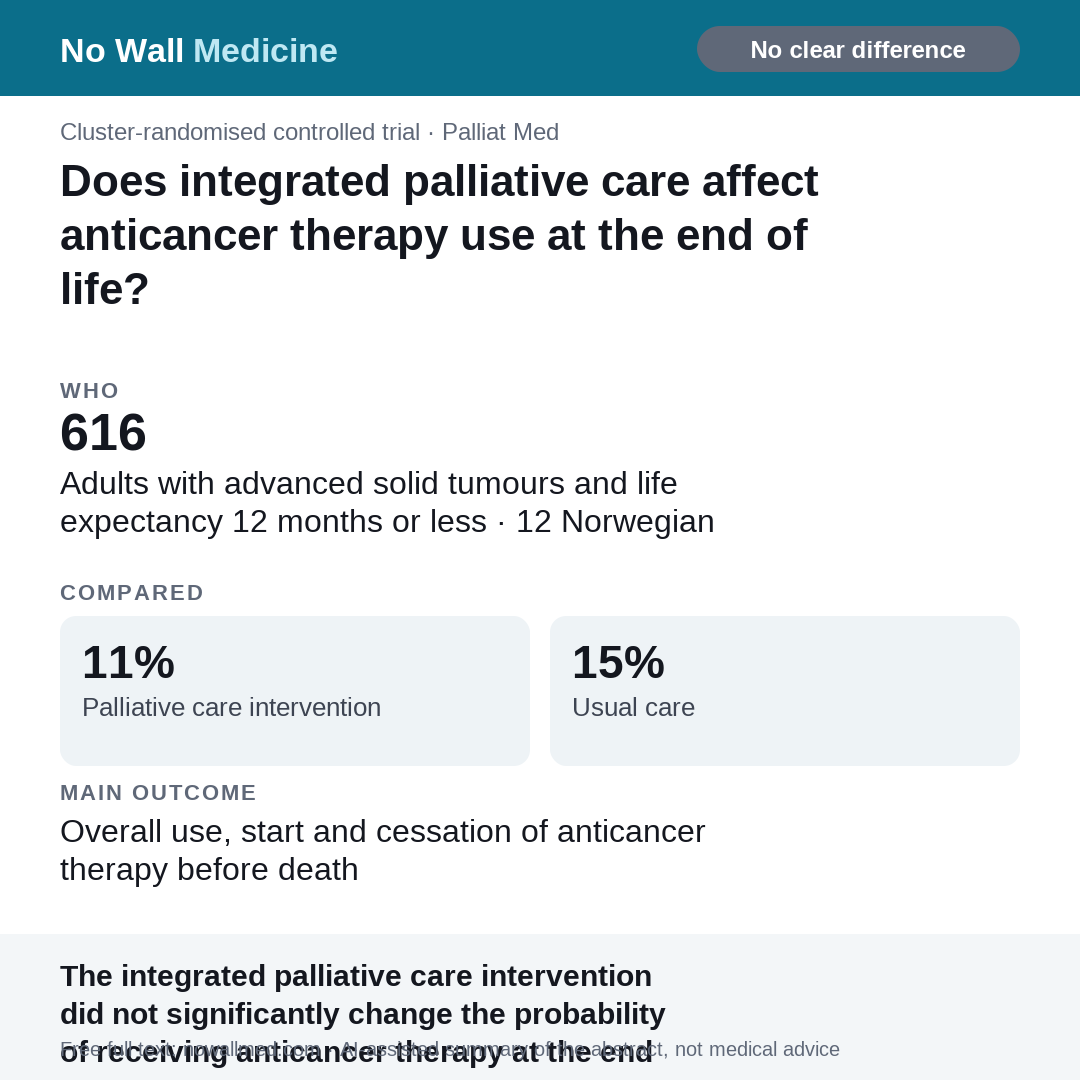
Clinical question: Does integrated palliative care affect anticancer therapy use at the end of life?
Why it matters: The potential effect of integrating palliative care and oncology on the use of anticancer therapy at the end of life is unknown.
Key points
- Researchers studied 616 patients with advanced solid tumors across 12 Norwegian hospitals to compare a complex palliative care intervention against usual care.
- The intervention did not show significant differences in the probability of receiving anticancer therapy in the last 3 months before death.
- In the final month of life, 11% of the intervention group and 15% of the control group received anticancer therapy.
Headline and key points written with AI from the paper’s abstract, with every number checked against it. Read the paper before relying on them.
Was this summary helpful?
Subject terms
Cite this article
Hjermstad MJ, Pirnat A, Aass N, Andersen S, Astrup GL, Dajani O. PALLiative care in ONcology (PALLiON): A cluster-randomised trial investigating the effect of palliative care on the use of anticancer treatment at the end of life. Palliat Med. 2024. doi:10.1177/02692163231222391
Spotted a mistake? Suggest a correction
Top studies every Monday
The week’s key trials and guidelines in your specialties, plus any topics you follow. By email, free.
Get the weekly digest