Pancreatic exocrine insufficiency after non-pancreatic upper gastrointestinal surgery: meta-analysis
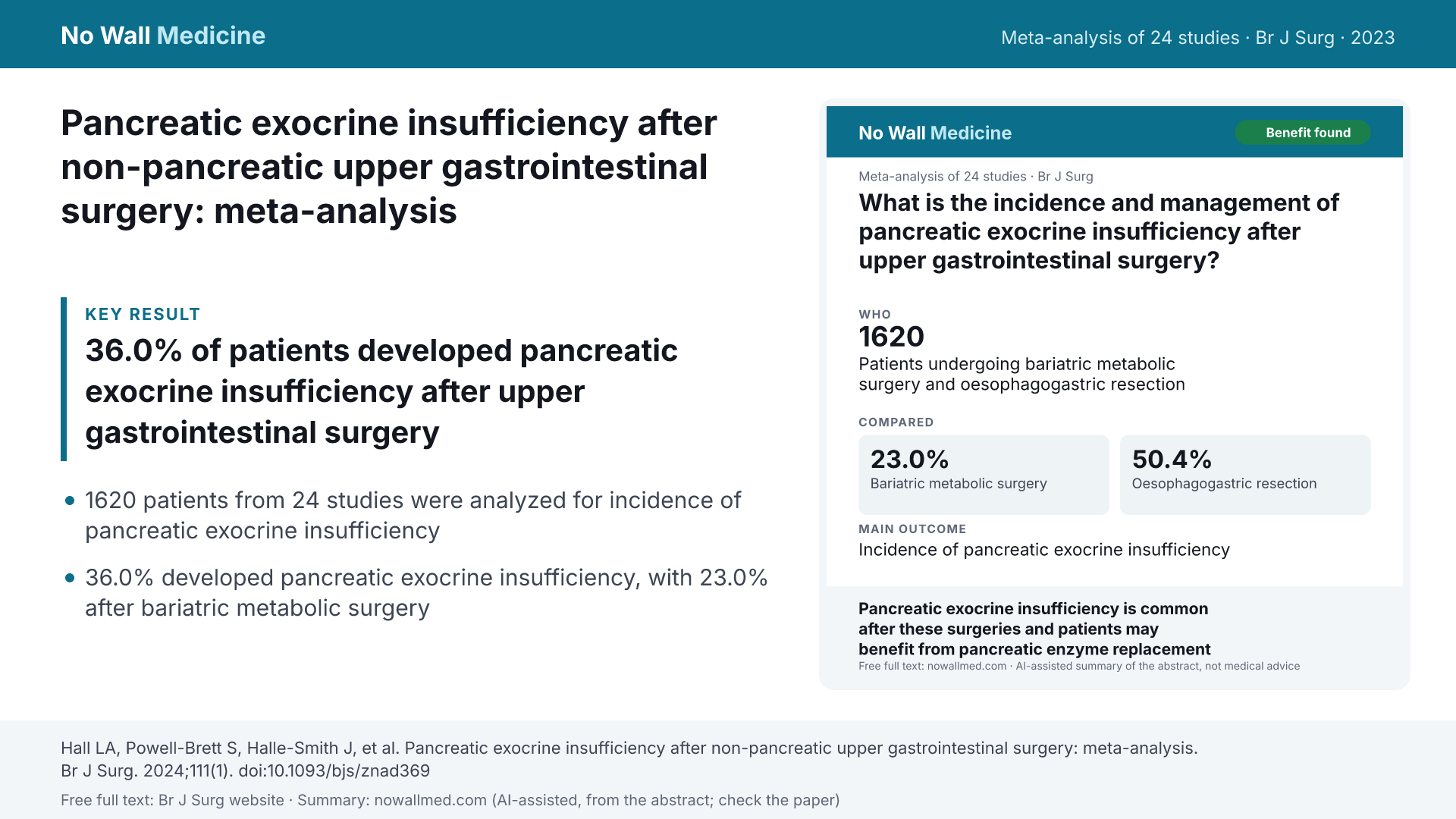
Key result: 36.0% of patients developed pancreatic exocrine insufficiency after upper gastrointestinal surgery
Meta-analysis of 24 studiesBenefit found
What is the incidence and management of pancreatic exocrine insufficiency after upper gastrointestinal surgery?
Who
1620
Patients undergoing bariatric metabolic surgery and oesophagogastric resection
Compared
23.0%Bariatric metabolic surgery
50.4%Oesophagogastric resection
Main outcome
Incidence of pancreatic exocrine insufficiency
Bottom line: Pancreatic exocrine insufficiency is common after these surgeries and patients may benefit from pancreatic enzyme replacement therapy.
Br J Surg · 2023-12-08
Key points
- 1620 patients from 24 studies were analyzed for incidence of pancreatic exocrine insufficiency.
- 36.0% developed pancreatic exocrine insufficiency, with 23.0% after bariatric metabolic surgery.
- 78.6% of patients responded positively to pancreatic enzyme replacement therapy.
Discussion prompts
- Would these patients look like yours? Who was left out?
- Is the main outcome one that matters to patients?
- Is the difference large enough to change what you do?
Cite: Hall LA, Powell-Brett S, Halle-Smith J, et al. Pancreatic exocrine insufficiency after non-pancreatic upper gastrointestinal surgery: meta-analysis. Br J Surg. 2024;111(1). doi:10.1093/bjs/znad369
Free full text: Br J Surg website · Summary and visual abstract: nowallmed.com/a/pancreatic-exocrine-insufficiency-after-non-pancreatic-upper-1912k39/ (AI-assisted from the abstract; check the paper before relying on it).