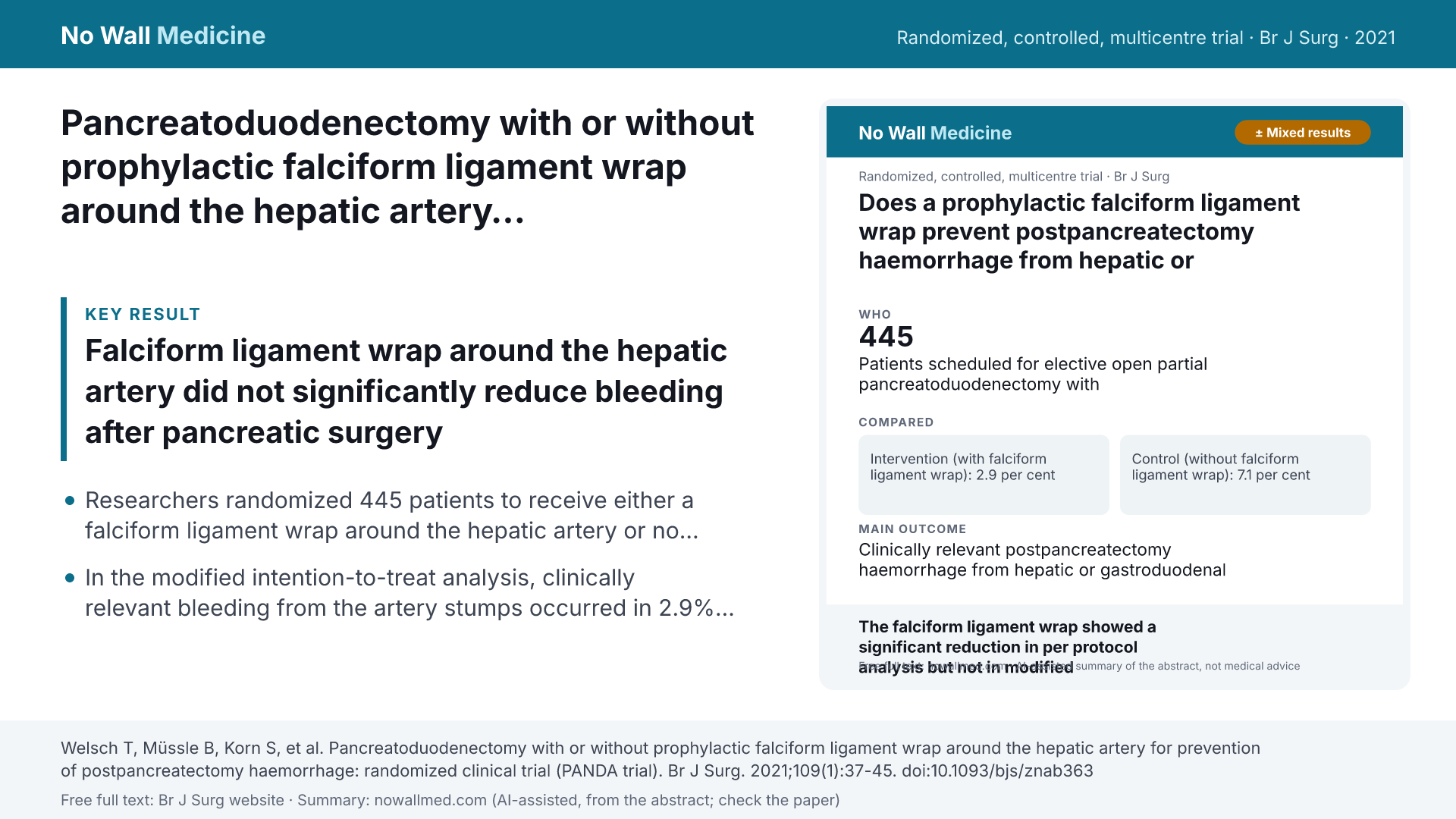
Falciform ligament wrap around the hepatic artery did not significantly reduce bleeding after pancreatic surgery
Pancreatoduodenectomy with or without prophylactic falciform ligament wrap around the hepatic artery for prevention of postpancreatectomy haemorrhage: randomized clinical trial (PANDA trial)
Randomized, controlled, multicentre trialMixed results
Does a prophylactic falciform ligament wrap prevent postpancreatectomy haemorrhage from hepatic or gastroduodenal artery stumps?
Who
445
Patients scheduled for elective open partial pancreatoduodenectomy with pancreatojejunostomy · Multicentre
Compared
Intervention (with falciform ligament wrap): 2.9 per cent
Control (without falciform ligament wrap): 7.1 per cent
Main outcome
Clinically relevant postpancreatectomy haemorrhage from hepatic or gastroduodenal artery stump
Result: odds ratio 0.39 (95 per cent c.i. 0.15 to 1.02)
Bottom line: The falciform ligament wrap showed a significant reduction in per protocol analysis but not in modified intention-to-treat analysis.
Br J Surg · 2021-11-09Download image
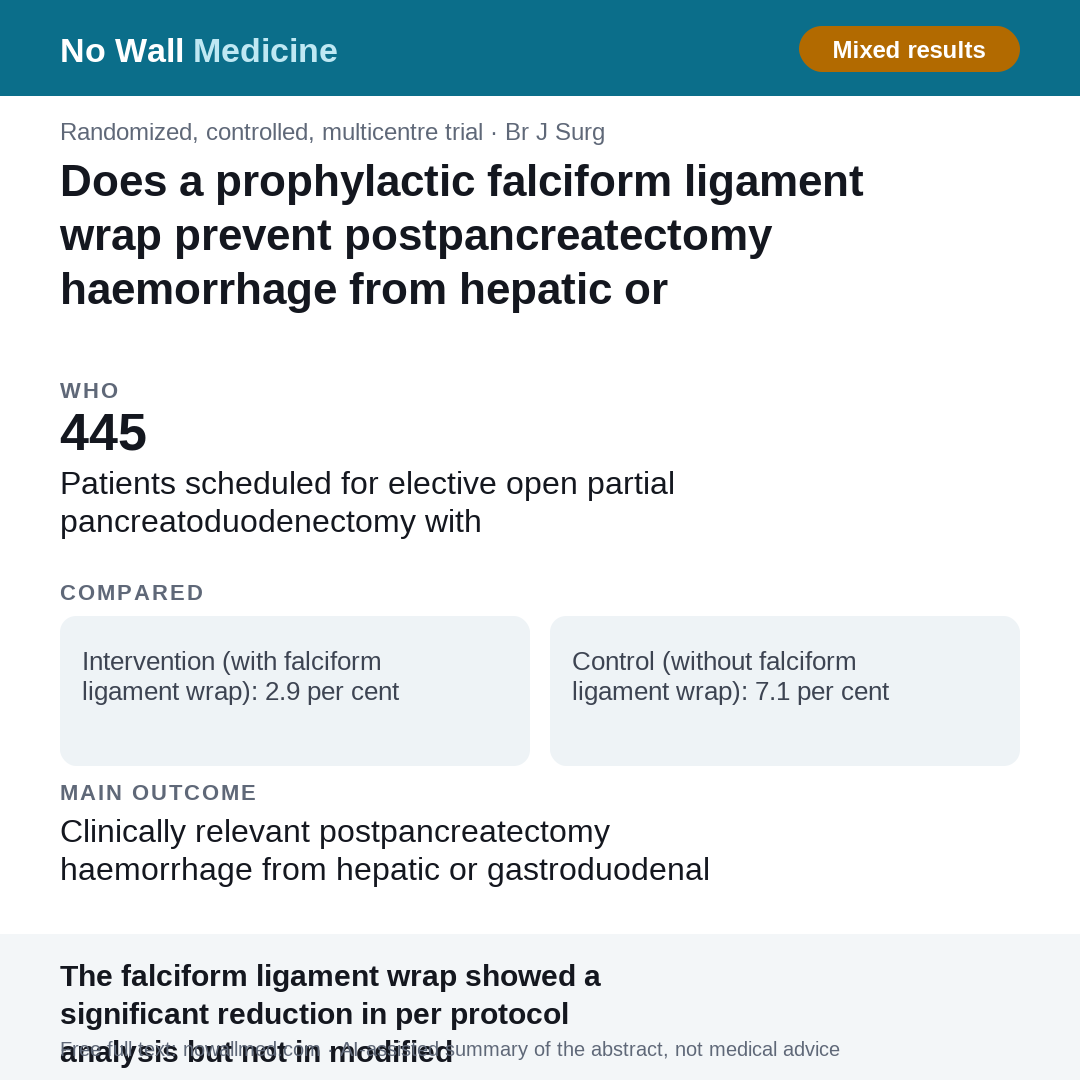
Clinical question: Does a prophylactic falciform ligament wrap prevent postpancreatectomy haemorrhage from hepatic or gastroduodenal artery stumps?
Why it matters: Preventive strategies to stop postpancreatectomy haemorrhage, which is bleeding after surgery to remove part of the pancreas, are currently lacking.
Key points
- Researchers randomized 445 patients to receive either a falciform ligament wrap around the hepatic artery or no wrap during pancreatic surgery.
- In the modified intention-to-treat analysis, clinically relevant bleeding from the artery stumps occurred in 2.9% of the intervention group and 7.1% of the control group.
- The rate of any clinically relevant postpancreatectomy haemorrhage, including bleeding from other sites, was 9.7% in the intervention group and 14.8% in the control group.
Headline and key points written with AI from the paper’s abstract, with every number checked against it. Read the paper before relying on them.
Was this summary helpful?
Subject terms
Cite this article
Welsch T, Müssle B, Korn S, et al. Pancreatoduodenectomy with or without prophylactic falciform ligament wrap around the hepatic artery for prevention of postpancreatectomy haemorrhage: randomized clinical trial (PANDA trial). Br J Surg. 2021. doi:10.1093/bjs/znab363
Spotted a mistake? Suggest a correction