Panendoscopy for head and neck cancer detection of second cancers linked to low management changes
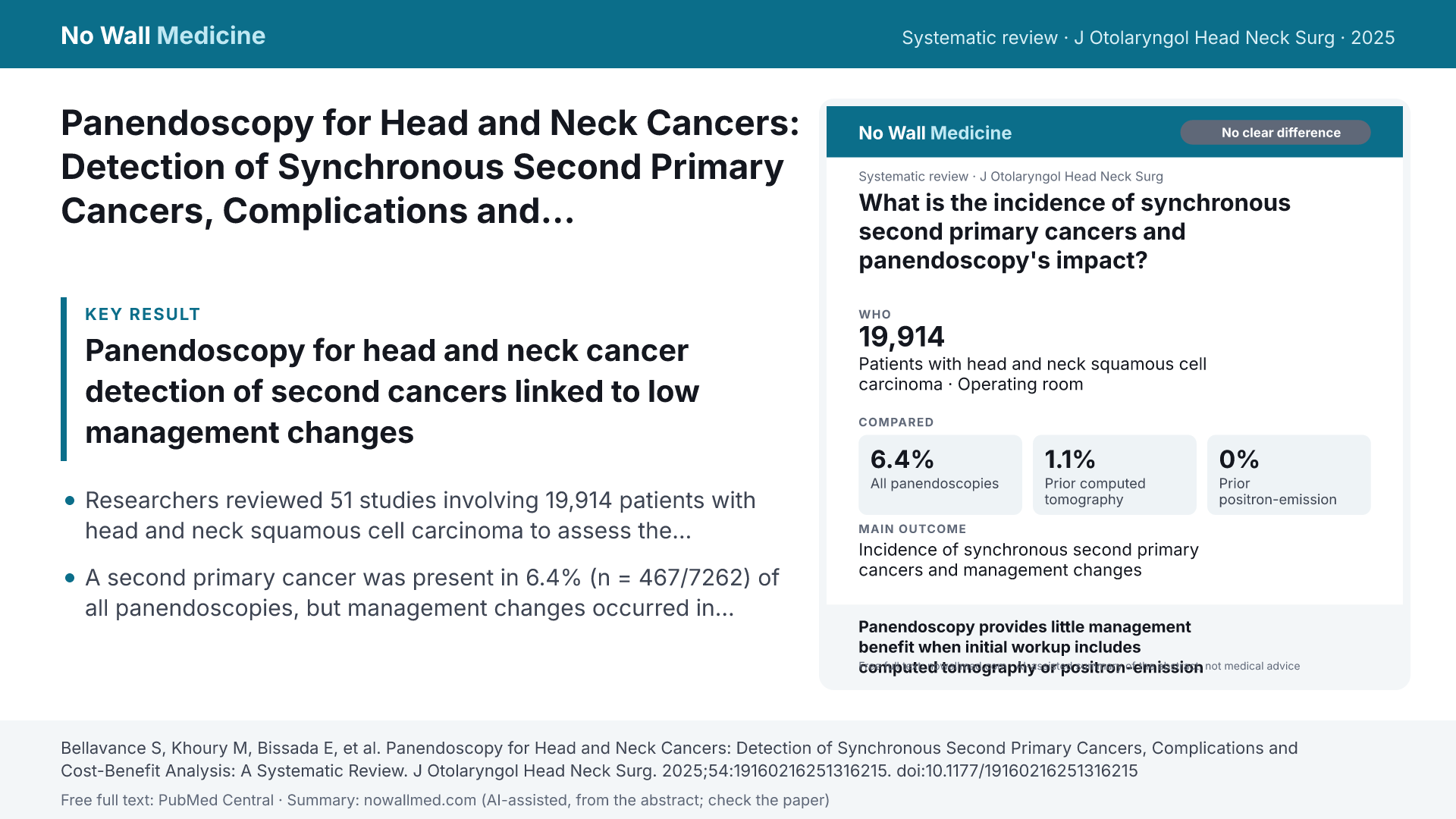
Panendoscopy for Head and Neck Cancers: Detection of Synchronous Second Primary Cancers, Complications and Cost-Benefit Analysis: A Systematic Review
Systematic reviewNo clear difference
What is the incidence of synchronous second primary cancers and panendoscopy's impact?
Who
19,914
Patients with head and neck squamous cell carcinoma · Operating room
Compared
6.4%All panendoscopies (467/7262)
1.1%Prior computed tomography (3/268)
0%Prior positron-emission tomography-computed tomography (0/544)
Main outcome
Incidence of synchronous second primary cancers and management changes
Bottom line: Panendoscopy provides little management benefit when initial workup includes computed tomography or positron-emission tomography-computed tomography.
Limitation: More studies are needed to assess cost-effectiveness in a public healthcare system.
J Otolaryngol Head Neck Surg · 2025-02-17Download image
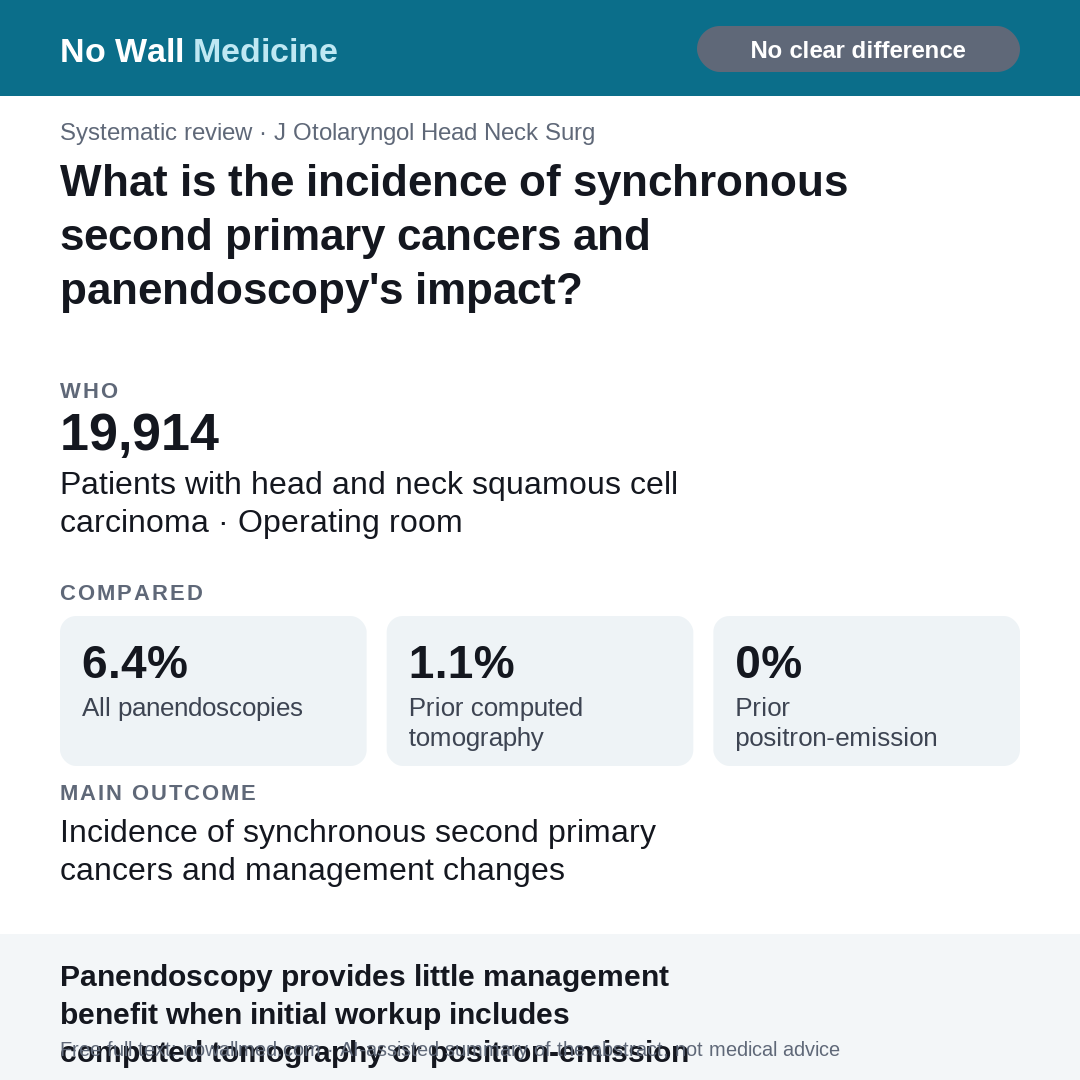
Clinical question: What is the incidence of synchronous second primary cancers and panendoscopy's impact?
Key points
- Researchers reviewed 51 studies involving 19,914 patients with head and neck squamous cell carcinoma to assess the detection of synchronous second primary cancers.
- A second primary cancer was present in 6.4% (n = 467/7262) of all panendoscopies, but management changes occurred in only 1.1% (n = 3/268) of cases with prior computed tomography.
- The rate of major complications from panendoscopy was 0.7% (n = 58/8386), while costs in a private healthcare system ranged from $3802 USD to $17,296 USD.
Headline and key points written with AI from the paper’s abstract, with every number checked against it. Read the paper before relying on them.
Was this summary helpful?
Subject terms
Cite this article
Bellavance S, Khoury M, Bissada E, et al. Panendoscopy for Head and Neck Cancers: Detection of Synchronous Second Primary Cancers, Complications and Cost-Benefit Analysis: A Systematic Review. J Otolaryngol Head Neck Surg. 2025. doi:10.1177/19160216251316215
Spotted a mistake? Suggest a correction