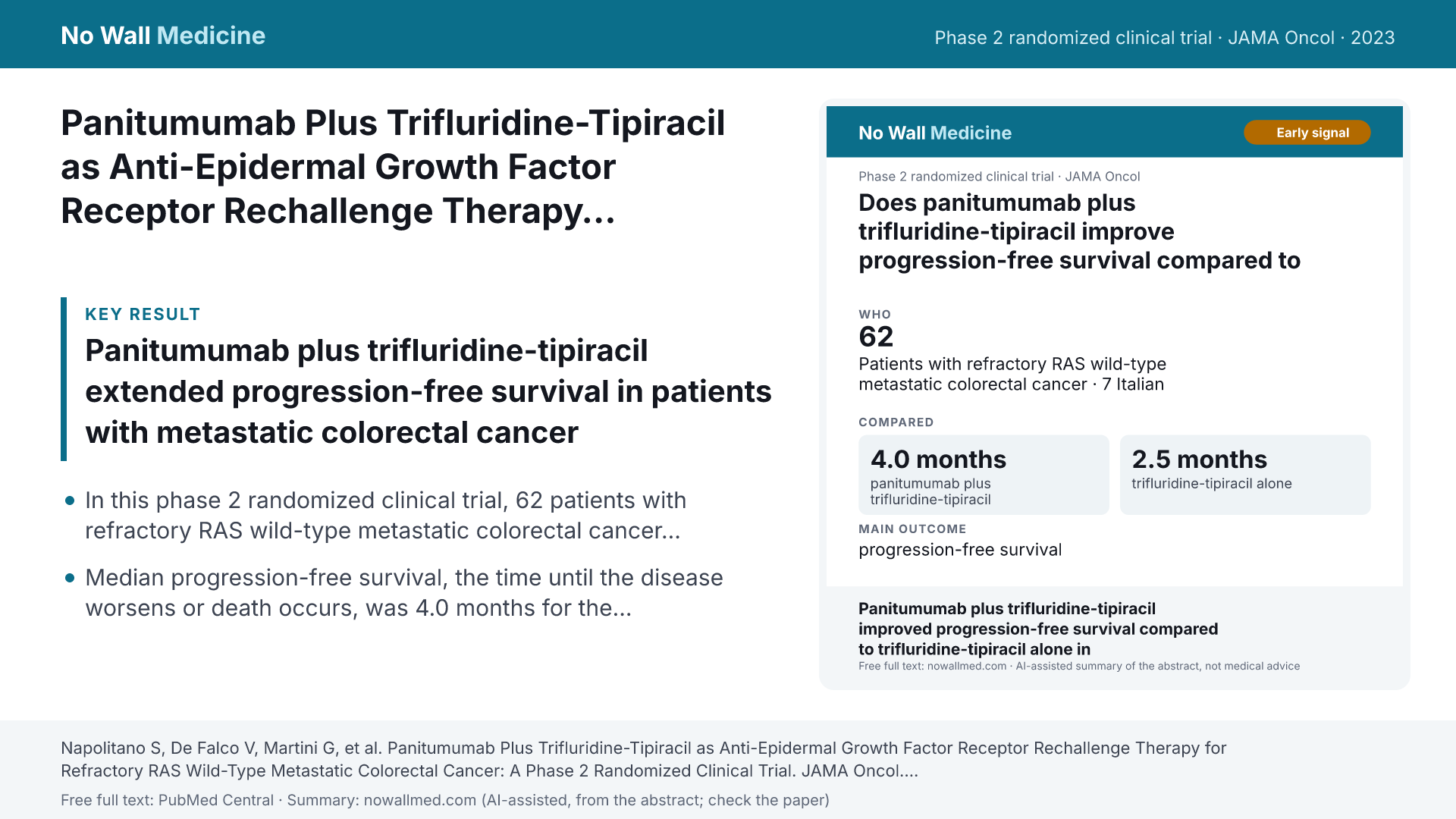
Panitumumab plus trifluridine-tipiracil extended progression-free survival in patients with metastatic colorectal cancer
Panitumumab Plus Trifluridine-Tipiracil as Anti-Epidermal Growth Factor Receptor Rechallenge Therapy for Refractory RAS Wild-Type Metastatic Colorectal Cancer: A Phase 2 Randomized Clinical Trial
Phase 2 randomized clinical trialEarly signal
Does panitumumab plus trifluridine-tipiracil improve progression-free survival compared to trifluridine-tipiracil alone?
Who
62
Patients with refractory RAS wild-type metastatic colorectal cancer · 7 Italian centers
Compared
4.0 monthspanitumumab plus trifluridine-tipiracil (95% CI, 2.8-5.3 months)
2.5 monthstrifluridine-tipiracil alone (95% CI, 1.4-3.6 months)
Main outcome
progression-free survival
Result: hazard ratio 0.48 (95% CI 0.28-0.82)
Bottom line: Panitumumab plus trifluridine-tipiracil improved progression-free survival compared to trifluridine-tipiracil alone in refractory RAS wild-type metastatic colorectal cancer.
Limitation: ctDNA extended sequence variation analysis was performed in a subgroup of patients
JAMA Oncol · 2023-05-18 · Save PNG
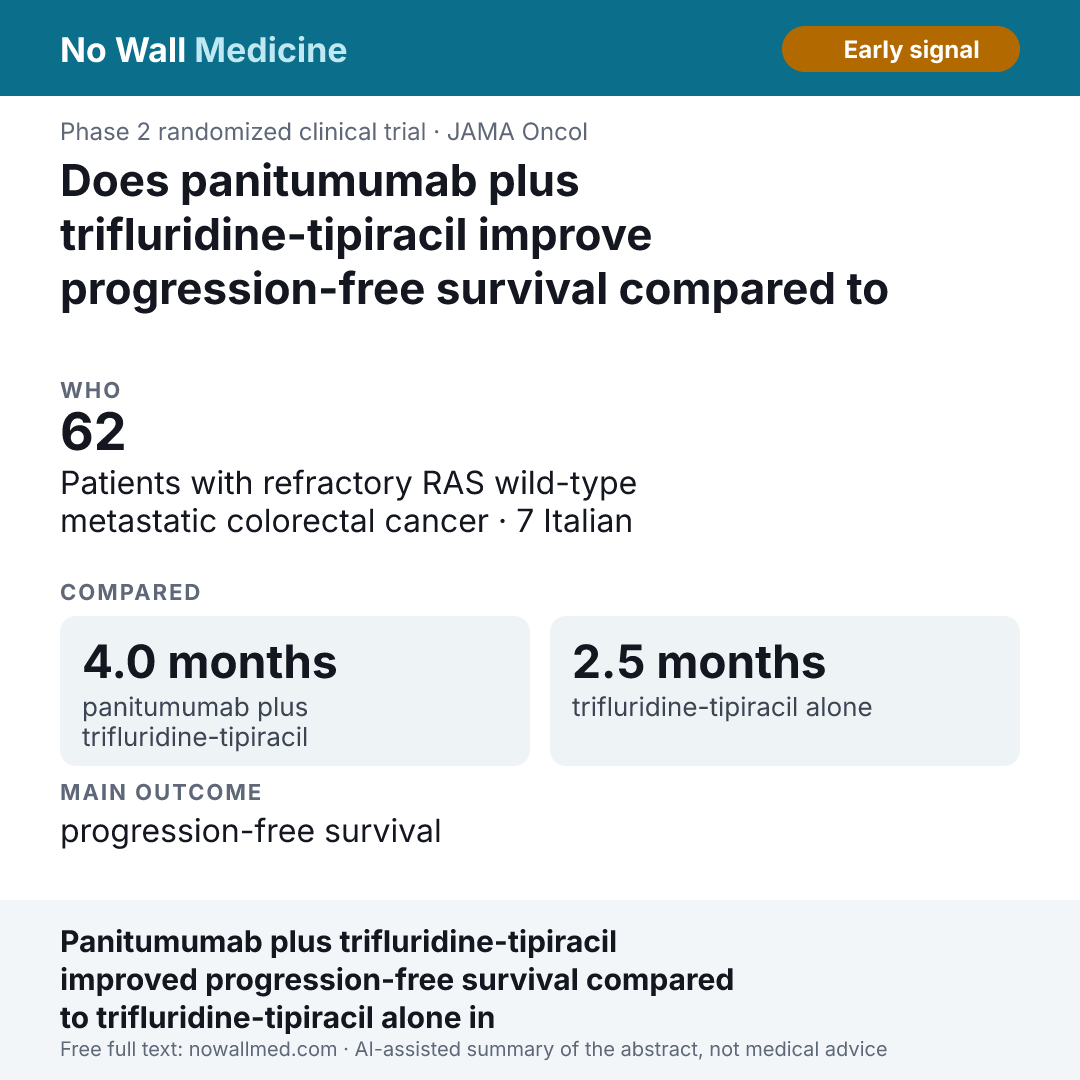
Clinical question: Does panitumumab plus trifluridine-tipiracil improve progression-free survival compared to trifluridine-tipiracil alone?
Why it matters: Third-line therapies for metastatic colorectal cancer currently have limited efficacy, and it is unknown if reintroducing epidermal growth factor receptor inhibitors is beneficial.
Key points
- In this phase 2 randomized clinical trial, 62 patients with refractory RAS wild-type metastatic colorectal cancer were assigned to receive either panitumumab plus trifluridine-tipiracil or trifluridine-tipiracil alone.
- Median progression-free survival, the time until the disease worsens or death occurs, was 4.0 months for the panitumumab combination versus 2.5 months for trifluridine-tipiracil alone.
- In a subgroup with specific tumor DNA profiles, 15 of 23 patients had a median progression-free survival of 6.4 months.
Headline and key points written with AI from the paper’s abstract, with every number checked against it. Read the paper before relying on them.
Was this summary helpful?
Subject terms
Headline, design, result, key points, caveat and citation as plain text.
Cite this article
Napolitano S, De Falco V, Martini G, et al. Panitumumab Plus Trifluridine-Tipiracil as Anti-Epidermal Growth Factor Receptor Rechallenge Therapy for Refractory RAS Wild-Type Metastatic Colorectal Cancer: A Phase 2 Randomized Clinical Trial. JAMA Oncol. 2023;9(7):966-970. doi:10.1001/jamaoncol.2023.0655
Spotted a mistake? Suggest a correction